

Political power meets digital finance in a high stakes crypto experiment
Evolving Story: The intersection of politics and cryptocurrency has entered a new and unpredictable phase. A crypto venture tied to President Donald Trump and his family has found itself at the center of market turbulence, regulatory scrutiny, and accusations of a coordinated attack. At the same time, a new stablecoin initiative known as USD1 has been positioned as a bold effort to preserve dollar dominance in a rapidly evolving global financial landscape.
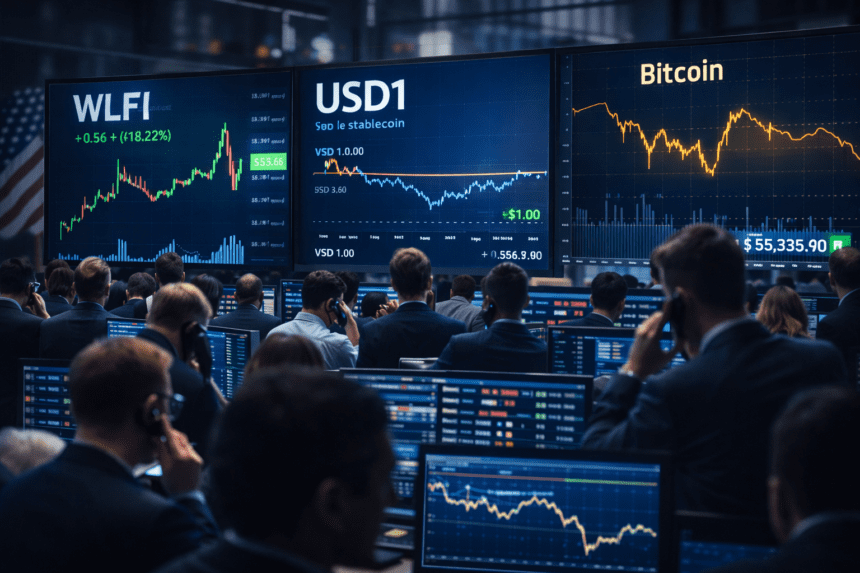
In recent days, the Trump family backed crypto project World Liberty Financial and its token WLFI experienced sharp volatility. According to reporting from CoinDesk and Bloomberg, the project stated that it was facing what it described as a coordinated attack. The announcement came after price swings in the associated stablecoin and heightened trading activity in WLFI. This turbulence occurred against the backdrop of broader crypto market instability, with Bitcoin trading well below its October 2025 peak of one hundred twenty six thousand dollars.
The episode raises important questions. Can politically branded crypto ventures maintain stability in a market known for speculation and rapid shifts in sentiment. Does a stablecoin tied to a high profile political family inspire confidence or increase risk. And what happens when global economic policies such as tariffs and spending bills intersect with a fragile digital asset market.
To understand what is happening, it is important to examine the project itself, the wider market conditions, and the broader implications for crypto adoption.
The Rise of World Liberty Financial and the WLFI Token
World Liberty Financial emerged as a Trump family backed crypto venture aimed at capitalizing on the renewed political focus on digital assets. The project introduced the WLFI token, which saw a notable surge of more than twenty three percent ahead of a major crypto forum held at Mar a Lago. Trading volume reportedly exceeded four hundred sixty six million dollars in twenty four hours, signaling significant interest.
The forum drew lawmakers, Wall Street executives, and industry leaders. Although Donald Trump himself was not scheduled to attend, the association with the Trump brand generated strong media attention and investor speculation.
This surge in WLFI occurred during a period when the broader market was facing uncertainty. Bitcoin had fallen nearly fifty percent from its October 2025 peak. That decline cast doubt on expectations that a Trump presidency would usher in what some had described as a golden age of crypto.
Supporters of the Trump family venture argue that political leadership sympathetic to crypto could drive regulatory clarity and encourage innovation. Critics, however, warn that tying a token too closely to political identity may amplify volatility.
When WLFI surged, it reflected both enthusiasm and speculative positioning. But enthusiasm in crypto markets can be fragile. Reports soon emerged that the associated stablecoin was wobbling, prompting the project to claim that it was under coordinated attack.
The Stablecoin USD1 and the Dollar Narrative
In parallel with WLFI, Donald Trump Jr. and Eric Trump announced plans for a new stablecoin called USD1. They framed the initiative as a modern digital extension of the United States dollar. According to public statements, USD1 is intended to help preserve dollar hegemony by offering a stable digital alternative in global markets.
Stablecoins are designed to maintain a consistent value, often pegged to a fiat currency such as the US dollar. They serve as a bridge between traditional finance and crypto markets, allowing traders to move funds without exposure to volatility.
The concept of preserving dollar dominance through digital infrastructure is not new. Over the past decade, dollar backed stablecoins have grown significantly. Major issuers hold large reserves of US Treasury securities, effectively extending the reach of the dollar into decentralized markets.
By positioning USD1 as a tool for strengthening the dollar, the Trump family aligns the project with national economic narratives. The message suggests that crypto innovation can coexist with and even reinforce US monetary leadership.
However, stablecoins depend on trust. They require transparent reserves, strong governance, and confidence that the peg will hold. If a stablecoin tied to a political brand experiences instability, questions quickly arise about oversight and risk management.
When reports surfaced that the Trump linked stablecoin was wobbling, the project responded by alleging a coordinated attack. Such attacks in crypto can take various forms, including aggressive short selling, liquidity withdrawal, or misinformation campaigns. Whether the volatility was the result of malicious activity or ordinary market dynamics remains unclear, but the episode highlights the fragility of stablecoin ecosystems.
Market Volatility Under a Pro Crypto Presidency
Donald Trump has positioned himself as supportive of cryptocurrency innovation. During his political comeback, he signaled openness to digital assets and criticism of regulatory overreach. Yet despite this stance, the broader market has not been immune to turbulence.
Bitcoin’s decline from its peak raised doubts about whether political leadership alone can sustain bullish momentum. The global crypto market capitalization hovered around two point four trillion dollars, reflecting modest recovery but far from previous highs.
Several macroeconomic factors have weighed on sentiment. A recent ten percent global tariff introduced under Trump’s policy agenda rattled financial markets. While the tariff was framed as a protective economic measure, it increased uncertainty in global trade. Risk assets including crypto often react negatively to such shocks.
In addition, Trump signed a one point two trillion dollar spending bill to avert a government shutdown. Large fiscal packages can influence investor expectations about inflation, interest rates, and monetary policy. Crypto markets, particularly Bitcoin, are sensitive to liquidity conditions and rate expectations.
Despite short term volatility, some Trump allies have demonstrated confidence in crypto. Congressman Byron Donalds reportedly bought Bitcoin during recent dips, signaling belief in long term growth. Such purchases send a message that insiders view corrections as opportunities.
Still, the reality is that crypto markets remain deeply interconnected with broader macro trends. Political branding cannot insulate tokens from global forces.
The Alleged Coordinated Attack and What It Means
When World Liberty Financial claimed it was under coordinated attack, it tapped into a familiar narrative in crypto history. Markets have witnessed episodes where projects accuse rivals, traders, or shadow actors of attempting to destabilize a token.
Coordinated attacks can involve concentrated selling pressure designed to break a price peg or trigger panic. In the case of stablecoins, if traders lose confidence and rush to redeem or sell, even temporary liquidity imbalances can create sharp deviations from the intended value.
However, it is also true that volatility can arise organically in speculative markets. High trading volume combined with leveraged positions can amplify moves in either direction.
Bloomberg reported that the Trump family venture acknowledged unusual trading activity. CoinDesk highlighted concerns around price stability and transparency. The combination of political visibility and financial experimentation creates a complex risk environment.
For investors, the episode underscores the importance of due diligence. Stablecoins require clear disclosure about reserves and risk controls. Tokens tied to prominent figures may attract attention but must still meet technical and financial standards.
Political Branding Versus Decentralized Ideals
Crypto emerged with a philosophy centered on decentralization and independence from political influence. Yet over time, mainstream adoption has drawn in governments, corporations, and political leaders.
A token associated with a former president represents a striking evolution. On one hand, political engagement can legitimize digital assets. On the other hand, it can challenge the ethos of neutrality that many early adopters value.
When markets perceive a token as closely tied to a political brand, price action may become linked to political events. Announcements, policy decisions, and campaign rhetoric could all influence trading behavior.
This dynamic may increase volatility. It also raises ethical questions about the blending of public office and private financial ventures.
Supporters argue that political involvement accelerates regulatory clarity and adoption. Critics counter that it risks conflicts of interest and market manipulation concerns.
The WLFI and USD1 projects sit at the center of this debate.
Broader Implications for Crypto Adoption
The turbulence surrounding the Trump linked stablecoin arrives at a pivotal moment for crypto adoption. Institutional investors have entered the space through exchange traded products and corporate treasury allocations. Governments are exploring digital currencies. Regulatory frameworks are evolving.
If high profile projects experience instability, public perception may suffer. Trust is foundational to financial systems. Stablecoins in particular rely on the belief that value will remain stable.
At the same time, experimentation drives innovation. The emergence of new stablecoins and politically aligned ventures reflects a maturing ecosystem.
The key question is whether these projects contribute to mainstream adoption or remain speculative vehicles tied to short term excitement.
If USD1 achieves transparent backing and consistent stability, it could reinforce the role of the dollar in digital markets. If WLFI demonstrates resilience, it may prove that politically connected ventures can operate within competitive markets.
However, if volatility persists or allegations of manipulation grow louder, regulators may step in with stricter oversight.
Conclusion, The recent wobble in the Trump linked stablecoin and the surge in WLFI token trading mark another chapter in the evolving relationship between politics and cryptocurrency. World Liberty Financial has captured attention through branding and bold messaging about preserving dollar dominance. Yet markets remain unforgiving.
Bitcoin’s decline from its peak, global tariff tensions, fiscal policy shifts, and allegations of coordinated attacks all contribute to a volatile landscape. Political endorsement does not eliminate market risk. Instead, it introduces new layers of complexity.
For investors and observers, the lesson is clear. Crypto remains a high risk high reward environment shaped by technology, macroeconomics, regulation, and human behavior. Projects tied to powerful names must still prove stability, transparency, and resilience.
As the digital asset space continues to grow, the interplay between political influence and decentralized finance will shape the next phase of adoption. Whether WLFI and USD1 become lasting pillars or cautionary tales will depend on their ability to navigate volatility while maintaining trust.