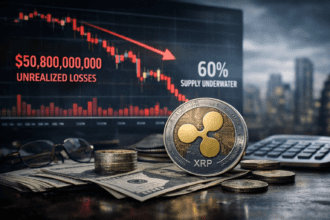



How Long-Dormant Supply, Liquidity Dynamics, and Market Psychology Collided
The sudden drop of XRP below the $2 mark sent shockwaves through the crypto market, not because of a regulatory ruling or a macro shock, but because of something far more unsettling to traders: a long dormant wallet waking up. After remaining inactive for roughly seven years, a single XRP wallet moved tokens worth approximately $721 million, triggering a cascade of selling pressure that pushed prices sharply lower. The event highlighted a recurring reality in crypto markets supply that has been quiet for years can still re-enter circulation at any moment, and when it does, sentiment can turn fast.
At the center of the sell-off was timing and perception. XRP had been trading with renewed optimism, supported by improving legal clarity, steady network usage, and broader market strength. Confidence had built around the idea that long-term holders were content to sit tight, reinforcing the belief that available supply was limited. The sudden activation of a wallet untouched since the late 2010s shattered that assumption in a single move, reminding investors that latent supply is never truly gone only dormant.
What made the situation more dramatic was not just the size of the transfer, but the symbolism behind it. A seven-year-old wallet represents early-era conviction, someone who endured multiple bull and bear cycles without selling. When such a holder finally moves funds, the market often interprets it as a signal whether justified or not that a major top could be forming. This psychological impact frequently outweighs the actual mechanics of supply and demand, accelerating sell-offs well beyond what raw volume alone would suggest.
From a market structure perspective, the sell-off exposed how sensitive XRP remains to large, concentrated movements. While XRP boasts deep liquidity across centralized exchanges, even highly liquid markets can struggle when sudden, unexpected supply enters at scale. Traders watching on-chain data reacted quickly, front-running potential selling and pulling bids, which amplified downside momentum. As stop-losses triggered and leverage unwound, the price slid below $2, a level many viewed as a psychological support zone.
Importantly, the wallet movement itself did not guarantee immediate liquidation. Large transfers do not always mean instant selling; they can involve internal reorganizations, custody changes, or preparation for structured distribution. But in fast-moving markets, perception often matters more than confirmation. Traders rarely wait for perfect information, and the uncertainty surrounding the wallet’s intent was enough to spark defensive positioning across derivatives and spot markets alike.
The event also reignited long-standing debates about XRP’s supply dynamics. Unlike Bitcoin, whose issuance schedule and distribution are widely considered predictable, XRP’s history includes large early allocations and ongoing discussions about token concentration. While Ripple’s escrow system has added transparency over time, dormant wallets outside escrow remain a wildcard. When one of these wallets resurfaces, it naturally raises questions about how much additional supply could still be waiting on the sidelines.
Despite the sharp drop, it’s important to note that XRP’s broader fundamentals did not change overnight. Network activity remained stable, and no new regulatory setbacks emerged during the sell-off. This distinction matters, because markets often overreact to supply shocks in the short term, only to stabilize once emotional selling subsides. In previous cycles, similar wallet awakenings across various cryptocurrencies have triggered violent but temporary moves, followed by consolidation as new buyers absorb supply.
Another key factor was market context. The broader crypto environment has matured significantly over the past few years, with increased institutional participation, more sophisticated traders, and deeper derivatives markets. These features improve long-term resilience but can also magnify short-term volatility. When fear enters the system, leverage unwinds quickly, and price discovery becomes brutal. XRP’s move below $2 reflected not just selling pressure from one wallet, but a chain reaction across multiple layers of the market.
For long-term holders, the episode served as a reminder that volatility is the price of participation in crypto markets. Assets with large historical distributions and long trading histories carry unique risks tied to legacy holders. At the same time, these events can also act as stress tests. If the market successfully absorbs such a large shock without prolonged damage, it may strengthen the asset’s long-term credibility rather than weaken it.
From a strategic perspective, experienced investors often watch what happens after the panic, not during it. Does volume taper off? Do prices stabilize near key levels? Does on-chain activity normalize? These signals tend to reveal whether a sell-off represents distribution ahead of a deeper downtrend or simply a violent reset of positioning. Early signs following the XRP dip suggested that while sentiment was shaken, buyers were willing to step in once forced selling slowed, hinting that confidence had not evaporated entirely.
The incident also underscores the growing importance of on-chain transparency. Wallet tracking tools allowed traders to identify the source of the movement almost instantly, shaping narratives in real time. While this transparency empowers market participants, it also accelerates reactions, sometimes turning ambiguous data into self-fulfilling prophecies. As crypto markets evolve, learning to interpret on-chain signals without overreacting will become an increasingly valuable skill.
In the bigger picture, XRP’s sudden drop below $2 was less about one wallet and more about how markets process uncertainty. Dormant supply reappearing is not unique to XRP, nor is it inherently bearish over the long term. What matters is how the ecosystem responds whether liquidity deepens, confidence rebuilds, and price finds equilibrium. History suggests that markets capable of surviving these shocks often emerge more robust, with weaker hands shaken out and stronger conviction taking their place.
Ultimately, the $721 million wallet movement was a sharp reminder that crypto markets never truly forget their past. Old coins, early holders, and long-silent wallets remain part of the ecosystem’s living memory. When they resurface, volatility follows. But for investors who understand this dynamic, such moments are not just risks they are signals of transition, marking the ongoing evolution of a maturing digital asset market.