

“Institutional inflows grow but net creations, hedging, and liquidity mute price impact.”
XRP ETFs Exceed $1 Billion So Why Hasn’t the Price Moved?
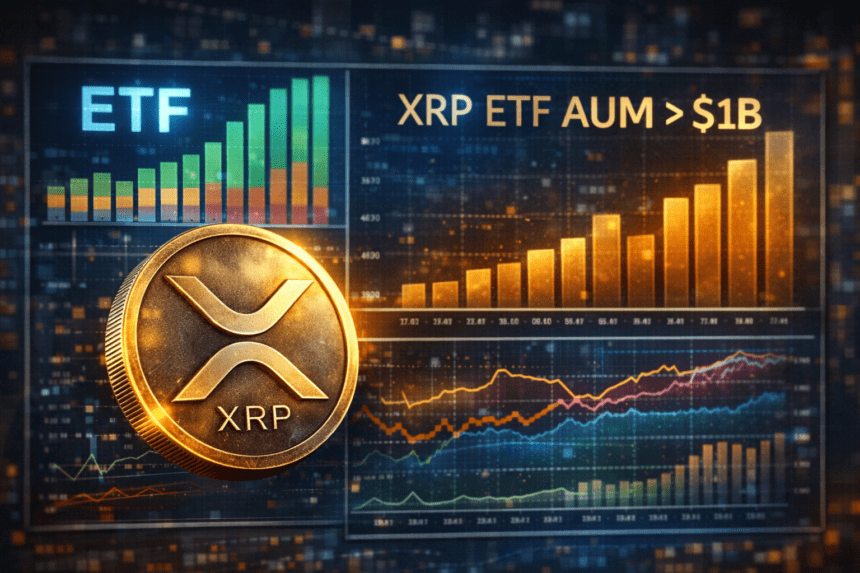
Despite crossing a major institutional milestone, XRP’s price has remained notably stagnant even as spot exchange-traded funds (ETFs) tied to the token amassed more than $1 billion in assets under management (AUM). This odd disconnect between strong inflows into regulated financial products and a muted spot market response has drawn scrutiny from traders, analysts, and institutional investors alike, sparking a deeper look at how ETF flows actually translate or fail to translate into token price action.
Spot XRP ETFs launched in the U.S. in November 2025, and since then they have attracted sustained investment, reaching cumulative AUM figures exceeding $1.14 billion to $1.25 billion according to multiple data trackers and reports.
For many observers, these numbers signal that institutional demand is growing, especially as traditional financial firms seek regulated alternatives to direct token exposure. Yet while such institutional flows are broadly viewed as bullish by theory, XRP’s spot price has hovered in a narrow range around $1.85–$1.90 for weeks, a stubborn area of consolidation without meaningful upside breakout.
One of the crucial explanations for this disconnect lies in understanding what ETF AUM actually measures versus how that translates to “net demand” in the spot market. AUM simply reflects total assets held within the ETF, but this figure can rise due to price appreciation or secondary-market trading within ETF shares not necessarily fresh demand that absorbs new XRP from the open market.
The primary driver of price impact is net creations the actual minting of new ETF shares that requires the sponsor to buy XRP on behalf of investors, thereby removing tokens from circulation and tightening supply. When net creations lag or are offset by redemptions, the token can remain rangebound even as headlines tout milestone AUM figures.
This dynamic has been central to explaining why XRP’s price has moved little even as Hedging strategies employed by market makers also play a role. To manage risk, institutional traders often hedge ETF exposures with derivatives such as futures and perpetual swaps. This layer of hedging can mitigate immediate spot price reaction: as new ETF purchases occur, simultaneous hedges in derivatives markets can absorb much of the buying pressure before it reaches the token’s spot price. In effect, the hedge layer blunts the transmission of ETF inflows to actual price movement.
Another structural factor relates to liquidity distribution. Unlike markets with deep, concentrated liquidity say, major Bitcoin or Ethereum order books on large U.S. exchanges XRP liquidity is spread across venues. This fragmentation can mute price sensitivity to flows, further dulling the impact of ETF inflows on liquidity adjusted price levels.
Adding more complexity is the escrow supply cadence that has historically shaped expectations around XRP’s available circulating supply. Ripple, the company closely associated with the XRP ecosystem, periodically releases tokens from escrow based on predefined schedules. When market participants expect new supply to enter circulation even if it doesn’t immediately occur this can anchor price expectations and discourage aggressive upside moves.
All of these factors help explain why, even with an institutional product crossing a billion-dollar mark, the spot XRP price has remained muted: the mechanisms that typically convert capital inflows into upward price pressure aren’t as straightforward as “more money in equals higher price.” Instead, institutional demand must translate into net absorption of supply without offsetting hedges or technical selling pressure.
Price data supports this picture. XRP has traded in a relatively tight range, often struggling to reclaim and hold psychologically relevant thresholds like $2.00, even as ETF assets continue to climb. Reports note consistent inflows into XRP ETFs while price languishes below early-cycle highs, suggesting that market structure not lack of investor interest may be the key limiting factor.
Broader market sentiment also matters. In the latter part of 2025, the entire crypto market experienced periods of volatility and risk-off behavior, including major drawdowns and selling pressure toward year-end. These macro forces likely absorbed much of the capital that might otherwise have supported an XRP breakout, especially from retail side selling or profit-taking after earlier rallies.
Despite the stagnant price, the ETF milestone is far from meaningless. The fact that institutional products are attracting sustained investment signals a shift in how XRP is viewed by traditional financial actors. Vanguard, a long-standing bastion of caution toward crypto, surprised the market by opening crypto ETF access to millions of clients, highlighting a growing institutional openness to regulated digital asset exposure.
Market analysts also point out that price reaction isn’t always immediate especially for a token that has endured deep corrections and broad market stress in prior quarters. Some observers liken the situation to earlier phases in Bitcoin and Ethereum ETF adoption, where inflows initially had minimal effect before gaining traction over longer time horizons.
For traders and investors, the takeaway is clear: while hitting $1 billion in ETF assets is a noteworthy achievement for XRP, it doesn’t guarantee a rapid price rally on its own. True momentum may hinge on continued net creations, hedge-layer unwindings, deeper liquidity concentration, and broader market conditions favoring risk-on asset performance. Only when these elements align might institutional demand translate into meaningful upward price traction.
In the meantime, XRP sits at an intriguing crossroad backed by increasing institutional attention through ETF channels, yet held in check by market structure nuances, technical trading behaviors, and macro forces that dampen immediate price reaction. Investors watching for a breakout will likely pay close attention to net creation metrics, liquidity shifts, and evolving market sentiment in the months ahead as the market digests this unusual yet compelling dynamic.