

A remote island at the center of global power, diplomacy, and military strategy.
Understanding the Dispute Over Diego Garcia and the Chagos Islands
In February 2026, a high-profile political disagreement erupted involving United States President Donald Trump and United Kingdom Prime Minister Keir Starmer, centering on the future of Diego Garcia, a small but strategically significant island in the Indian Ocean. The controversy stems from a 2025 agreement between the UK and Mauritius over the sovereignty of the Chagos Islands, and it has sparked criticism, diplomatic back-and-forth, and broader geopolitical debate.
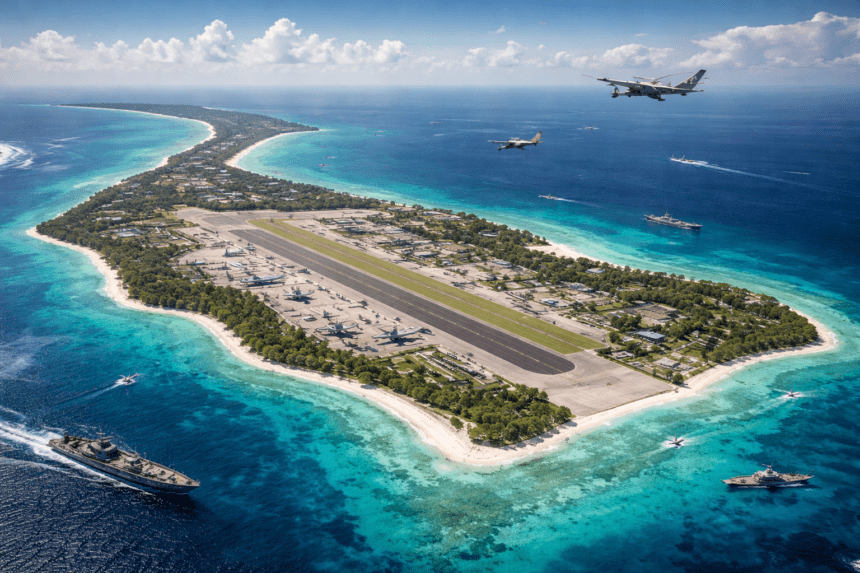
Diego Garcia is the largest island in the Chagos Archipelago and the site of a long-standing joint UK-US military base. For decades, this base has played a key role in Western military operations from the Gulf region to parts of Asia – because of its extremely strategic location roughly mid-way between Africa and Asia.
The Chagos Islands themselves were taken from Mauritius in the 1960s before Mauritius gained independence. The local population, the Chagossians, were forcibly removed to make way for the military base, a historical grievance that has fueled decades of legal and political disputes.
The 2025 UK-Mauritius Sovereignty Agreement
In 2025, the UK under Starmer signed an agreement with Mauritius to transfer sovereignty of the Chagos Islands to Mauritius. However, the deal included provisions allowing the UK to retain and lease back control of Diego Garcia and a buffer zone around it for 99 years so that the joint military base could continue operating.
This arrangement was designed to address long-running legal issues. Various international courts and United Nations resolutions had said that Britain’s continued administration of the islands was unlawful and that Mauritius should be recognised as the sovereign state. The treaty was meant to both respect international law and preserve the strategic military base.
Trump’s Criticism: “A Big Mistake”
On 18 February 2026, Donald Trump took to his social media platform, Truth Social, to publicly criticise Prime Minister Starmer’s approach to this sovereignty deal. Trump stated that Starmer was “making a big mistake” by entering in his words a long lease that he said could lead to Britain losing control of Diego Garcia. He warned that the land “should not be taken away from the UK”, and used emphatic language like “DO NOT GIVE AWAY DIEGO GARCIA!” to underline his argument.
Trump’s central concern was strategic: he said a strong military presence on Diego Garcia was essential in the event of conflict, especially pointing to potential tensions with Iran. Trump suggested the island might be needed to respond to a hypothetical Iranian threat or other military contingencies, implying that relinquishing outright control even if under lease could weaken Western strategic readiness.
Conflicting US Government Signals
The controversy has deeper complexity because other parts of the US government have taken different positions. Just a day before Trump’s critical post, the US State Department officially expressed support for the UK-Mauritius deal, emphasising the importance of securing the future of the joint base under agreed terms. This divergence highlights that Trump’s comments reflect his own stance and according to White House officials, that is being taken as the administration’s policy message rather than broad , unified US policy.
In earlier discussions, Trump had even softened his stance, at one point calling the deal “the best he could make” and insisting discussions with Starmer about the base were “productive.” Yet his latest criticism marks a sharp return to a more hostile position.
Reactions from the UK and Elsewhere
The UK government has defended the treaty with Mauritius. A Foreign Office spokesperson stressed that the deal was essential for “the long-term future of this vital military base” and for shared security interests with key allies, including the United States.
Meanwhile, various UK political figures and parties have weighed in. Some conservatives and opposition leaders embraced Trump’s criticism, arguing that the UK should not compromise control over a strategic asset. Others warned that relying on unpredictable political statements from foreign leaders would not be a sound basis for national security policy.
The Human Dimension: Chagossians and Sovereignty
Amid all this geopolitical debate, the people most directly affected remain the Chagossians the original inhabitants of the islands. They were uprooted decades ago and many still live far from home. In February 2026, a group of four Chagossians made headlines by landing on one of the smaller atolls in an attempt to block the sovereignty transition and seek to resettle in their ancestral homeland, although they were issued removal orders by British authorities. Many Chagossians continue to pursue legal and political avenues to return to the islands.
What Happens Next?
The sovereignty deal is still working its way through UK parliamentary processes and international diplomatic channels. The ongoing debate between strategic military considerations and historical justice for displaced communities will likely continue, with strong opinions on all sides.
Thoughts
The dispute over Diego Garcia and the Chagos Islands reflects broader tensions in international relations between sovereignty, strategic security interests, historical injustices, and the balance of power among allies. Trump’s comments have added volatility to an already complex situation, showing how geopolitics, public opinion, and military strategy can collide in unexpected ways