


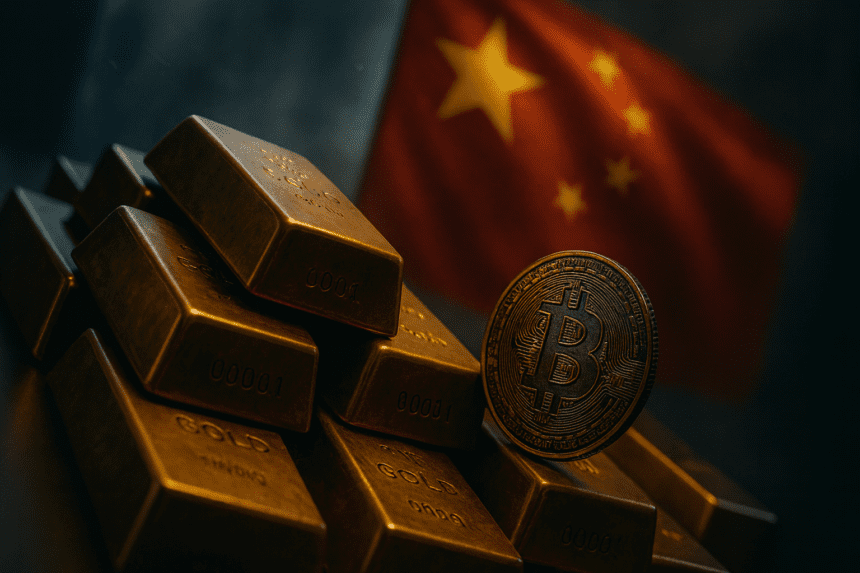
Gold Hoarding and Digital Money: Macro Signals That Reinforce BTC’s Store-of-Value Narrative
In late 2025, financial markets witnessed a striking macroeconomic trend: China’s central bank continued to accumulate gold at record rates, pushing its reported reserves ever higher even as global economic uncertainty and geopolitical tensions linger. At first glance, these purchases may seem only relevant to precious metals markets, but a deeper look reveals a broader insight into the evolving nature of “outside money” assets held outside traditional banking and government credit systems and why Bitcoin remains at the heart of this narrative.
China’s approach building up gold reserves rather than publicly embracing Bitcoin or other digital assets reflects a long-standing preference for traditional safe havens, especially in times of dollar weakness and geopolitical friction. Central banks across the world, including China, have been buying gold in recent years at the fastest pace in decades as they diversify away from dollar-centric financial systems. Those gold purchases not only push bullion prices higher but also highlight an important macroeconomic truth: sovereign actors seek assets that provide stability, liquidity, and durability when confidence in the status quo falters.
Gold has maintained this role for centuries because it’s tangible, scarce, and widely recognized. But while China’s record bet on gold does not signal a pivot toward crypto adoption officials have not indicated any intention to add Bitcoin to official reserves many analysts believe it validates the philosophical underpinning of Bitcoin as a modern form of “outside money.” Unlike fiat currencies controlled by central banks, assets such as gold and Bitcoin are not liabilities of any government. They stand apart from the balance sheets of states and financial institutions. For Bitcoin supporters, this shared characteristic with gold freedom from political and monetary policymaking is what makes BTC a compelling alternative store of value in a world of rising sovereign debt and fluctuating inflation expectations.
To understand this better, consider why central banks like China’s are hoarding gold in the first place. With global interest rates still relatively low in real terms and inflation dynamics uneven, traditional reserve assets such as U.S. Treasuries carry risks related to currency debasement and yield erosion. Gold, by contrast, does not promise interest but instead offers a long-term hedge against currency risk. This logic echoes the core thesis of Bitcoin’s proponents: Bitcoin, like gold, is scarce capped by design at 21 million coins and cannot be printed at will by central banks, making it a candidate for preserving value when traditional monetary policy gets strained.
China’s strategy also underscores a broader global shift in reserve management. As gold prices reached record levels around 2025 and central banks collectively expanded bullion holdings, sovereign actors behaved as though the era of relying solely on dollars and interest-bearing assets is giving way to a more diversified reserve paradigm. Markets have taken notice: investors and institutions increasingly view BTC as part of a diversification toolkit that includes gold alongside equities, commodities, and bonds. ETFs centered on Bitcoin have attracted significant institutional capital, illustrating demand among allocators for assets uncoupled from traditional macro leverage and sovereign control.
Interestingly, China’s gold accumulation has occurred despite the government’s historically strict stance against cryptocurrencies. China banned nearly all crypto trading and mining activities years ago, keeping Bitcoin largely absent from official reserve strategy. Yet the fact that Beijing chooses gold as its safe-asset playbook highlights a shared principle the search for assets that maintain value independently of central bank liabilities. Bitcoin extends that same principle into the digital age: programmable scarcity, decentralization, and global transferability without intermediaries. In other words, even though China isn’t adopting Bitcoin, its gold strategy affirms the macro logic that has driven many proponents to call Bitcoin “digital gold.”
From the perspective of global finance, these developments suggest a convergence of old and new store-of-value narratives. Gold and Bitcoin are not identical, and proponents of each often emphasize different strengths. Gold boasts a long track record of centuries, deep institutional trust, and widespread physical market infrastructure. Bitcoin offers digital scarcity, censorship resistance, and the ability to move value across borders with minimal intermediaries. Still, both assets share a key attribute: they do not depend on the fiscal health or monetary policy of any single government for their existence or value proposition. That independence is increasingly attractive in a world where monetary expansion, fiscal deficits, and geopolitical competition shape policy decisions.
There are broader geopolitical angles at play as well. China’s gold stockpiling is often read as part of a strategy to reduce reliance on the U.S. dollar system and enhance monetary sovereignty. In that context, reserve diversification through gold complements other structural efforts such as bilateral trade arrangements in non-dollar currencies and strategic alliances with other major economies. Although Bitcoin is not currently part of China’s official toolkit, some analysts believe digital assets could eventually play a role in similar sovereign strategies, especially as central bank digital currencies (CBDCs) and cross-border settlement systems evolve.
The global appetite for gold and the rise of Bitcoin also reflects shifting risk perceptions among institutional investors. With central banks absorbing more government debt and real yields near historic lows, many traditional portfolios struggle to find yield without exposure to credit or equity risk. In this environment, uncorrelated assets like gold and Bitcoin attract attention not just as hedges but as portfolio diversifiers that can help manage systemic risk. For Bitcoin, the narrative of uncorrelated, digital scarcity has motivated investors looking beyond equities and fixed income a dynamic reinforced by the macro backdrop that drives gold demand.
Critics of Bitcoin often point to its volatility or lack of intrinsic yield as weaknesses compared with traditional safe havens. Indeed, Bitcoin’s price can swing sharply in short periods, and unlike gold, it lacks physical industrial demand. But from an asset allocation perspective, volatility is not synonymous with lack of value if the long-term trend reflects growing adoption and perceived scarcity. Over the long term, Bitcoin’s fixed supply and increasing integration into financial markets through institutional products have helped shape expectations of BTC as a digital alternative to gold, especially for investors and allocators who view currency debasement and monetary instability as real risks.
Ultimately, China’s record gold bet does not directly validate Bitcoin in the sense of prompting official adoption, since Beijing has not signaled any shift in policy regarding crypto. But it implicitly supports the macroeconomic thesis that underpins Bitcoin’s narrative that in times of uncertainty, investors and sovereign custodians alike seek assets outside the traditional monetary system, with limited counterparty risk and durable store-of-value properties. By reinforcing this broader trend in reserve behavior, China’s gold accumulation may lend indirect support to the idea that Bitcoin fits within the same family of assets that preserve value in turbulent economic times.
As global macro conditions evolve with ongoing discussions about currency diversification, reserve strategy, and long-term purchasing power preservation the parallels between gold and Bitcoin will likely remain part of broader investment and policy debates. While gold’s centuries-long status gives it undeniable weight in official reserve management, Bitcoin’s rise as a digital store of value continues to attract attention from institutions and retail investors alike. Whether Bitcoin ever attains the same sovereign prestige as gold remains an open question, but China’s actions this year underscore the importance of thinking beyond the bounds of traditional monetary assets a paradigm where digital scarcity and decentralized reserve logic may increasingly play a vital role in financial systems of the future