

Washington tests a new path between sanctions pressure and resource diplomacy
The global energy and commodity landscape is changing rapidly, and a recent move by the United States government highlights just how fluid international resource politics has become. In early March 2026, Washington issued a limited licence allowing certain transactions involving Venezuelan gold following a high level diplomatic visit between U.S. officials and Venezuela’s interim leadership. The decision marks a notable shift in how the United States is engaging with Venezuela’s vast mineral wealth after years of sanctions and political confrontation.
For more than a decade, Venezuela’s mining and energy sectors have been heavily restricted by international sanctions, especially those imposed by the United States. These sanctions targeted the country’s state owned enterprises and resource exports in an effort to pressure political leadership and address corruption and governance concerns. However, the new licence issued by the U.S. Treasury suggests a cautious recalibration of this approach.
The licence authorizes certain activities involving Venezuelan origin gold, including its export, sale, transport, refining and resale under controlled conditions. These transactions must be conducted through authorized entities and follow strict regulatory oversight.
The decision is tied to a broader diplomatic effort that includes cooperation on mining investment and strategic mineral development. The change could signal the beginning of a new phase in U.S. Venezuela relations and may reshape the global gold supply chain.
Venezuela’s Vast Mineral Wealth
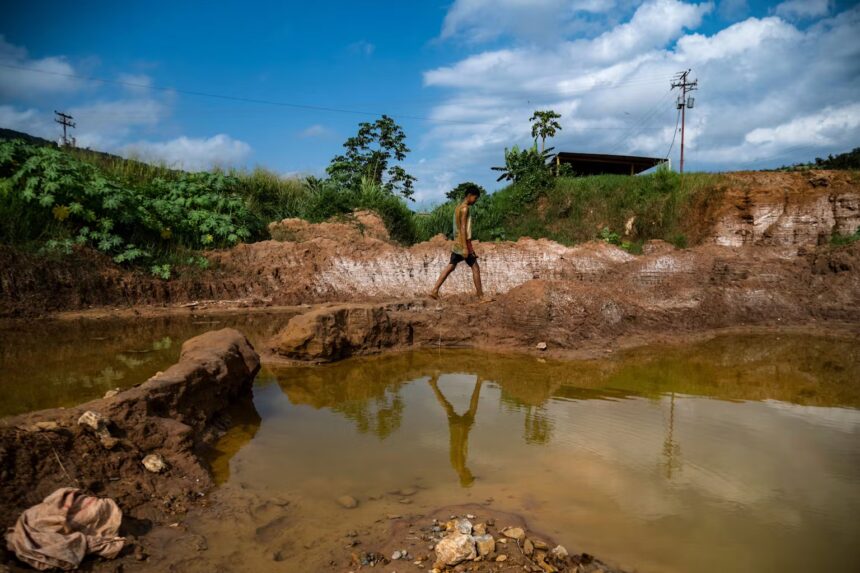
Venezuela is widely known for its massive oil reserves, but the country also possesses enormous deposits of gold and other strategic minerals. One of the most important mining regions is the Orinoco Mining Arc, a massive resource zone in southern Venezuela that spans more than 110,000 square kilometers and contains significant gold, bauxite, coltan and diamond reserves.
The economic potential of this region is enormous. Analysts estimate that the mineral wealth in the area could reach trillions of dollars in value if fully developed.
However, political instability, corruption, environmental concerns and international sanctions have prevented the region from reaching its full production capacity. Illegal mining operations and armed groups have also played a role in disrupting legitimate resource development.
For years the Venezuelan government has attempted to attract foreign investors to revive the sector. Yet sanctions imposed by Washington and other Western governments effectively isolated Venezuelan gold from global markets.
The new limited licence could begin changing that dynamic.
The High Level Diplomatic Visit
The licence announcement followed a visit to Caracas by U.S. Interior Secretary Doug Burgum and a delegation that included representatives from more than two dozen mining and resource companies.
The visit was designed to explore cooperation on critical minerals and natural resources that are essential for modern technology, energy infrastructure and defense systems.
During the trip, Burgum met with Venezuela’s interim President Delcy Rodríguez to discuss reforms aimed at attracting foreign investment to the country’s mining sector. Officials from both sides described the talks as part of a broader strategy to strengthen economic cooperation.
The discussions were not limited to gold. Venezuela’s mineral deposits include coltan, rare earth elements and other materials that are increasingly important for electric vehicles, electronics and advanced weapons systems.
From Washington’s perspective, securing access to these resources could help diversify supply chains that are currently dominated by China and other countries.
The Limited Gold Licence Explained
The licence issued by the U.S. Treasury’s Office of Foreign Assets Control provides a narrow but significant opening for trade involving Venezuelan gold.
Under the authorization, approved U.S. companies can participate in transactions involving Venezuelan gold under specified conditions. These activities may include exporting gold to the United States, refining it in American facilities and then reselling or exporting the refined product.
Importantly, the licence does not represent a full removal of sanctions. Instead it creates a carefully controlled channel for specific transactions that are considered compliant with U.S. policy goals.
Officials emphasize that the licence is designed to support transparency and responsible engagement with Venezuela’s resource sector while maintaining pressure against illegal mining networks and corruption.
In practice, this means that companies participating in the gold trade must comply with strict reporting and regulatory requirements.
The Strategic Importance of Gold
Gold has always played a unique role in the global economy. Unlike most commodities, it functions not only as an industrial material but also as a financial asset and store of value.
Central banks hold gold reserves as part of their monetary strategy, and investors often turn to gold during periods of economic uncertainty.
For Venezuela, gold has become especially important as a source of foreign currency. Years of economic crisis and sanctions dramatically reduced oil revenues, forcing the country to rely more heavily on alternative exports.
Gold mining therefore became a critical component of Venezuela’s survival strategy.
Yet sanctions complicated this approach by limiting access to international markets.
The new licence could allow Venezuelan gold to reach global buyers through legitimate channels rather than informal or illicit networks.
The Role of Global Commodity Traders
Reports indicate that the new policy could facilitate deals between Venezuela’s state mining company Minerven and international commodity traders.
One reported agreement involves supplying hundreds of kilograms of gold to a global commodities firm, with the metal ultimately being refined and distributed through U.S. markets.
Commodity trading firms play a crucial role in the global supply chain. They purchase raw materials from producers, arrange transportation and logistics, and deliver refined products to industrial buyers.
By allowing authorized traders to handle Venezuelan gold, the United States may be attempting to bring the trade into regulated channels where transparency and oversight are possible.
Environmental and Social Concerns
Despite its economic potential, gold mining in Venezuela has been surrounded by controversy.
Environmental organizations have warned about deforestation, mercury pollution and habitat destruction in mining areas.
The Orinoco Mining Arc in particular has drawn criticism from scientists and conservation groups who argue that large scale mining threatens fragile ecosystems and indigenous communities.
Human rights organizations have also raised concerns about labor conditions and the presence of armed groups in some mining regions.
These issues highlight the complex challenges facing any effort to expand Venezuela’s mining sector.
If foreign investment increases, international companies may face pressure to ensure that operations follow environmental and ethical standards.
The Geopolitical Context
The decision to allow limited gold trade cannot be separated from the broader geopolitical environment.
Global competition for critical minerals has intensified as countries race to secure resources needed for clean energy technologies, electric vehicles and advanced electronics.
China currently dominates many segments of the global mineral supply chain, including rare earth processing.
Western governments have increasingly sought alternative sources of critical minerals to reduce dependence on Chinese supply networks.
Venezuela’s resource wealth makes it an attractive potential partner in this strategy.
By allowing controlled gold transactions, the United States may be testing a new model of economic engagement that balances sanctions enforcement with strategic resource access.
Economic Opportunities for Venezuela
For Venezuela, the potential benefits of the new licence could be substantial.
The country’s economy has struggled with hyperinflation, declining industrial output and infrastructure collapse over the past decade.
Reopening the mining sector to international investment could generate revenue, create jobs and help stabilize government finances.
Officials in Caracas have expressed optimism that reforms to mining laws will attract foreign companies willing to invest in exploration and production.
These reforms include security guarantees for investors and streamlined regulatory processes.
However, success will depend on whether international companies view the political environment as stable enough to commit long term capital.
Risks and Uncertainties
While the licence opens new opportunities, it also carries risks.
Political tensions between Washington and Caracas have fluctuated dramatically over the years, and future administrations could alter the policy again.
Sanctions compliance requirements may also create legal complexities for companies participating in the gold trade.
Another challenge is the security situation in Venezuela’s mining regions, where illegal mining networks and armed groups remain active.
Companies entering the sector must navigate these risks carefully.
A Shift in US Venezuela Relations
The limited gold licence could represent an early step toward a broader recalibration of U.S. policy toward Venezuela.
After years of confrontation and economic isolation, Washington appears to be exploring selective engagement in sectors where strategic interests align.
This approach allows the United States to maintain sanctions pressure while still benefiting from cooperation in areas such as energy and mineral supply chains.
Whether this strategy evolves into a long term partnership remains uncertain.
However, the gold licence indicates that resource diplomacy may become an increasingly important tool in international relations.
Global Gold Market Implications
Although the amount of gold currently involved in the licence is relatively small, the symbolic impact on global markets could be significant.
If Venezuelan production eventually increases and more licences are issued, the country could reemerge as a meaningful supplier in the global gold market.
This could influence pricing dynamics and supply chains for precious metals.
Investors and commodity traders will likely watch closely for further policy developments.
Conclusion, The United States decision to issue a limited licence for Venezuelan gold marks a notable moment in international economic diplomacy.
After years of sanctions and political confrontation, Washington is cautiously exploring a new path that allows controlled engagement with Venezuela’s resource sector.
The move highlights the growing importance of critical minerals in global geopolitics and reflects the complex balancing act between economic opportunity, environmental responsibility and political strategy.
For Venezuela, the licence could represent the first step toward revitalizing its mining industry and reconnecting with international markets.
For the United States and its allies, it offers a potential new source of strategic resources in an increasingly competitive global landscape.
Whether this experiment in resource diplomacy succeeds will depend on how both countries navigate the challenges ahead.
But one thing is clear: Venezuela’s gold reserves have once again become part of the global geopolitical conversation.