
From Diplomacy to Major Air Strikes , Understanding What Happened on 28 February 2026
On 28 February 2026, the Middle East saw one of the most dramatic escalations of conflict in decades. The United States and Israel launched coordinated military strikes against multiple targets inside Iran, marking a major turning point in long running tensions between Tehran, Jerusalem and Washington. Reports from international news organisations confirm that explosions were heard across the Iranian capital of Tehran and other major cities as air strikes began early that morning. Many countries in the region, including US allies hosting American forces, were soon drawn into the violence with retaliatory missile launches and broader security alerts.
This military action followed weeks of intense diplomatic efforts and warnings from Washington and Jerusalem that Iran’s nuclear and ballistic missile programmes posed an existential threat to regional security. The strikes on Iran were described by US officials as a major combat operation aimed at neutralising what they called “imminent threats”, but they have sparked global fears of a wider war and a deep humanitarian crisis in the Middle East.
Why the Strikes Happened
Tensions between Iran and both the United States and Israel have been building for years. A core issue is Iran’s nuclear programme and its ballistic missile development. The United States and Israel have long accused Tehran of secretly pushing towards nuclear weapons capability, something Iran has denied, insisting that its nuclear activities are for peaceful purposes. In early 2026, talks between American and Iranian officials aimed at curbing nuclear enrichment and ballistic programmes ended without a breakthrough.
In the weeks before the air strikes, the US military had moved additional ships and aircraft into the region. Leaders in Washington and Jerusalem signalled that they were prepared to act militarily if diplomacy failed to stop Iran’s expanding regional influence and its development of long range missile systems. Israel’s defence minister publicly said that Israel had carried out a pre-emptive strike against Iran to remove emerging threats. Within hours, both Israel and the United States confirmed the commencement of operations against Iranian military targets.
From the outset, US and Israeli officials said that their operation had clear strategic objectives. According to a Reuters analysis, the strike targeted senior leadership locations, missile sites, air defence systems and nuclear related infrastructure as part of the thousands of potential targets identified to be hit in full combat sorties. Israeli forces reportedly struck major cities including Tehran, Isfahan, Qom, Karaj and Kermanshah. President Donald Trump called on Iranian security forces to lay down their arms and declared that the strikes aimed to establish conditions for a change in Iran’s leadership or political direction.
What Happened on That Day
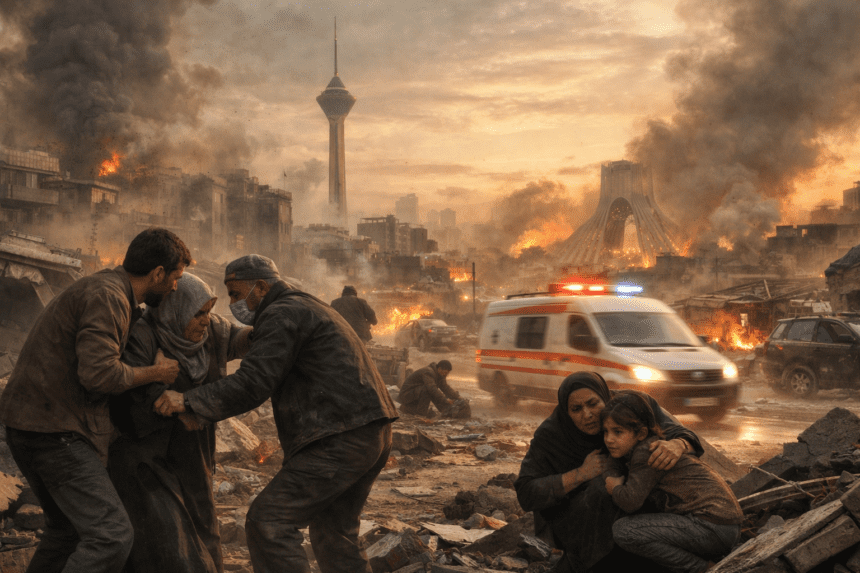
In the early hours of the morning on 28 February, explosions were heard in the skies over multiple Iranian cities. Satellite and news reports showed large plumes of smoke rising over urban centres as military aircraft and missile systems engaged pre-designated targets. The US Department of Defense publicly referred to the operation as “Operation Epic Fury”, while the Israeli government called its efforts “Operation Lion’s Roar”.
Television broadcasts and live news coverage documented residents in Tehran and other cities reacting with panic and fear. Many civilians rushed to collect their children from school or sought shelter as air raid alerts sounded. Some Iranian government officials reported that parts of the capital and other regions were under direct attack, although Iran’s supreme leader and other top officials’ immediate safety was not fully confirmed during the first hours of the conflict.
Reports soon emerged of casualties and damage. State linked Iranian sources claimed that a girls’ elementary school in the southern town of Minab, Hormozgan province, was struck by a missile during the wave of strikes, killing dozens of children and injuring many more. Iranian judicial authorities gave initial casualty figures in the scores at that location alone. While independent verification remains ongoing, multiple respected news organisations reported that the incident occurred amid the broader attack on Iranian targets.
Iran’s Response
Almost immediately after the strikes began, Iran announced that it was responding with military force of its own. Iranian state media and official sources confirmed that missiles and armed drones were launched toward Israeli territory as well as American bases and allied countries hosting US forces in the Gulf region. Nations such as Qatar, Kuwait, Bahrain, Saudi Arabia and the United Arab Emirates reported missile or drone activity over their airspace in the hours following the initial strikes.
In its public statements, Iran’s leadership vowed to fight what it described as an act of aggression and to defend its sovereignty. Tehran issued warnings that any country hosting American military forces could be considered within reach of Iranian military operations. Iran also officially brought the matter before the United Nations Security Council, calling for urgent intervention to halt what it described as breaches of international law.
In Iran itself, the reaction among ordinary citizens was mixed. Some expressed fear and anxiety as cities were hit by explosions, while others criticised both the foreign attack and their own government’s policies. Scenes of panic were reported, with long queues forming at petrol stations and residents seeking safer rural areas in the face of possible extended conflict.
Regional Impact
The strikes and Iran’s response quickly spread fear and instability across the Middle East. Many nations in the region felt direct effects. Civilian and military installations in several Gulf nations reported damage from falling debris, intercepted missiles or stray drone activity. Airports were closed in some countries, trade routes were disrupted and air travel was cancelled as a precautionary safety measure.
Across the region, governments scrambled to respond. Some countries expressed clear support for the US and Israeli objectives, while others condemned the strikes as unjustified and dangerous. Emergency meetings were held at various diplomatic levels to address the widening crisis.
Global Reaction
World leaders and international organisations reacted swiftly as news of the strikes and the ensuing violence spread. The United Nations Secretary General called for an immediate cessation of hostilities and stressed the importance of diplomacy and civilian protection. Several European nations echoed this call, urging all parties to show restraint and prevent further escalation.
Different countries took varied positions. Some allied with the United States praised the military action as necessary to prevent Tehran from acquiring dangerous capabilities. Others criticised the attacks for violating international law and jeopardising decades of diplomatic efforts aimed at containing conflict through dialogue and negotiation.
In capitals around the world, analysts warned that the strikes could have far reaching consequences for global economic stability, especially in the energy sector. Iran is a key oil exporter and its location near major shipping routes like the Strait of Hormuz means that rising tensions can have an immediate effect on global oil prices and supply chains.
The Human Cost
One of the most urgent concerns arising from this conflict is its impact on civilians. In Iran, reports from the Minab school strike suggest dozens of children lost their lives, an event that has shocked families and human rights observers worldwide. Hospitals across affected cities have been overwhelmed with injuries from explosions and collapsing structures.
In Israel, residents in major cities such as Tel Aviv and Jerusalem took shelter as Iranian missiles were intercepted overhead. Civil defence protocols were activated, and while initial reports suggested limited direct casualties from incoming missiles, the psychological toll on families and communities was considerable.
In several Gulf countries, civilians and service members were wounded by debris or indirect blast effects as Iranian missiles were intercepted or fell in urban and military areas. These incidents highlighted that even attacks aimed at military targets can have unpredictable and tragic consequences for non combatants.
What Comes Next
As this situation continues to unfold, the path forward remains uncertain. Military analysts warn that the conflict could widen if engaged nations misjudge one another’s capabilities or intentions. Diplomatic channels are struggling to keep pace with the speed of events, and further international negotiations are urgently needed to prevent prolonged warfare in a region already beset by years of intermittent conflict.
Global economic markets are watching closely, especially in the energy sector where disruptions to supply routes could have knock on effects worldwide. Humanitarian organisations are preparing for possible refugee flows and increased medical needs as this crisis continues.
In Iran itself, divisions between supporters of the regime and those calling for political change may deepen as street protests and domestic unrest continue alongside the external conflict. Analysts note that Tehran’s leadership faces immense pressure from both internal protests and external military pressure, complicating any path to peace.
Final Thoughts
The military strikes launched by the United States and Israel against Iran on 28 February 2026 represent a watershed moment in Middle Eastern history and global politics. This unprecedented escalation has already resulted in loss of life, destabilisation across the region, and fears of a much broader conflict that could spread beyond the Middle East.
As the world watches and waits, international diplomatic efforts must urgently work to de-escalate the situation, safeguard civilians, and find a path back from the brink of all out war. The stories of those caught up in the violence serve as a reminder that behind political decisions are real human lives men, women and children who deserve protection and peace.