Inflation cools but the labour market shows cracks
Inflation Holds at 2.4%
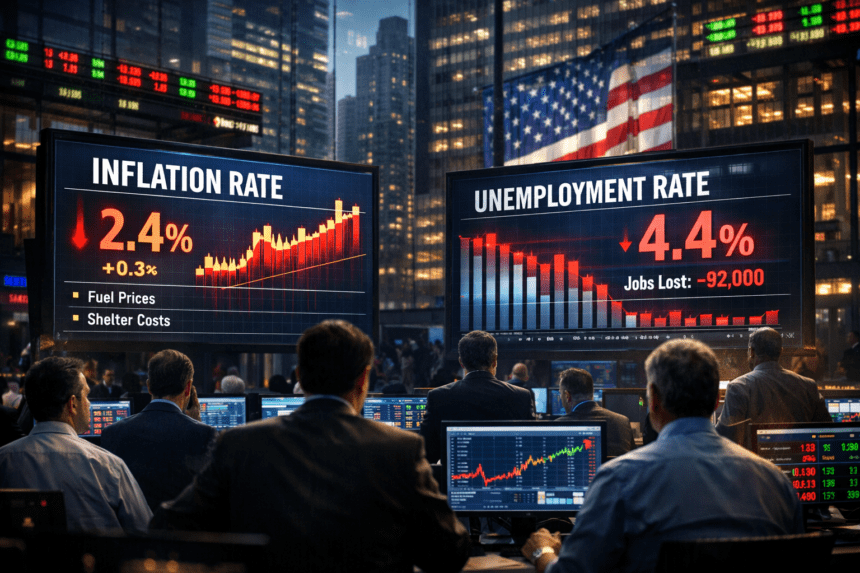
According to the latest Consumer Price Index (CPI) report, inflation in the United States remained 2.4% year over year in February 2026, unchanged from January.
On a monthly basis, prices rose 0.3%, slightly faster than January’s 0.2% increase.
Core inflation which excludes volatile food and energy prices held steady at 2.5% annually.
Several factors continue to drive price increases:
• Housing (shelter costs)
• Food prices
• Energy costs including gasoline
Shelter costs rose 0.2% during the month, remaining the largest contributor to inflation.
Energy markets also showed renewed volatility, with fuel oil prices jumping 11.1%, while overall energy costs rose roughly 0.6%.
Food prices increased 0.4% in February, continuing a steady upward trend.
Although inflation has cooled significantly compared with earlier years, the 2.4% reading still sits above the Federal Reserve’s 2% target, leaving policymakers cautious.
Labour Market Shows Signs of Weakness
At the same time, the February Employment Situation Report delivered an unexpected shock.
The U.S. economy lost approximately 92,000 jobs in February, reversing stronger employment growth seen earlier in the year.
The unemployment rate rose to 4.4%, up from 4.3% in January, signalling the labour market may be starting to cool.
Job losses were concentrated in several sectors:
• Health care (partly due to labour strikes)
• Information and technology
• Federal government employment
Despite the setback, the labour market still shows some resilience.
Average wage growth remains around 3.8% year-over-year, meaning wages are still rising faster than inflation.
Weekly unemployment claims remain relatively stable at roughly 213,000, suggesting layoffs remain historically low even as hiring slows.
Markets Are Increasingly Nervous
Financial markets are beginning to reflect growing uncertainty about the economic outlook.
According to the global prediction market Polymarket, the probability of a U.S. recession occurring in 2026 is currently estimated at around 29%.
Prediction markets often reflect real-time investor sentiment and expectations about economic conditions.
While a recession is far from guaranteed, the rising probability shows that traders and analysts are becoming more cautious about the direction of the economy.
Geopolitical Risks Could Push Inflation Higher
Another concern for economists is rising geopolitical tension.
The ongoing Middle East conflict involving Iran is already pushing oil prices higher, and further disruptions could drive energy costs up significantly.
Higher oil prices often feed into transportation, manufacturing, and food costs potentially pushing inflation higher again.
The Federal Reserve’s Dilemma
For the Federal Reserve, the situation presents a difficult balancing act.
Inflation is cooling but still above target.
The labour market is weakening but remains historically strong.
Cutting interest rates too soon could reignite inflation, while maintaining high interest rates could slow the economy further.
For now, economists widely expect the Fed to hold interest rates steady while monitoring upcoming economic data.
The Bottom Line
The latest U.S. economic data suggests the country may be entering a transition phase.
Inflation is stabilising.
The labour market is beginning to soften.
Recession risks are rising but remain far from certain.
Whether the United States can successfully navigate a soft landing in 2026 may ultimately depend on how inflation, energy prices, and employment trends evolve in the months ahead.