

Donald Trump uses the national stage to paint a picture of triumph and conflict
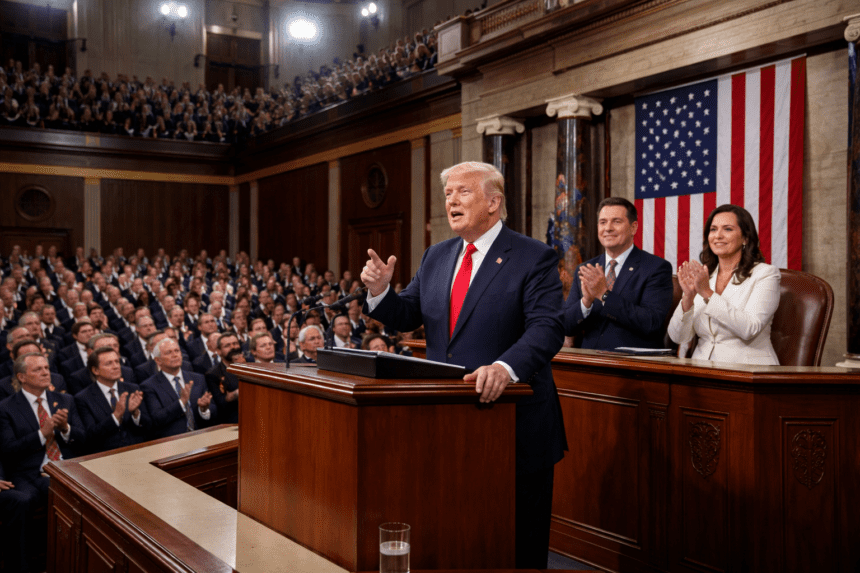
On February 24, 2026, President Donald Trump delivered the first official State of the Union address of his second term to a joint session of the United States Congress in the House Chamber of the U.S. Capitol in Washington, D.C. This night-long political spectacle the longest State of the Union address in American history at about 1 hour and 48 minutes was both a showcase of presidential theatre and a stark reflection of America’s deep political divides.
Trump came to the lectern with a clear goal: to persuade the nation that his leadership has brought hard-won successes, that America is “back” and poised for even greater achievement, and that his agenda deserves continued Republican support ahead of challenging midterm elections. What resulted was a speech at once celebratory, confrontational, and polarising designed as much to rally the GOP base as to confront Trump’s critics head on.
A record breaking address
Trump’s 2026 State of the Union was historic in length and intensity. Speaking for nearly two hours, he shattered previous records for a presidential address to Congress, echoing his penchant for extended, high energy speeches. The duration surpassed even his own 2025 address to Congress which itself was exceptionally long for a presidential speech.
From the outset, Trump adopted an upbeat tone, framing his presidency as a story of recovery and resurgence. He repeatedly invoked phrases like “our nation is back,” and described what he called a “turnaround for the ages” under his leadership. Much of the early part of the speech highlighted supposed economic gains, lower inflation rates, vibrant markets, tax reforms, and job growth, although many critics and independent fact checkers noted that elements of this rosy picture diverged from Americans’ lived experiences and broader economic indicators.
Domestic achievements and theatrical flourishes
Beyond policy claims, Trump built theatrical moments into the address. He honoured select individuals from war veterans to Olympic athletes using these segments to underscore themes of patriotism and resilience. These segments drew bipartisan applause but were also designed to humanise and dramatise the administration’s narrative.
Trump also used the speech to spotlight his administration’s policy priorities. Immigration was one such issue. Trump sharply criticised Democrats for what he called lax border enforcement and, at one point, asked members of Congress to stand if they agreed the government’s first duty was to protect American citizens. When many Democrats remained seated, the moment became a defining expression of the evening’s partisan tension.
His rhetoric extended to domestic law and order, crime, and election integrity frequently casting Democrats as obstructive or harmful to the nation’s progress. On foreign policy, Trump struck a firm tone toward Iran and other geopolitical adversaries, warning against nuclear ambitions while emphasising American strength on the global stage.
Divisions on display
While Trump’s supporters cheered each major proclamation, the address also laid bare political discord. Many Democratic lawmakers either boycotted portions of the speech or engaged in visible protest, underscoring the opposition’s rejection of Trump’s agenda. In some cases, Democratic members remained seated during moments intended to be unifying a symbolic gesture of resistance rather than acquiescence.
The atmosphere in the chamber was far from unified. Partisan lines were evident not just in applause and silence, but in isolated outbursts and critiques that resonated beyond Washington. The speech underscored the fracturing of what was once a more ceremonial national ritual and transformed it into a battleground for political messaging.
Economics, immigration, tariffs and more
Economics formed a core theme of Trump’s speech. He touted reductions in inflation, lower consumer prices, and a flourishing stock market, asserting these as signs of Republican policy success. He also highlighted tax initiatives and promoted new proposals like retirement savings plans and investment accounts for children, although analysts noted that many ideas lacked detailed implementation pathways.
On immigration, Trump reiterated his administration’s hardline policies. The president decried undocumented immigration and praised enforcement measures even as some of those policies remained deeply controversial and triggered protests outside the Capitol in the days leading up to the address.
Tariffs and trade were another area where Trump projected strength. He defended recent tariff policies, despite a recent Supreme Court ruling against broad tariff authority, and raised the rhetoric against the court’s decision, reflecting ongoing tensions between the executive branch and judicial oversight.
The Democratic rebuttal
Immediately following Trump’s address, Virginia Governor Abigail Spanberger delivered the official Democratic response, seeking to counter the president’s framing and messaging. Speaking from Williamsburg, Virginia, Spanberger challenged the notion that America has entered a “golden age” under Trump, instead underscoring real economic hardships felt by ordinary Americans. She argued that rising costs for healthcare, housing, and basic goods belie the administration’s celebratory rhetoric.
Spanberger and other Democratic voices positioned affordability everyday economic struggles as central themes of their response and broader strategy leading into the 2026 midterm elections. They accused Trump’s policies of benefiting elites at the expense of working families and called for accountability and unity in governance.
Democrats also highlighted concerns about immigration enforcement and human rights, critiquing the tone and tactics used by federal agencies and questioning whether life has improved under Republican rule. Spanberger’s rebuttal was broadcast widely and underscored a stark contrast in visions for the country’s future.
A nation divided
The 2026 State of the Union address revealed not only deep partisan divides in Congress and among voters but also differing perceptions of national wellbeing. Polling ahead of the address showed low approval ratings for Trump’s performance, with many Americans expressing dissatisfaction with the state of the economy and concerns over the direction of the country.
Analysts and commentators noted that even though the speech provided Trump a national platform, it may have reinforced rather than softened the sharp political cleavages in American society. The address became less an act of national unity which the State of the Union tradition once aspired to be and more a campaign stage for both parties.
In the end, Trump’s record breaking address was a blend of spectacle, policy advocacy, and ideological conflict. For supporters, it was a declaration of accomplishment and a rallying call for the midterms. For opponents, it was a manifestation of partisan grievance and a prompt to mobilise resistance. And for a deeply divided nation, it was yet another flashpoint in the long, turbulent story of modern American politics.