

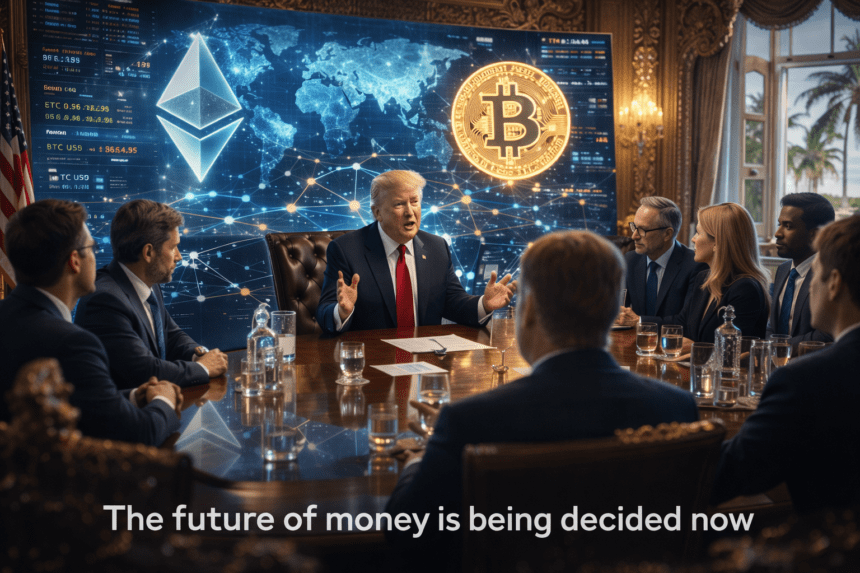
The future of money is being decided now
In recent months the role of cryptocurrency and blockchain technology has moved into the spotlight in U.S. political and economic conversations. What was once dismissed by Donald Trump as “not money” has become a topic embraced by parts of his administration and by many in the broader financial community.
Although the 2025 National Security Strategy did not prioritise crypto technology in its formal text, other official acts show that the U.S. government under Trump has taken steps to support the growth of the crypto industry. For example, an executive order was signed in January 2025 to strengthen the United States’ leadership in digital financial technology. That order directed federal efforts toward developing clear rules for digital assets rather than promoting a central bank digital currency.
Trump has also supported the idea of creating a national crypto reserve a government stockpile of Bitcoin and other major digital assets as a complement to U.S. dollar-based financial strategy. This proposal, which has been discussed by policymakers and industry backers, is intended to position the U.S. at the forefront of global digital finance.
Some in the crypto world have welcomed these moves, saying the U.S. should lead in financial innovation and digital assets. Others have raised concerns about transparency conflict of interest and the potential for political influence given the Trump family’s business interests in crypto and stablecoins.
The Mar a Lago Forum What It Is and Who Will Attend
Recently it was announced that World Liberty Financial a firm closely linked with the Trump family’s business interests will host an inaugural World Liberty Forum on February 18, 2026 at Mar-a-Lago in Florida. This event is planned as a major gathering that brings together leaders in finance technology regulation and investment to discuss the future of global money crypto and financial innovation.
The forum aims to explore topics including:
Digital assets and blockchain technology’s role in global markets,
Regulatory policy challenges and frameworks for innovation,
Geopolitical shifts in financial systems,
The relationship between traditional finance and new distributed technologies.
Reported attendees include executives from major financial firms and regulators such as CEOs from traditional investment institutions and leaders from U.S. financial regulatory agencies along with fintech and crypto industry experts.
While specific speaking agendas have not been fully released publicly, the forum represents a high-profile intersection of private sector leaders government officials and investors focused on the evolving role of digital money worldwide.
Why This Matters Globally
The idea that blockchain or cryptocurrency technology could help maintain or even enhance U.S. influence in the global monetary system is gaining traction among some policymakers and investors. For example:
Crypto is being viewed as a tool that might support the strength and international use of the U.S. dollar by attracting investment and innovation activity to the United States.
Industry leaders argue that the U.S. can set global standards for digital asset regulation and infrastructure, potentially shaping how cross-border value moves in the future.
Public-private collaborations and high-level summits signal a broader shift from speculative crypto markets toward integrating distributed ledger technologies with mainstream financial services and government strategy.
However the rapid rise in U.S. crypto involvement including events tied to private business interests has also brought scrutiny from media and watchdog groups concerned about ethical boundaries and the potential for conflicts of interest.
What Has Happened Already and What Comes Next
Earlier in Trump’s current presidency the White House hosted a digital assets summit where representatives from major U.S. crypto companies met with policymakers to discuss regulatory clarity and market structure. That event highlighted the growing importance of digital assets in U.S. economic policy discussions.
A range of crypto industry leaders and Trump administration officials were reported to hold cryptocurrency investments during key policy discussions demonstrating how deeply intertwined economic and technological policymaking has become.
Looking ahead the Mar-a-Lago forum coupled with legislative efforts related to stablecoins and digital asset frameworks is likely to shape how the U.S. positions itself on digital money innovation globally. Both supporters and critics are watching closely as stakeholder groups debate how blockchain should be regulated fostered and integrated into existing financial systems.
Thoughts and Opinion : Is This the Beginning of the Biggest Shift in Global Economics and Personal Finance
The convergence of political leadership private investment interest and blockchain technology reflects a deeper shift in how the world is beginning to think about money ownership and financial power. While traditional centralised banking systems still dominate global finance the rapid rise of digital financial technologies is no longer theoretical or experimental. It is now being actively discussed and shaped by governments institutional investors and technology leaders at the highest levels.
Events such as the upcoming World Liberty Forum at Mar-a-Lago are significant not simply because of who is attending but because they signal that blockchain and digital assets are moving from the margins of innovation into the centre of economic strategy. When political leaders major capital allocators and technology builders align around a shared discussion of the future of money it suggests a possible turning point rather than a passing trend.
This moment could represent one of the most important economic transitions since the creation of the modern banking system or the abandonment of the gold standard. If blockchain based infrastructure becomes integrated into global settlement systems capital markets and currency frameworks it may reshape how value moves across borders how assets are owned and how individuals interact with financial systems on a daily basis.
For personal finance this shift could be just as meaningful. Blockchain technology has the potential to give individuals greater transparency direct ownership and access to financial tools that were previously limited to institutions. It may reduce reliance on intermediaries lower costs and allow people to participate more directly in global markets regardless of geography. At the same time it introduces new responsibilities around education security and self custody that will define the next era of financial literacy.
Whether blockchain becomes the dominant foundation of global money or remains a powerful parallel system alongside traditional finance is still uncertain. Regulatory decisions technological resilience and public trust will ultimately determine the outcome. However what is now clear is that this conversation has reached the highest levels of influence and decision making.
This does not guarantee a single global outcome but it strongly suggests that the world is entering a new phase of economic experimentation and transformation. The path forward may be complex uneven and contested but it is increasingly unlikely that the financial system of the future will look the same as the one of the past.