


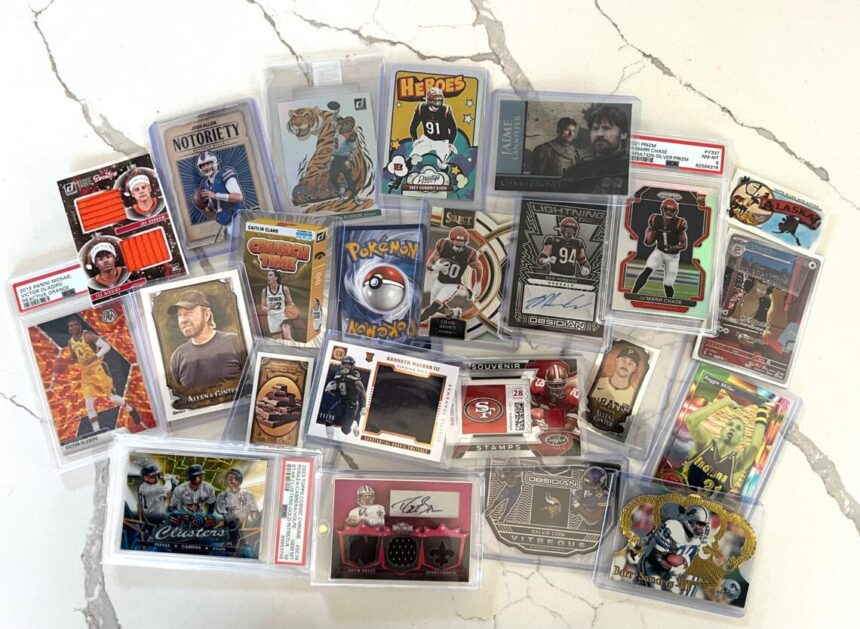
Federal investigations, industry consolidation, and quiet blockchain adoption are reshaping how collectors verify value.
Trading cards no longer live in the world of childhood nostalgia. In today’s market, a single piece of cardboard can carry a six- or seven-figure price tag, be insured like fine art, traded globally in seconds, and used as collateral in financial arrangements. Once collectibles reach that level of value, they stop being hobbies and start behaving like assets. And when assets are involved, the most valuable thing in the system is no longer the object itself it is trust.
The modern trading card ecosystem is built on trust signals. Grading labels, encapsulation, population reports, and certification numbers act as shorthand for authenticity and condition. A single grade point can mean the difference between a card being worth thousands or hundreds of thousands of dollars. That authority has made grading companies central pillars of the market. It has also made them unavoidable pressure points.
Over the past several years, U.S. federal authorities have increasingly investigated fraud tied to collectibles. These cases have not accused major grading companies of criminal behavior, but they have repeatedly exposed how grading authority can be exploited. Counterfeit slabs, forged labels, altered cards, and manipulated auction practices have all appeared in federal indictments. The pattern is consistent: when a grading label confers instant legitimacy and value, criminals attempt to replicate or abuse it.
At the same time, the grading industry itself has been consolidating. The majority of graded cards in the United States now pass through a small number of dominant firms. In late 2025, this concentration attracted the attention of lawmakers, with a formal request for the Federal Trade Commission to examine whether acquisitions in the grading space could reduce competition or create conflicts of interest. This was not a criminal allegation. It was a structural concern about market power and transparency.
For collectors, these developments land at an uneasy moment. Large grading companies provide liquidity, standardization, and global recognition. Without them, the modern market could not function at scale. But consolidation also creates fear. When grading standards evolve, when turnaround times stretch, or when controversial decisions occur, collectors often feel they have little recourse. Databases are centralized. Decisions are subjective. Appeals are limited. Trust becomes something you must accept rather than verify.
This is the environment in which blockchain technology has quietly entered the conversation. Not as a loud promise to replace grading companies, and not as a speculative NFT experiment, but as a potential tool for reinforcing record integrity. Blockchain does not decide whether a card deserves a grade of 9 or 10. It does not replace expertise. What it does offer is something more modest and more powerful: an immutable way to record what decision was made, when it was made, and whether that record has ever been altered.
Most fraud in the collectibles market does not come from disagreements over grading judgment. It comes from identity attacks. Fake slabs. Swapped cards. Altered items re-introduced into the market. Provenance histories quietly rewritten. Blockchain cannot prevent bad actors from attempting fraud, but it can make successful deception harder and quieter manipulation nearly impossible. That alone changes the risk equation.
The most telling signal that this approach has merit does not come from crypto startups, but from conservative global brands. Pokémon, one of the most carefully managed intellectual properties in the world, has shown signs of using blockchain-style infrastructure behind the scenes for digital collectibles. Features such as unique digital items in Pokémon HOME appear to rely on blockchain-backed verification, yet players are not exposed to wallets, tokens, or speculation. From the user’s perspective, nothing “crypto” is happening at all. The technology simply ensures that items are unique and verifiable.
This matters because Pokémon represents the opposite of risk-taking experimentation. If a brand of that scale is willing to use blockchain quietly as backend infrastructure, it suggests a broader pattern. Blockchain does not need to be visible to be useful. In fact, its most successful applications may be the ones users never notice.
The same logic applies to trading cards and grading. The future is unlikely to be a fully decentralized free for all where anyone can mint grades on-chain. Collectors do not want that. They want authority, consistency, and expertise. What they also want is accountability and auditability. A hybrid model where physical grading remains expert driven but certification records are cryptographically anchored offers a path that strengthens trust without dismantling the system that already exists.
In such a model, grading companies retain control over issuing certifications. The difference is that each certification produces a tamper evident digital fingerprint. Reports and scans can be stored off-chain, while their integrity is anchored to a public ledger. Physical slabs can include secure physical-digital links that prove the slab corresponds to the recorded certificate. Regrades, reholders, and disputes become visible events rather than opaque database changes.
This approach is not without risk. Immutable records raise legal and privacy questions. Mistakes can be difficult to unwind. Ownership histories can expose collector behavior if poorly designed. And none of this matters if dishonest actors control the data entering the system. Blockchain preserves truth, but it also preserves lies. Governance still matters.
But ignoring the problem is no longer an option. Trading cards have crossed the threshold into global financial relevance. With that comes regulatory interest, criminal attention, and technological pressure. The systems that supported a hobby are being asked to support an asset class. They must evolve accordingly.
The next era of collecting will not be defined by cardboard alone, and it will not be defined by code alone. It will be defined by how well trust is created, distributed, and protected. Whether through regulation, technology, or a careful balance of both, the market is being forced to answer a simple question: when value scales globally, can trust keep up?
For collectors, the answer will shape not just prices, but confidence. And in a market built on belief, confidence is everything.