


FOMO DailyFOMO DailyFOMO Daily
Font ResizerAa
  • Home
  • News
  • Politics
  • Entertainment
  • Sport
  • Lifestyle
  • Finance
  • Cryptocurrency
Reading: Stablecoins Just Lost a Key Fight in Washington
Share
Font ResizerAa
FOMO DailyFOMO Daily
  • Home
  • News
  • Politics
  • Entertainment
  • Sport
  • Lifestyle
  • Finance
  • Cryptocurrency
Search
  • Home
  • News
  • Politics
  • Entertainment
  • Sport
  • Lifestyle
  • Finance
  • Cryptocurrency
Copyright © 2026 FOMO Daily - All Rights Reserved.

Stablecoins Just Lost a Key Fight in Washington

If this rule direction holds, stablecoins may stay programmable and global, but bank-issued tokenized deposits could keep the trust advantage that matters most in a crisis.

Oscar Harding
Last updated: March 19, 2026 8:18 pm
Oscar Harding
5 Min Read
Share
5 Min Read

The battle over digital dollars is shifting from speed and scale to something more powerful: who gets the government safety net

The next phase of the stablecoin fight in Washington is becoming much clearer.

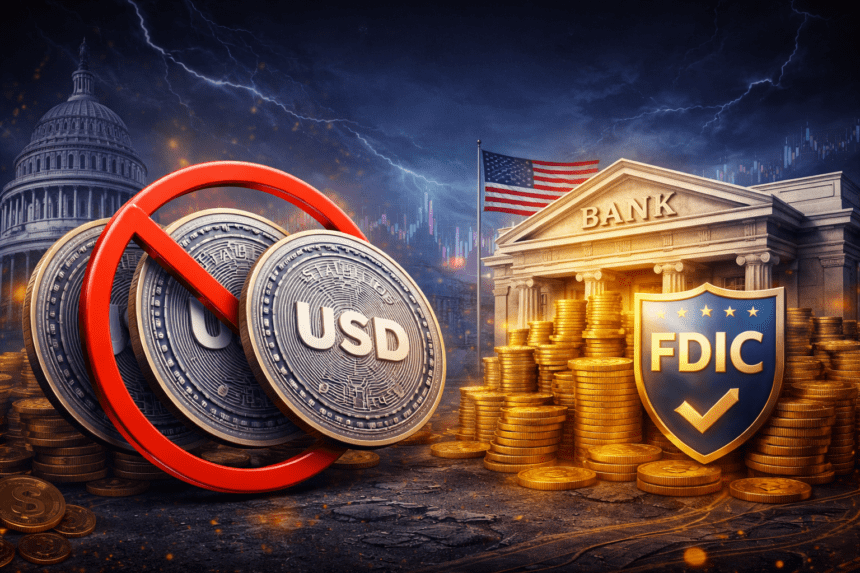
It is not just about who can issue digital dollars, who can scale faster, or who can land more users. It is about who gets to bring federal deposit protection on-chain, and right now that line appears to be breaking in favor of banks.

FDIC Chairman Travis Hill said on March 11 that the agency plans to propose that payment stablecoins subject to the GENIUS Act would not be eligible for pass-through insurance. He also said the FDIC plans to clarify that tokenized deposits that meet the legal definition of a deposit should receive the same regulatory and deposit insurance treatment as ordinary bank deposits.

That distinction is a big deal.

If a stablecoin issuer keeps reserves in a bank account and that bank fails, pass-through insurance could have treated the underlying users like insured depositors in some structures. Hill’s position is that this would clash with the GENIUS Act’s prohibition on payment stablecoins being represented as subject to federal deposit insurance. Payments Dive reported that under the FDIC’s planned approach, the reserve account would instead be treated like a corporate deposit account, generally eligible for only the normal $250,000 deposit insurance cap at the account level rather than coverage based on each token holder’s claim.

That does not mean only banks can issue all digital dollars, and it does not mean every bank-issued token automatically wins. The OCC’s proposed GENIUS Act rule shows that there are multiple permitted issuer paths, including subsidiaries of insured banks, certain uninsured banks, and some nonbank entities that obtain approval.

But it does mean the market may be heading toward a two-tier system for on-chain dollars.

In one lane sit payment stablecoins: regulated, usable, and potentially large, but without the marketing or structural advantage of FDIC insurance. In the other lane sit tokenized deposits: digital bank money that, when they legally qualify as deposits, can keep the same insurance protection as traditional bank accounts. That is a major competitive edge because trust matters most when markets are stressed.

This is why the story matters far beyond crypto policy circles.

For years, stablecoins were pitched as the faster, more open version of digital cash. Banks looked slower, heavier, and easier to disrupt. But if banks can now issue on-chain deposit products while preserving the protection people already understand, the advantage shifts. The product may be less open, less crypto-native, and more controlled, but it comes with something stablecoins are increasingly unlikely to have: the full weight of the existing banking safety net.

That does not kill stablecoins.

They can still dominate open blockchains, cross-border settlement, crypto trading, and internet-native payments. But if regulators keep drawing this line, stablecoins may end up strongest in the parts of finance where users accept more risk in exchange for speed and openness, while banks defend the trust-heavy parts of money with insured tokenized deposits. That is not the end of stablecoins. It is a reminder that the banks may still control the safest version of digital dollars.

The deeper point is this: the fight over digital money was never only about technology.

It was always going to be about legal status, insurance, and who gets treated as real money when something breaks. Washington now seems to be answering that question in a way crypto may not like.

Stablecoins may still win distribution.

Banks may be winning trust.

Why XRPL’s Big Share of Tokenized T-Bill Supply Isn’t Triggering Big Trading Action
Bitcoin backed loan reshapes corporate finance
When Stablecoins Were Meant to Replace Banks But Are Becoming Banks
Grok, AI Generated Images, and the EU Clash With X
Are Korean Retail Traders Propping Up ETH Treasuries?

Sign up to FOMO Daily

Get the latest breaking news & weekly roundup, delivered straight to your inbox.

By signing up, you acknowledge the data practices in our Privacy Policy. You may unsubscribe at any time.
Share This Article
Facebook Whatsapp Whatsapp LinkedIn Reddit Telegram Threads Bluesky Email Copy Link Print
ByOscar Harding
G'day I’m Oscar Harding, a Australia based crypto / web3 blogger / Summary writer and NFT artist. “Boomer in the blockchain.” I break down Web3 in plain English and make art in pencil, watercolour, Illustrator, AI, and animation. Off-chain: into  combat sports, gold panning, cycling and fishing. If I don’t know it, I’ll dig in research, verify, and ask. Here to learn, share, and help onboard the next wave.
Previous Article EU Condemns Deadly Kabul Hospital Strike as Pakistan-Afghanistan Crisis Deepens

Latest News

EU Condemns Deadly Kabul Hospital Strike as Pakistan-Afghanistan Crisis Deepens
News Opinion Politics
The DAO Dream Is Hitting Reality
News Technology News World News
Crypto Wanted to Kill the Card Giants. Now the Card Giants Are Buying the Rails
Finance International Crypto News News Opinion
America’s Crypto Reset Is Real — But The Biggest Story Is Who Gets To Run It
Business Cryptocurrency Economy Finance Opinion Politics
Taliban Alleges Mass-Casualty Pakistan Strike On Kabul Rehab Centre, But The Full Death Toll Is Still Unconfirmed
News Opinion Politics World News
North Korea’s War Dividend Keeps Growing As Russia’s Grind Turns Into Pyongyang’s Payday
Business Finance News Opinion Politics
Bitcoin Near $75K Again
Finance News
Free Speech Is Not The Right To Control Other People’s Ears
Business Economy Entertainment Finance Opinion
Solana Turns Six And Wall Street Is Quietly Moving On-Chain
Cryptocurrency Finance News Opinion
Buckingham Palace Pressure Campaign Puts Andrew’s Place in the Line of Succession Back in Focus
News Opinion Politics
Tether Still Leads in Cash, But USDC Is Now Moving Crypto’s Money
News Political News
Trump-Backed Crypto Platform WLFI Sells $5M “Access” While Promoting Democratized Finance
Business Crypto Investment Economy Opinion Politics
U.S. Inflation Stalls While Job Losses Raise Questions About the Economy
Business Economy Finance Opinion Politics
Polish President Vetoes EU Defence Loan Plan as Tusk Searches for Plan B
Europe News Opinion Political News Politics

You Might Also Like

Record $1.2B Bitcoin ETF Surge as BlackRock’s IBIT Leads

October 7, 2025

Tension in the Sanctuary

January 21, 2026

SEC Probes Crypto Treasury Firms

September 26, 2025

Why a 5 % Drop in Bitcoin Could Spark a Bull Stampede

February 19, 2026

FOMO Daily — delivering the stories, trends, and insights you can’t afford to miss.

We cut through the noise to bring you what’s shaping conversations, driving culture, and defining today — all in one quick, daily read.

  • Privacy Policy
  • Contact
  • Home
  • News
  • Politics
  • Entertainment
  • Sport
  • Lifestyle
  • Finance
  • Cryptocurrency

Subscribe to our newsletter to get the latest articles delivered to your inbox.

FOMO DailyFOMO Daily
Follow US
Copyright © 2026 FOMO Daily. All Rights Reserved.
Welcome Back!

Sign in to your account

Username or Email Address
Password

Lost your password?