

A political clash erupts in Warsaw over billions in EU defence funding
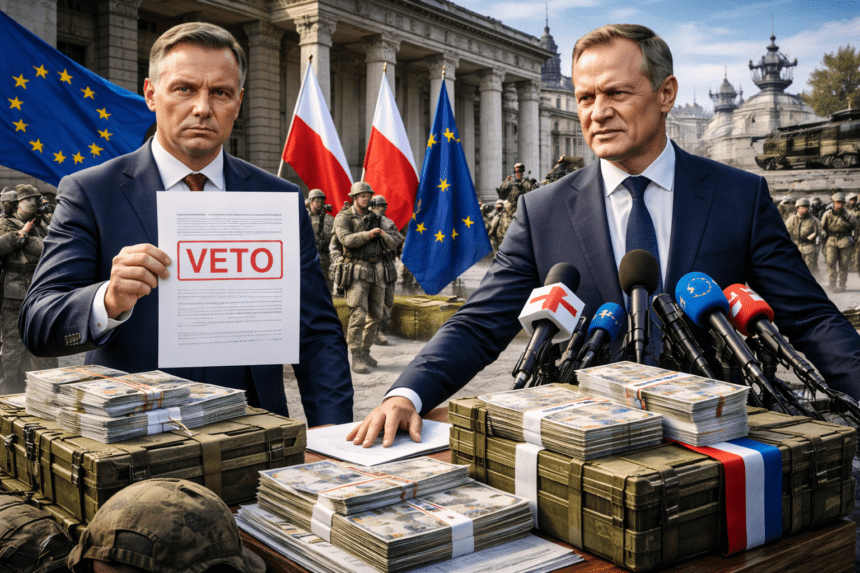
A major political showdown has erupted in Poland after the country’s president vetoed legislation that would have allowed Warsaw to access €43.7 billion in European Union defence loans, part of a wider EU effort to strengthen military capabilities across the continent.
The decision by President Karol Nawrocki has triggered a sharp response from Prime Minister Donald Tusk, who says his government will pursue an alternative path to secure the funding despite the veto.
The dispute highlights deep divisions within Poland’s leadership over how the country should finance its military expansion at a time when security concerns in Europe are rising.
A €43 Billion Defence Loan Blocked
The legislation would have allowed Poland to participate in the EU’s Security Action for Europe (SAFE) program a €150 billion initiative designed to strengthen defence production and military readiness across the European Union.
Poland was expected to be the largest recipient of funds, with up to €43.7 billion in loans available to modernise the military and expand defence infrastructure.
But President Nawrocki vetoed the bill, arguing the loan could burden Poland with decades of debt and potentially weaken national sovereignty.
He also warned that EU oversight mechanisms attached to the loans could influence how Poland purchases military equipment and allocates defence spending.
Tusk Responds With a “Plan B”
Prime Minister Donald Tusk quickly condemned the veto and called an emergency government meeting, promising that the decision would not stop Poland from strengthening its military capabilities.
Tusk said his government will pursue alternative ways to access EU defence financing or use other national mechanisms to fund military investments.
While the veto complicates the process, the government believes it can still move forward though it may take longer and require additional negotiations with Brussels.
A Broader Political Battle
The clash reflects a deeper political divide in Poland.
Tusk’s pro-European coalition supports close cooperation with the European Union and sees the SAFE program as a critical opportunity to accelerate military modernisation.
Meanwhile, Nawrocki and his allies linked to the nationalist Law and Justice political camp are more skeptical of EU involvement in national security decisions.
Critics of the loan program argue it could increase Poland’s reliance on EU institutions and foreign financing.
Supporters say the funds are essential for strengthening Europe’s defence capabilities in response to Russia’s ongoing war in Ukraine and growing security tensions in Eastern Europe.
Poland’s Growing Military Role
Poland already spends more than 4% of its GDP on defence, one of the highest rates in NATO.
Successive governments have significantly increased military spending since Russia’s full-scale invasion of Ukraine in 2022.
The EU’s SAFE initiative was designed partly in response to these security pressures, aiming to strengthen Europe’s defence industry and reduce reliance on external suppliers.
What Happens Next
Despite the veto, the battle over the defence loans is far from over.
Poland’s government still has several options to secure funding, including using existing military funds or negotiating alternative arrangements with the EU.
For now, the clash has exposed the growing political tension between Poland’s president and its government and the broader debate across Europe over how defence should be funded in an increasingly unstable world.
One thing is clear:
as geopolitical tensions rise, the fight over Europe’s military future is only just beginning.