


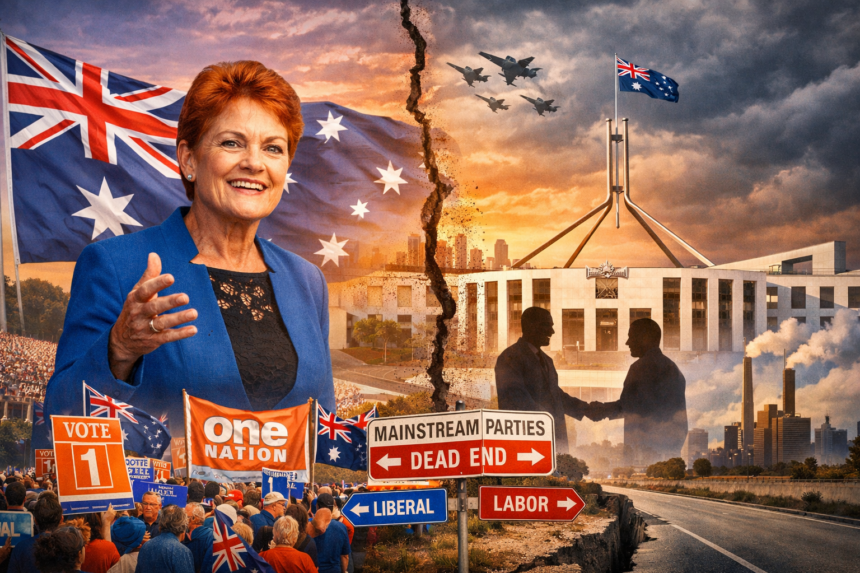
The immediate headlines are about Pauline Hanson’s party, but the deeper story is about a system that is fragmenting on the right and losing its old stabilisers
The facts show a rise that is no longer easy to dismiss
One Nation’s latest rise is not just a mood swing people can wave away with the old language of protest politics. The hard numbers are now too large and too repeated for that. National polling reported earlier this year put One Nation on 22 percent of the primary vote, ahead of the combined Liberal and National parties on 21 percent. That was not a one off curiosity. It reflected a broader pattern of conservative fragmentation that has been building since the 2025 federal election and has become harder to explain away as simple noise.
There is also hard evidence in actual election results that the party’s support is translating into something more serious than talkback radio energy. In the 2026 South Australian election, One Nation secured at least one lower house seat, was competitive in multiple others, and posted a statewide primary vote above 22 percent in a contest where the Liberal vote collapsed badly. Later counting and projections suggested the party was likely to win a second lower house seat as well. That is not the behaviour of a party merely floating on anger for a weekend. It is what structural penetration starts to look like.
The broader federal landscape also helps explain why this matters more than it might have a decade ago. At the 2025 federal election, Labor won 94 seats while the Coalition slumped to 43, with 12 seats going to others. That already pointed to a system in which the old two bloc order was under visible strain. When a major party system weakens at the same time a populist right party rises, those two developments are not separate stories. They are often part of the same story.
The fact pattern points to structural stress, not just outrage
The factual case for structural stress starts with the Coalition itself. Reporting through early 2026 consistently described a conservative side of politics that was fractured, uncertain, and struggling to hold together its old electoral coalition. One analysis on the Liberal and National split explicitly said the electoral foundations of the right were shifting, while other reporting across the year highlighted the Coalition’s internal divisions and weakening grip on its traditional base. That matters because One Nation does not have to build a majority coalition from scratch if the old conservative coalition is already decaying in front of it.
The South Australian election showed that clearly. Labor dominated the overall contest, but One Nation surged into the gap created by a collapsing Liberal vote in regional and outer areas. Analysts quoted in reporting said Liberal preferences were a key factor in converting that support into seats, but the underlying point is even more important. Preferences can help finish the job, but they cannot create a surge out of thin air. A party only becomes preference relevant when it has already become socially and electorally relevant first.
There is another fact that deserves more attention. Nationally, Australians have become more open to third party and non major party voting patterns over time. A broader election analysis last year argued that Australian politics is increasingly being shaped by minor parties and independents rather than by the old binary contest alone. That trend matters because One Nation’s current rise is not happening inside the old political architecture. It is happening in a country where voters are already more willing to desert inherited loyalties. In that sense, the ground is more fertile for insurgents than it was during earlier One Nation peaks.
My opinion is that the old protest vote explanation is now too small
This is where opinion enters, and my view is straightforward. The old line that One Nation is just a temporary dumping ground for angry voters no longer seems big enough to explain what is happening. Protest is still part of the story, obviously. Many voters are frustrated with both major parties, and some recent reporting on the South Australian result explicitly described the party’s support as driven in large part by protest sentiment. But protest is not the same thing as political irrelevance. A protest vote that becomes durable, transferable across elections, and embedded in particular regions stops being mere venting. It becomes a structural feature of the system.
That is what I think many commentators still underestimate. They hear the word protest and assume temporary irrationality. But protest can become an electoral habit, and electoral habits can become political architecture. Once enough voters decide the old parties no longer speak for them, the motivation does not have to be ideologically tidy to be politically powerful. In fact, it is often stronger when it is not tidy. It can pull together resentment about cost of living, migration, cultural change, distrust of elites, energy policy, regional decline, and political contempt all at once. That blend is messy, but messiness does not stop it from moving votes.
The right side of politics is no longer organised the way it used to be
Another reason this looks structural is that the right is no longer disciplined by the same gatekeeping instincts that once kept One Nation more contained. In earlier eras, the major parties were more willing to quarantine populist right challengers and treat them as dangerous contaminants. In the South Australian election, by contrast, the Liberals preferenced One Nation above Labor in ways analysts said directly helped the party win representation. That does not prove ideological fusion, but it does show a system whose antibodies are weaker than they used to be.
My opinion is that this matters enormously. When a populist insurgent party can grow while also benefiting from the tactical decisions of a weakened mainstream conservative party, it gains two advantages at once. It gets outsider energy and insider assistance. That is a potent combination. It also sends a subtle message to voters that the party is no longer beyond the pale in the way it once was. Electoral legitimacy is often built not only through votes but through how other players treat you.
This is also why the question is bigger than Pauline Hanson herself. Personalities matter, but systems matter more. If One Nation were only a vehicle for one leader’s charisma, then its future would be much easier to doubt. But the surrounding conditions now include a weakened Coalition, a more fragmented electorate, a public more comfortable with minor party experimentation, and a national mood shaped by insecurity and dissatisfaction. Those are conditions a party can exploit even when its own internal limitations remain obvious.
Insecurity is becoming a political accelerant
There is also a wider mood in the country that gives this surge more fuel than simple party competition. Recent national security research found almost half of Australians think a foreign military will attack within five years, with concern rising sharply across age groups and broad anxiety growing around disinformation, AI enabled attacks, supply chain disruption, foreign interference, climate risks, and economic shocks. That does not automatically translate into votes for One Nation, but it does tell you something about the emotional atmosphere in which politics is now operating. People who feel insecure across many fronts become more open to parties that offer hard edges, blunt answers, and a sense of control.
My view is that this is one of the most underrated factors in the whole conversation. Political systems do not fragment only because parties make strategic mistakes. They fragment because citizens start to feel that ordinary politics is no longer adequate to the scale of the pressures around them. When that happens, parties that once looked too rough or too extreme can start to feel, to some voters, more realistic than polished centrism. That does not mean they are realistic. It means they feel emotionally matched to the crisis mood.
The Liberal problem is not just tactical, it is existential
The structural explanation also makes sense because the main conservative rival is not merely having a bad season. It is struggling with a deeper identity problem. Reporting through 2025 and 2026 repeatedly returned to the same theme: the Liberal side of politics is uncertain whether to move toward the centre, move further right, or attempt some unstable combination of both. That kind of confusion is exactly what creates room for insurgents. If voters do not know what the mainstream conservative option stands for, the sharper and angrier alternative becomes easier to hear.
In my opinion, this is why fiddling at the edges will not work. Tactical message changes, a new slogan, or another leadership reset are unlikely to solve a structural loss of confidence. The right has a representational problem. A growing number of voters seem to believe that the existing conservative parties either do not mean what they say or do not have the nerve to act on it. That perception may be unfair in parts, but perceptions are politically real. If a mainstream party starts to look both weak and insincere, voters often drift not toward moderation but toward something louder.
That does not mean One Nation is destined to replace the Liberals nationally. Australia’s electoral system, geography, and parliamentary logic still make that a very high bar. But replacement is not the only measure that matters. A party can reshape the whole right without becoming the largest right wing party. It can change preference flows, candidate behaviour, messaging, policy pressure, and the psychological boundaries of debate. In many ways that is already happening.
Cost of living and social strain still sit underneath everything
Although structural explanations are important, they do not float above daily life. They are powered by it. Housing stress, fuel prices, stagnant confidence, and the sense that economic pressure keeps rising while political language keeps getting more managerial all help insurgent parties. Around the same time One Nation’s surge was being discussed, the Prime Minister was holding emergency talks over fuel demand and prices, underlining how persistent cost pressures remain in ordinary life. One Nation does not need to solve these problems convincingly to benefit from them. It only needs enough voters to believe the existing parties have stopped being responsive.
My view is that this is why purely moral denunciation of One Nation usually fails to contain it. If voters are drifting toward the party because they feel economically pressured, culturally dismissed, and politically unrepresented, then being told the party is irresponsible or offensive will not necessarily move them back. Sometimes it drives them further in. That does not mean criticism is wrong. It means criticism without a credible answer to the underlying strain is rarely enough.
The lesson from South Australia is bigger than South Australia
State elections are never perfect national templates, but the South Australian result still matters because it compressed several broader trends into one test case. A major centre right party collapsed. A populist right challenger surged above 22 percent. Preferences helped institutionalise the gains. Labor still dominated overall, which meant the populist rise was not simply a story of general anti government revolt. That combination tells us something important. One Nation’s growth is not only about defeating Labor. It is also about cannibalising the conservative side when it looks confused, distant, or exhausted.
That is why I think the phrase structural issues at play is the right frame. The old party map is under stress. The conservative bloc is weaker. Voters are more fluid. Public insecurity is higher. Preferences can now amplify insurgent parties rather than smother them. And the emotional legitimacy of protest politics is stronger than it was in earlier cycles. Put those elements together and the surge looks less like a freak spike and more like a system adjusting to a new equilibrium.
What the major parties are most likely to get wrong
The major parties now face a serious risk of learning the wrong lesson. One possible mistake is to dismiss the rise as a freak protest that will fade on its own. Another is to simply mimic One Nation’s rhetoric without addressing the institutional failures that made its message attractive in the first place. Both approaches are tempting and both are likely to fail.
My opinion is that the smarter reading is harder and less comfortable. The major parties need to recognise that trust, representation, and social confidence are being eroded across multiple fronts at once. This is not just a communications problem. It is a legitimacy problem. Voters who feel they are only seen at election time, who think the rules work better for insiders than for them, and who believe every major issue is met with process language instead of clarity are already halfway out the door before the campaign even starts.
For Labor, the danger is complacency. A badly split right can make government look safer than it really is. But if One Nation’s rise continues, it can harden the right in ways that eventually make broader opposition politics more volatile and less predictable. For the Coalition, the danger is more direct. The party can either confront the fact that its base is leaking because it looks hollow, or continue drifting while outsiders turn that weakness into a new political structure. Neither path is easy, but one is at least honest.
The bigger point
The facts tell us One Nation is rising fast, that the major conservative parties are struggling, and that electoral fragmentation is no longer a side story in Australia. The opinion part is deciding what that means. My judgment is that it means the country is entering a more unstable phase of political competition where the old assumptions about protest parties being temporary are no longer safe. Structural issues are now visible in the open. The old right is weaker, the electorate is looser, and the emotional conditions that feed populism are broadening rather than shrinking.
That does not guarantee One Nation a permanent breakthrough. Politics can still shift quickly. Leaders can fail, coalitions can re form, and protest energy can burn itself out. But the point is that none of those outcomes should be assumed anymore. This time the surge sits on top of a political system that is already more fractured than it used to be. That is why it feels different. And that is why treating it like just another flare up may be the biggest mistake the major parties can make.