


Uniting Tradition and Modern Life in Japan
Japan is a country where tradition and modernity intertwine in everyday life. Among its many national holidays, one stands out not because of fireworks or parades, but for its deep historical roots and quiet cultural significance The Emperor’s Birthday. Known in Japanese as Tenno Tanjobi, the Emperor’s Birthday is not simply another public holiday. It is a day when the Japanese people reflect on national identity, express respect for their ceremonial leader, and gather as a nation to honor continuity and goodwill.
What Is the Emperor’s Birthday?
The Emperor’s Birthday is a national holiday in Japan celebrating the birth of the current Emperor of Japan. This holiday changes its date depending on the birthday of the reigning sovereign. Since Emperor Naruhito ascended the throne on May 1, 2019, the holiday has been observed on February 23, his birthday.
Although the Emperor no longer holds political power under Japan’s post-World War II constitution, the position remains a powerful symbol of the state and of the unity of the people. Celebrating his birthday has become a way for the nation to come together and appreciate the peaceful continuity of the Chrysanthemum Throne.
Traditionally, the Emperor’s Birthday was celebrated on different dates over Japan’s long history as emperors changed. For example, during the Shōwa era (Hirohito’s reign), it was observed on April 29, and during the Heisei era (Emperor Akihito), it was observed on December 23. When Emperor Naruhito became emperor, the holiday shifted to February 23.
How Is It Celebrated?
Celebrations for the Emperor’s Birthday combine public engagement, national pride, and ceremonial tradition.
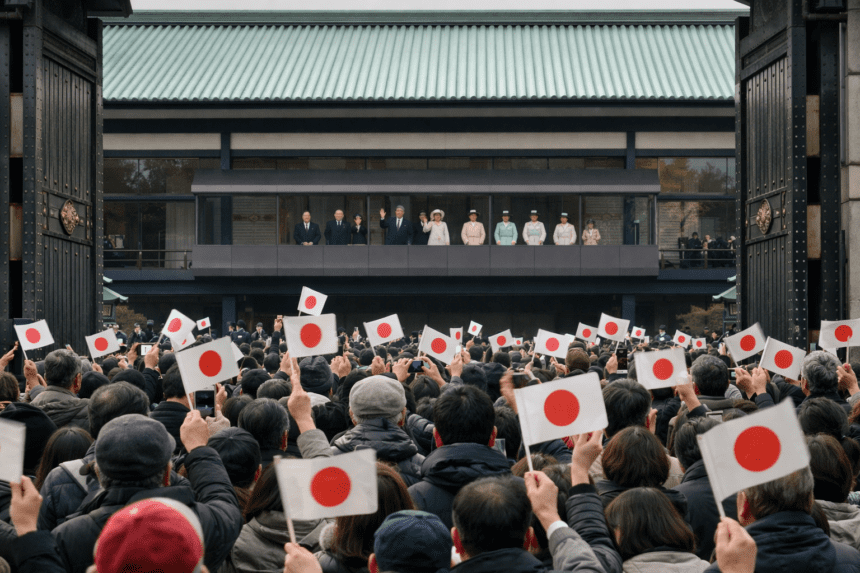
One of the most significant customs takes place at the Tokyo Imperial Palace. On this day, the palace gates are opened to the general public a rare occurrence that normally happens only twice a year: on January 2 and on the Emperor’s Birthday. On the palace grounds, tens of thousands of visitors gather in the East Plaza (Tōtei) to see the Emperor, Empress and other members of the Imperial Family.
The highlight for many visitors is the public greeting from the palace balcony, where the Imperial Family appears several times during the morning to acknowledge well-wishers. Crowds wave small Japanese national flags, cheer, and sometimes shout “Banzai” a traditional exclamation wishing “long life”.
In the afternoon, visitors may also enter another section of the palace grounds to sign an official greeting book or leave messages of goodwill. The Imperial Household Agency arranges for thousands of visitors to participate, and the submitted messages are officially forwarded as expressions of respect and celebration.
Why It Matters Today
To understand the importance of the Emperor’s Birthday, it’s essential to recognize the role of the Emperor in modern Japan. After the end of the war and the adoption of a new constitution in 1947, the Emperor’s role became purely symbolic representing the unity of the nation and its people. His position is not tied to governance or political authority, but to continuity, culture and national identity.
On the Emperor’s Birthday, Japanese citizens often display the national flag (Hinomaru) outside their homes and businesses, participate in cultural events, and take the time to reflect on national heritage. While many people use the holiday as a quiet day off, others see it as a moment to express heartfelt respect and gratitude for the Emperor’s continued service.
For travelers, this holiday provides a rare glimpse into Japan’s culture and traditions especially if visiting the Imperial Palace in Tokyo. Even outside the capital, the mood of the nation is subtly affected: schools, government offices and many businesses are closed, while larger attractions, restaurants and shops usually remain open to accommodate visitors.
The Historical Roots of the Celebration
The practice of honoring the Emperor’s birthday has roots in ancient Japan, though it was formalized in the modern era. Imperial birthdays were once celebrated privately among court circles, but over time, they took on broader meaning and eventually became public holidays with official ceremonies.
After the Meiji Restoration in the late 19th century, Japan modernized and codified many of its traditions. The Emperor’s Birthday was turned into a public holiday to strengthen national unity and identity during a period of rapid change. Subsequent reforms preserved the day as an annual event, even as emperors and era names changed.
In earlier eras, the holiday might have involved more elaborate court rituals and celebrations with nobles. Today, the focus is on shared national experience and public participation in a peaceful, orderly setting.
A Holiday of Unity and Respect
Unlike many modern holidays that focus primarily on entertainment or consumption, the Emperor’s Birthday carries a unique emotional and symbolic weight. It reflects Japan’s respect for its cultural institutions, its historical continuity, and the deep connection many citizens feel to the imperial family, even in a constitutional era.
For many Japanese people, the holiday is a chance to reflect on what it means to be part of a nation with centuries of history. For visitors, it offers a moment to observe a tradition shaped both by history and contemporary values. Whether you witness the balcony greeting at the palace, watch crowds wave flags with pride, or simply notice the quiet observance of a national symbol, the Emperor’s Birthday is a reminder of Japan’s blend of tradition and modernity