


Washington’s early war costs reveal how quickly modern conflicts burn through billions.
A striking financial comparison is emerging from the early days of the conflict with Iran.
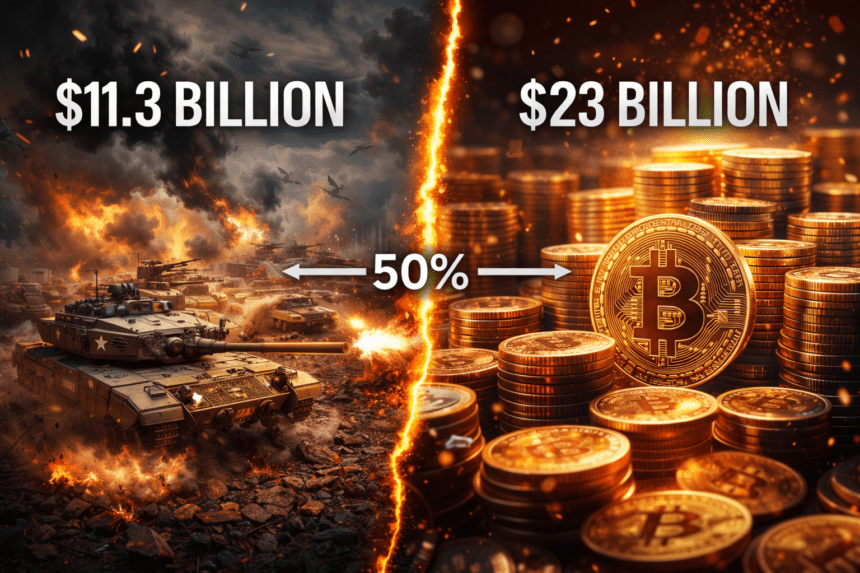
According to figures shared with lawmakers in a closed-door briefing, the United States spent at least $11.3 billion during the first six days of the war, a number that roughly equals half the market value of the Bitcoin held by the federal government.
The comparison has quickly caught attention across financial and crypto communities because it illustrates how massive military spending can dwarf even large digital asset reserves.
The Cost of the First Week
The $11.3 billion figure represents early operational spending and does not include the full cost of the conflict. Officials indicated that the amount could rise significantly as the situation develops and additional funding requests move through Congress.
At that pace, the conflict is burning through roughly $1.88 billion per day.
To put that into perspective, analysts compared the spending with the value of the U.S. Strategic Bitcoin Reserve, a digital asset pool created by executive order in 2025 to hold Bitcoin seized or owned by the federal government.
America’s Bitcoin Stockpile
The United States is currently the largest known state holder of Bitcoin, with roughly 328,372 BTC in government-controlled wallets.
At recent market prices around $70,000 per coin, that reserve is valued at approximately $23 billion.
When compared with the early war spending estimate, the math becomes striking: the first six days of the conflict equaled about 48–49% of the entire Bitcoin reserve’s value.
A Strategic Asset That Can’t Be Sold
Under the rules that created the U.S. Strategic Bitcoin Reserve, the government’s Bitcoin holdings are intended to function as a long-term reserve asset rather than something to be actively traded or sold.
The executive order establishing the reserve states that Bitcoin deposited into the reserve “shall not be sold” except under specific circumstances such as court orders or legal restitution requirements.
That means the Bitcoin reserve cannot simply be liquidated to cover government spending or wartime costs.
Instead, the digital assets are treated similarly to strategic reserves like gold an asset meant to strengthen national financial positioning rather than fund day-to-day government operations.
War, Markets, and Bitcoin
The Iran conflict has also rippled through global financial markets.
Geopolitical tensions have pushed oil prices higher, rattled stock markets, and injected volatility into cryptocurrency trading as investors react to uncertainty.
Bitcoin itself briefly dropped during the initial escalation of the conflict before rebounding as markets stabilized.
While the crypto market often reacts to geopolitical shocks, the comparison between war spending and Bitcoin reserves is mostly symbolic. It highlights the enormous scale of modern military operations more than it signals any direct change in digital asset policy.
The Bigger Picture
The numbers show two very different realities colliding.
On one side is the rise of Bitcoin as a strategic digital asset held by governments. On the other is the massive financial burden of global conflict.
Six days of war consuming the equivalent of half a national Bitcoin reserve demonstrates just how quickly billions disappear during major military operations.
For crypto watchers, the comparison underscores a simple point: even a multibillion-dollar Bitcoin reserve can look small next to the cost of war.