


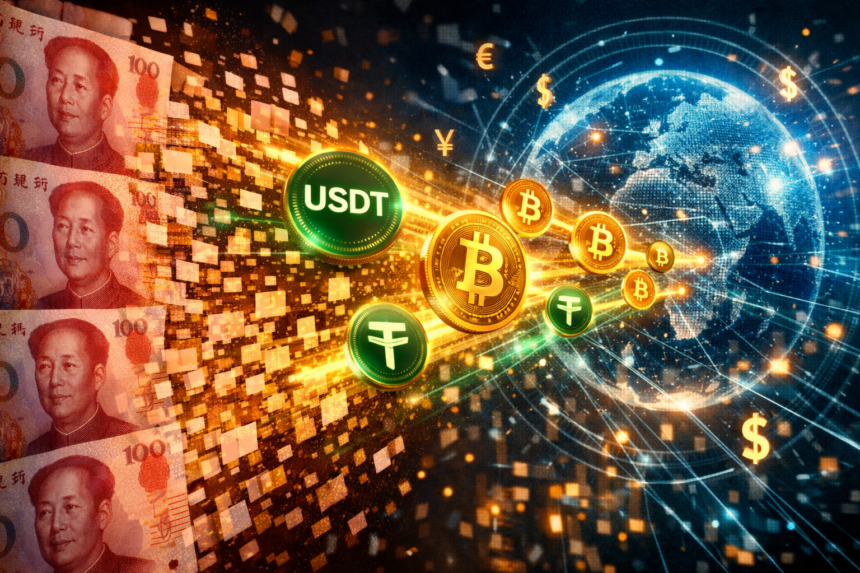
Why Renminbi’s Global Role Is Slipping and Crypto Alternatives Are Rising
In the ever-evolving world of global finance, one of the most dynamic stories unfolding today is how China’s strict currency controls are reshaping the behavior of traders, exporters and international markets. Policies designed to regulate capital flows and preserve monetary stability are having ripple effects and in some cases unintended consequences that are pushing businesses and investors toward digital alternatives like Tether’s USDT and Bitcoin. This shift reflects more than just a momentary market trend; it highlights deeper structural pressures on China’s currency, the renminbi, and the broader global foreign exchange and payment systems.
What the CryptoSlate Report Reveals
According to a recent analysis by CryptoSlate, tight controls on capital outflows part of Beijing’s efforts to manage the domestic economy are making conventional banking channels less attractive or feasible for certain types of cross-border transactions. As a result, a growing number of Chinese traders and exporters are turning to U.S. dollar-pegged stablecoins such as Tether’s USDT in order to settle international trades more efficiently. USDT functions as a kind of digital dollar, settled quickly on blockchain networks without the frictions caused by regulatory hoops in traditional finance.
The immediate impact of this shift is measurable: monthly USDT-based trade settlement volumes by Chinese clients have reportedly risen fivefold since 2021, according to young over-the-counter desks and traders. The reasons are both pragmatic and systemic: stablecoins offer 24/7 settlement and fewer intermediaries requiring permission, enabling fast movement of funds that may not be possible through regulated foreign exchange channels in China.
At the same time, the renminbi’s share in global payments ecosystems, such as SWIFT, has weakened dropping to about 2.9 percent in mid-2025. In stark contrast, the U.S. dollar still dominates nearly half of global payments. This imbalance underscores the difficulty China faces in expanding the global role of its currency despite being the world’s second-largest economy.
Renminbi’s Struggle in Global Reserves
A Long Standing Goal Meets Structural Constraints
China has long pursued the internationalization of the renminbi aiming to reduce reliance on the U.S. dollar and boost its global financial influence. This effort includes promoting yuan usage in trade invoicing, foreign exchange swaps, offshore lending and financial systems like the Cross-Border Interbank Payment System (CIPS).
Despite these efforts, the currency’s share of global foreign exchange reserves and payments usage remains modest. Data from the International Monetary Fund and payment networks show the renminbi’s proportion at historically low levels compared with major currencies. Nearly all central banks and reserve managers continue to hold far larger positions in dollars and euros than in yuan.
Why? A central challenge relates to China’s broad set of economic and political policies especially its capital controls. These restrictions limit the free movement of money in and out of the country and make holding renminbi denominated assets less appealing to foreign investors who would normally value liquidity and convertibility. This has a knock-on effect on reserve holdings, reducing the confidence other nations place in the yuan as a cornerstone of their official foreign exchange holdings.
Exporters Find Alternatives
For companies that engage in cross-border trade, sticking to the tightly regulated renminbi settlement infrastructure can be slow, costly or simply impractical. That is where stablecoins particularly USDT come into play. They are often used in global crypto markets as a proxy for the U.S. dollar, enabling seamless and rapid settlement across borders without direct interaction with regulated currency systems. This makes them particularly appealing for businesses facing bottlenecks and tight restrictions under China’s currency regime.
This practical shift is significant: it demonstrates that when traditional currency rails are constrained, users will seek alternative instruments that effectively carry similar economic value but with greater freedom and efficiency. In this case, USDT has become a digital proxy for dollar access in parts of China’s trade ecosystem.
Bitcoin’s Place in the New Financial Equation
Beyond Stablecoins: A Neutral Digital Asset
While stablecoins serve as a digital dollar substitute, Bitcoin occupies a different role in this emerging landscape. Unlike fiat-pegged tokens, Bitcoin is decentralized, permissionless and not controlled by any single government. For many international investors and traders, Bitcoin represents a store of value outside of the systemic risks of national currencies including capital controls, inflationary pressures or political interference.
In recent years, Bitcoin’s adoption has grown where traditional financial systems struggle to meet demand for global liquidity. Its borderless design makes it especially appealing in restrictive environments; it can flow across jurisdictions without the need for banking intermediaries or clearances that often delay or complicate fiat transactions. Though more volatile than stablecoins, Bitcoin’s decentralized nature and capped supply make it attractive for traders seeking refuge from monetary instability or market control.
Regulatory Pressure and the Crypto Ban
It’s worth noting that China has aggressively limited access to decentralized cryptocurrencies like Bitcoin for domestic users. Since 2021, all cryptocurrency trading and services were banned in mainland China, pushing much of this activity underground or offshore. Yet despite that prohibition, crypto trading persists through informal channels, VPN networks and offshore exchanges that cater to traders seeking exposure to digital assets. This underlines the depth of market demand and the challenges authorities face in suppressing decentralized systems that operate outside direct regulatory oversight.
From exporters settling cross-border trades with USDT to investors seeking decentralized value via Bitcoin, the broader theme is clear: restrictions in one part of the financial ecosystem tend to create opportunities and demand in another. As regulation clamps down in traditional finance, digital assets find space to grow as practical alternatives.
What This Means for Global Finance
A Shifting Balance of Currency Influence
China’s ambitions to make the renminbi a more influential global currency remain intact, but they are facing persistent headwinds. While government strategies promote usage in trade and encourage integration with national systems like the digital yuan and CIPS, the lack of full convertibility and stringent capital controls continue to limit global adoption.
At the same time, the growth of digital alternatives reveals market adaptability and innovation. Stablecoins like USDT and decentralized networks that support Bitcoin are stepping into gaps where traditional systems fall short. For international traders and exporters, these options are not just speculative tools but functional mechanisms to move value quickly and without permission.
This landscape also has implications for central banks and policymakers around the world. As digital currencies and tokens play an increasing role in international finance, governments will need to balance financial stability, regulatory control and openness to innovation a complex equation that will shape the next decade of monetary policy and global exchange.
Looking Ahead
The story of China’s currency controls and digital alternatives is part of a broader transformation in global finance. The tension between state-controlled monetary systems and decentralized digital networks highlights a fundamental question: Who controls money in a world where capital can move freely across digital rails?
While China continues its strategic push to elevate the renminbi ““the people’s currency.” in global markets, Bitcoin and stablecoins like USDT illustrate how digital assets provide compelling workarounds that reflect real economic needs. Whether these forces converge into a hybrid financial ecosystem or continue to evolve in parallel remains to be seen but one thing is clear: the boundaries between traditional fiat and digital currency are blurring, reshaping how value flows around the world.