


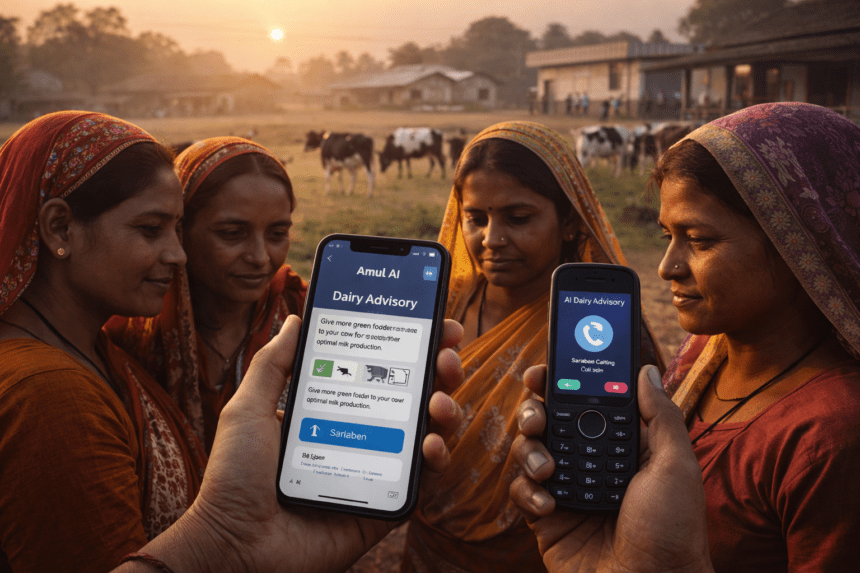
Bringing Artificial Intelligence to the Heart of Rural Agriculture
In early 2026, one of the world’s largest dairy cooperatives launched a groundbreaking technology initiative that could reshape rural livelihoods in India. Amul, the dairy brand behind India’s cooperative movement that helped turn the country into the world’s largest milk producer, has introduced Amul AI an artificial intelligence platform designed to support millions of dairy farmers with personalised guidance, data-driven insights and round the clock access to expert advice. The project was announced ahead of India’s AI Impact Summit 2026 and backed by the Ministry of Electronics and Information Technology (MeitY) and the EkStep Foundation as a test case for inclusive AI at scale.
This AI assistant, named Sarlaben, is not a simple chatbot or general agriculture app. It draws on decades of cooperative data and real-world dairy records including billions of milk procurement transactions and tens of millions of individual cattle health histories to deliver highly personalised, actionable recommendations to farmers in their own language.
A New Kind of Support for Dairy Farmers
Amul’s cooperative network spans more than 18,500 villages in Gujarat and represents over 3.6 million milk producers, most of them women responsible for daily milk production. The cooperative’s digital backbone already manages rich databases of milk collection, veterinary treatments, artificial inseminations, fodder production and animal milking patterns. Amul AI uses this structured, verified information as its foundation, allowing it to offer cattle-specific guidance on health, nutrition, breeding, feeding, disease management and husbandry practices.
One of the platform’s most important features is accessibility. Farmers who use Android or iOS can access Amul AI through the existing Amul Farmer mobile app, which has already been downloaded by more than one million users. But recognising that many rural producers do not own smartphones, the platform is also available via voice calls on feature phones or landlines, enabling farmers without advanced technology to obtain real-time guidance in Gujarati and potentially other local languages through the government’s multilingual digital framework.
According to Jayen Mehta, Managing Director of the Gujarat Cooperative Milk Marketing Federation (GCMMF) the organisation that markets Amul products the goal is to bring dependable, verified information directly to farmers instantly and in languages they understand, helping them make better management decisions and improve animal productivity and income.
Why AI Matters in India’s Dairy Sector
India leads the world in milk production. In the 2024-25 period, the country produced 347.87 million tonnes of milk, more than double the United States production, yet yields per animal are comparatively low. This productivity paradox reflects structural challenges: small herd sizes, limited access to veterinary care, poor-quality feed, and gaps in awareness about modern dairy practices.
In this context, information asymmetry especially in remote villages has long been a bottleneck. A farmer confronting a sick animal at midnight often has few resources to consult. Amul AI aims to close that gap by giving farmers access to instant, data-informed decisions that would otherwise require veterinary visits or in-person consultations.
The platform’s deep data roots make it uniquely suited to this task. Unlike many agricultural AI tools that train on limited or generic datasets, Amul AI uses real cooperative operational data including nearly 30 crore (300 million) individual cattle records, health histories and treatment information enabling it to give personalised, context-aware guidance.
Building on Cooperative Legacy
Amul’s cooperative model a pillar of India’s rural economy since the original White Revolution plays a critical role in the success of this initiative. The cooperative’s decades of systematic data collection, digitised milk collection systems and extensive farmer networks provided the foundation for training an AI system at scale. Most startups aim to collect data first and build products second; Amul reversed that logic by starting with structured, long-term data and using AI to make it actionable for farmers in real time.
Researchers and industry experts see this as a significant leap forward. Sreeshankar Nair, founder of a dairy-tech startup, points to three core challenges Amul AI could meaningfully address: increasing farmer awareness, expanding access to quality veterinary guidance, and linking farmers to grazing and feed resources more effectively.
Saswata Narayan Biswas, Director of the Institute of Rural Management, Anand (IRMA) an institution closely tied to Amul’s cooperative ethos describes the technology not as a mere upgrade, but as an instrument of inclusive rural transformation. For Biswas, the platform’s predictive disease detection, heat cycle tracking, optimised feed guidance and weather-based risk advisories are extensions of capabilities Amul has been building for years, unlocked now by AI.
Challenges and the Road Ahead
Despite the promise, the real measure of success for Amul AI will be whether it can reach the farmers who need it most. Early adoption is strong among smartphone users already integrated into Amul’s digital ecosystem, but the biggest information gaps often exist among farmers with limited digital access or literacy. Expanding voice call support in local dialects beyond Gujarati and ensuring that AI-driven guidance translates into measurable improvements in animal productivity and yield are key challenges ahead.
The platform’s rollout is also being watched as a test case for broader AI deployment in rural development. If AI can effectively serve millions of smallholder farmers across many languages and regions, India may be positioned to lead not only in dairy production but in inclusive AI adoption that empowers the most underserved communities.
Amul has built an AI system grounded in real cooperative data, real animals, and real farmers arguably one of the most credible bases for AI dairy farming at scale. Whether this infrastructure can truly improve livelihoods and spark a second wave of cooperative-driven growth will depend on execution and the ability to bridge the last miles of rural technology access.