


A narrative of rising safe haven demand and market turbulence
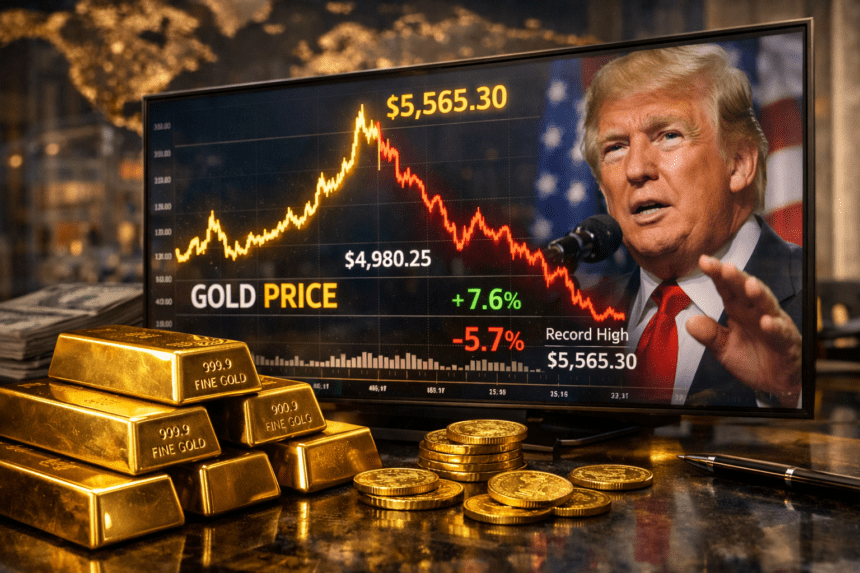
Gold has once again captured global financial headlines as its price vaulted to historic highs before experiencing sharp corrections within the same week. Over recent trading sessions gold’s spot price reached record levels above $5,500 and even pushed toward nearly $5,600 per troy ounce. This meteoric rise reflects a potent mix of safe-haven demand, geopolitical uncertainty and shifts in investor confidence, particularly linked to policy decisions and rhetoric from United States political leadership.
Investors have watched this safe haven metal for good reason. In times of market stress when confidence in equities dips or the value of major currencies like the US dollar fluctuates, gold often becomes the preferred store of value. The last week of trading in January 2026 offered a vivid example of this dynamic at work. Prices spiked as traders moved capital into gold and other precious metals, only to experience a rapid pullback as profit-taking and strengthening US currency forces emerged.
The Gold Rally That Shook Markets
Last week started with a strong uptrend in gold pricing. Data from markets shows gold crossing above major psychological barriers that had previously been considered unlikely so early in the year including passing the $5,000 mark and rapidly approaching higher territory near $5,600 per ounce. Analysts and global news wires widely noted that gold’s pace of rise far exceeded typical expectations for 2026.
This rally was partly driven by weakened confidence in the US dollar, itself influenced by political and economic signals emerging from the United States. According to reporting from the ABC and other outlets, remarks made by President Donald Trump at international forums and broader discussions regarding US policy contributed to a sense of uncertainty and reduced trust in the dollar’s stability. This weakened dollar scenario often makes gold, priced in dollars, more attractive to global buyers, lifting prices further.
At its peak mid week, gold was trading in the vicinity of all-time highs and strength in the market was not limited to gold alone. Silver and other precious metals also surged dramatically, reflecting a broad movement toward perceived safe assets.
What Caused Price Lows and Corrective Moves
Despite the strong rally early in the week, gold did not maintain its upward path indefinitely. As trading progressed, prices encountered resistance and profit-taking emerged as a predominant factor. Traders who had booked gains off the earlier rally began selling positions, exerting downward pressure on price levels. By Friday trading sessions, gold dipped below the $5,000 mark at times, registering significant declines from earlier highs.
This corrective move was also accompanied by a strengthening US dollar linked to expectations of tighter monetary policy under a potentially new Federal Reserve chair. Market commentary highlighted how the prospect of a Fed leadership change boosted dollar sentiment, which in turn made dollar priced commodities like gold less attractive relative to other assets.
The impact was visible beyond just gold as silver and other metals suffered steeper percentage drops due to the reversal. Some analysts called this a classic pullback following an overbought rally, suggesting that while gold prices still remain historically elevated, short-term volatility is likely to continue.
Political Rhetoric and Investor Sentiment
Much of the narrative around gold’s price movement recently ties back to investor reaction to political developments, especially in the United States. Reporting from ABC News described how certain remarks and policy shifts associated with President Trump triggered fears among investors about geopolitical risk and US economic stability, prompting a flight to gold. Concerns ranged from trade tensions to comments on alliances and even strategic geopolitical positions that could unsettle currency and bond markets.
This has created a kind of “gold rush” psychology among retail and institutional investors alike. When confidence wanes in traditional financial anchors like government bonds or major currencies due to political uncertainty, assets like gold often benefit. At the same time, such movements can be short lived if economic data or monetary policy expectations shift favorably for risk assets.
Contextual Forces Behind Price Moves
It is crucial to understand that gold does not move in isolation. Broader macroeconomic indicators such as inflation expectations, currency strength, interest rates and global geopolitical tensions play fundamental roles in shaping precious metal markets. During the last week’s trading activity, currency moves particularly the US dollar exerted notable influence alongside investor sentiment shifts linked to policy announcements.
Aggregate market data also indicated that despite the sharp corrections, gold was still on track to post one of its strongest monthly performances in decades. Record demand for gold exchange traded funds and physical holdings underscored that many investors still regard gold as a strategic hedge against ongoing instability.
What Comes Next for Gold Markets
The big question for many now is what trend gold will follow in coming weeks and months. Analysts and forecasters are divided. Some see continued upward pressure as geopolitical uncertainty persists and central banks maintain accommodative stances. Others warn that sharp corrections could endure if monetary policy shifts toward higher interest rates or if the US dollar strengthens further.
Investor behaviour in volatile markets often oscillates between risk appetite and risk aversion, and precious metals typically thrive when fear outweighs optimism. Whether the recent moves reflect longer-term trends or short-term positioning will depend on global economic signals, inflation data and the evolving political climate in major economies like the United States.
Summary, the latest gold price dynamics reflect a complex interplay of safe haven demand, political perceptions and traditional market forces. From all time highs to profit taking induced dips, gold’s journey in the past week underscores why it remains one of the most closely watched commodities by investors worldwide