
Sometimes a bad joke is just a bad joke
There are politicians who know how to use the internet.
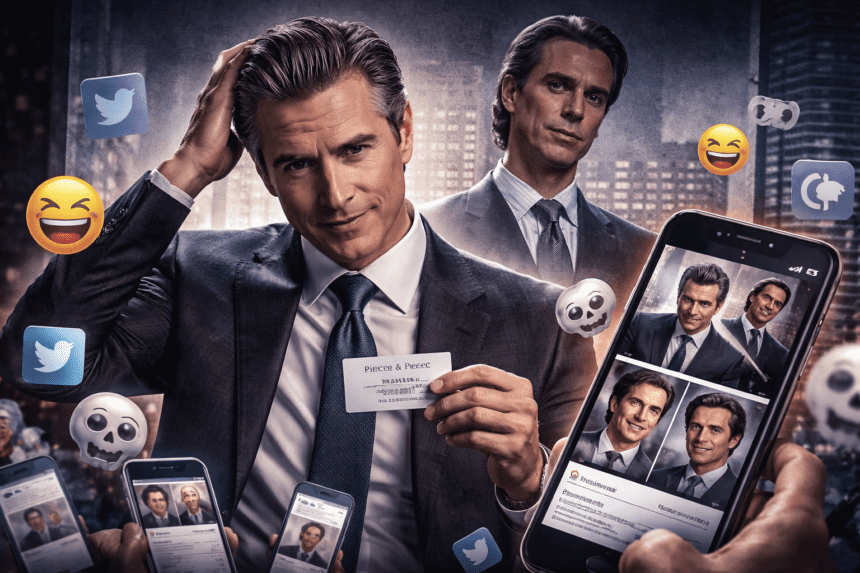
And then there are politicians who think being online is the same thing as being self-aware, Gavin Newsom’s latest post landed squarely in the second category. In a message that quickly got mocked across social media, he leaned into the long-running comparison between himself and Patrick Bateman, the narcissistic serial killer from American Psycho. The post followed a similar joke from Donald Trump, who had used the same “people say we look alike” format while comparing himself to Elvis Presley after a March 23 visit to Graceland.
That is the factual setup.
The opinion part is even simpler: this was a terrible instinct, because the problem was never just that the joke flopped. The problem was that it exposed a deeper kind of political vanity. Bateman is not just some random pop-culture figure with a slick haircut. He is one of the most obvious symbols in modern culture of narcissism, status obsession, emptiness and psychopathy. When a sitting governor sees that comparison and decides the right move is to treat it like a flattering looks conversation, something has gone badly wrong. That is what made the backlash so brutal. Blaze’s write-up quoted multiple reactions calling the post narcissistic, insane or wildly self-unaware. and the ridicule was not fringe level noise.
The post reportedly drew more than 4.5 million views as critics piled on, with responses mocking the fact that Newsom seemed to miss the point of the meme entirely. The criticism was not complicated. People were not saying he looked bad in the photo. They were saying he had chosen to embrace one of the worst fictional archetypes imaginable without realising what that said about him.
That is why this story matters more than it should.
On paper, this is just one social-media self-own. In practice, it taps into a much broader problem for Newsom: the sense that he increasingly performs politics like branding rather than conviction. The internet can forgive a lot. It can forgive cringe. It can forgive overreach. What it does not forgive is a politician who looks like he is trying to manufacture cool while radiating elite detachment, and that is exactly what this looked like.
The comparison also worked against him because Patrick Bateman is not merely sinister. He is a parody of polished image politics, shallow status signaling and empty self regard. In other words, he is already the kind of figure critics use when they want to accuse a politician of being all surface and no soul. Leaning into that comparison did not neutralise it. It strengthened it.
That is the opinion case.
The fact case is that Newsom walked straight into a trap set by his own online instincts. The original format came from Trump’s Elvis post, which followed his Graceland visit and fit neatly into his long-running celebrity-style persona politics. Newsom tried to mirror the structure, but he picked the wrong cultural reference and then seemed not to understand why people found it bizarre. That gap between intention and reaction is what turned a cheap jab into a self-inflicted hit, and that gap is politically revealing.
Because voters can smell when a politician is too wrapped up in his own image. They can definitely smell when he is trying to be funny and accidentally says something truer than intended. The Bateman comparison has lingered around Newsom for years because it fits a public impression that he is hyper-managed, over-styled and more comfortable inside an aesthetic than an argument. This post did not create that problem. It reminded people of it.
That is why the joke failed.
Not because the internet is too harsh. Not because opponents were mean. But because the joke accidentally confirmed the criticism it was supposed to deflect, and once that happens, it is not really a joke anymore.
It is branding damage.