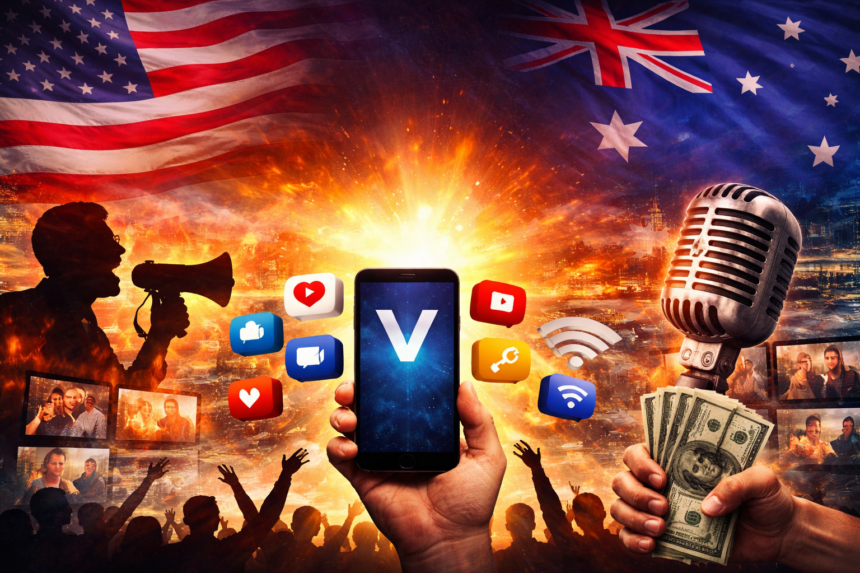
Lawful speech is not violence just because someone dislikes it
Free speech only matters when it protects speech that other people do not like.
That is the part too many people now want to skip. Everyone says they support free expression in the abstract, right up until they hear something that irritates them, challenges them, mocks them, or cuts across their worldview. Then the language changes. Suddenly it is no longer about argument, persuasion, and open exchange. It becomes about “harm,” “safety,” “deplatforming,” “community standards,” “misinformation,” or “responsible discourse.” Sometimes those concerns are legitimate. Sometimes they are just a softer and more fashionable way of saying: I do not want this person to be allowed to speak here anymore. That is not a stable foundation for a free society. It is a pathway toward a culture where emotional discomfort becomes the excuse for suppressing lawful speech. The danger is not only legal. It is cultural, economic, and technological.
The problem gets worse when social media becomes the main public arena for news, culture, politics, comedy, commentary, and personal branding. In that environment, control over speech is no longer just about what governments ban. It is also about what platforms hide, downrank, demonetize, shadow-limit, label, suppress, or quietly starve of reach. That matters because in 2026, visibility is power. Reach is power. Distribution is power. If the modern public square runs through feeds, search, clips, trending pages, live streams, and algorithmic recommendation systems, then the people who control those systems exert enormous influence over what gets seen, what gets buried, and which voices get momentum. The question is no longer just “Can you speak?” It is increasingly “Can you be found, followed, supported, and sustained?”
That is why the debate around free speech must evolve beyond slogans. The real issue is not whether every private company must become a speech absolutist host for everything. The real issue is whether the internet remains open enough, competitive enough, and decentralized enough for people to leave restrictive environments and build elsewhere. If legacy platforms become more controlling, more homogenized, more nervous about risk, and more hostile to controversial but lawful speech, then the answer is not to beg those same gatekeepers forever. The answer is to widen the ecosystem. More platforms. More moderation models. More niche communities. More creator-owned lanes. More places where different norms can compete instead of being imposed from the top down by a handful of giant, culturally dominant systems.
That is where the case for platforms like V.social becomes interesting.
Lawful Speech Is Not The Same Thing As Approved Speech
A healthy free-speech culture begins with one simple idea: not everything offensive is unlawful, and not everything unpopular is dangerous. Australia’s own parliamentary and Attorney-General guidance makes clear that freedom of expression protects opinion and expression broadly, including unpopular ideas that may offend or shock, even though restrictions can still apply in limited contexts. Australia also does not have a broad federal statutory free-speech guarantee in the American sense; instead, what exists at the constitutional level is largely the implied freedom of political communication, which acts mainly as a limit on government power, not as a guarantee that private companies must host any person or message.
That distinction matters because too many modern debates collapse everything into a single emotional frame. Someone feels offended. Someone complains. Someone says they feel unsafe. A pile-on begins. And before long, the assumption becomes that the speech itself must have crossed some objective moral line. But offense is not an objective legal category by itself. A crude joke can offend. A religious critique can offend. A political rant can offend. A libertarian take on censorship can offend. A satirical meme can offend. None of that automatically means a law was broken, a threat was made, or a genuine rights violation occurred. If “I feel offended” becomes enough to justify removal as a social default, then free speech survives only for the already-approved opinions of the moment.
The European human rights tradition has long repeated a principle worth remembering: speech protection extends not only to ideas that are favorably received, but also to those that offend, shock, or disturb. That standard exists for a reason. A free society is not designed to eliminate all friction from public discourse. It is designed to protect a space where disagreement, satire, ridicule, dissent, experimentation, provocation, and rough-edged opinion can still exist without being instantly reframed as illegitimate. A society that cannot tolerate offense cannot sustain true pluralism for long.
Of course, none of this means all speech should be protected in all contexts. Genuine threats, direct incitement, unlawful harassment, and clearly prohibited categories of speech can still be restricted. But the line must stay clear, legal, and narrow. Once the line becomes emotional, vague, and permanently movable, rights become unstable. The boundary between “this is illegal” and “this made me uncomfortable” is one of the most important boundaries in any open society. Lose that, and everything becomes negotiable by outrage.
There Is No Right To Force Other People To Listen
Here is the hard truth that many free speech debates avoid: there is a difference between the right to speak and the right to force other people to distribute your speech. That distinction is central in both Australia and the United States, even though the legal frameworks differ. In Australia, the implied freedom of political communication constrains government action, but it does not mean every private platform becomes a compelled host. In the United States, the First Amendment strongly constrains government censorship, but the Supreme Court’s Moody v. NetChoice ruling reinforced that platform moderation and curation can involve constitutionally protected editorial judgment, and that the legal analysis is more complex than simply calling large platforms public squares.
Libertarians should be honest about this. Free speech does not mean you get to commandeer someone else’s newspaper, website, server bill, moderation team, or recommendation engine. A private platform can still make choices. It can set rules. It can prioritize some content over other content. It can take a line that you dislike. But that truth cuts both ways. If a platform is free to moderate, users and creators are equally free to leave, compete, fork culture elsewhere, and build alternatives with different values. In market terms, the answer to over-centralized control is not always more centralized intervention. Sometimes the better answer is more competition, more exit options, more entrepreneurial building, and more voluntary communities.
That is why alternative platforms matter so much right now. Their value is not only ideological. It is structural. They reduce dependence on a shrinking number of cultural chokepoints. They create pressure on incumbents. They give creators bargaining power. They let audiences self-sort into communities aligned with their interests and tolerance levels. And perhaps most importantly, they remind the internet that no single moderation model should dominate all speech by default.
The Hidden Cost Of Platform Dependence
For creators, writers, meme accounts, commentators, educators, satirists, streamers, and niche community builders, platform dependence is one of the biggest unspoken risks on the internet.
The first risk is algorithmic dependency. When a creator builds on a giant legacy platform, reach is often rented, not owned. One update to ranking logic, one moderation flag, one invisible change in recommendation behavior, and years of momentum can be throttled overnight. The creator did not lose their talent, voice, or audience appeal. They lost the platform’s willingness to carry them at the same level. That is a fragile way to build a business or a brand. It turns digital livelihoods into a game of permanent appeasement, where creators are always trying to stay in favor with systems they do not control and barely understand.
The second risk is cultural narrowing. Large platforms become increasingly cautious as they scale. They face advertiser pressure, regulatory pressure, media pressure, activist pressure, and reputational pressure. The predictable result is broader moderation, safer defaults, more corporate language, and less tolerance for edgy, political, controversial, taboo, or simply unconventional content. Even when content remains technically “allowed,” creators can still feel pressure to soften their tone, avoid hot-button subjects, self-censor humor, or flatten their identity into something safer and more monetizable. That is not always formal censorship. But it can still produce silence through incentives.
The third risk is economic captivity. If your audience only exists inside someone else’s ecosystem, then your business model depends on rules that can change at any time. The monetization terms can shift. The rev-share can shift. Discoverability can shift. Link policies can shift. Even your relationship with your own followers can be mediated by the platform’s interface design and feed logic. In a creator economy, that is the equivalent of building a shop in a mall where the landlord can randomly move your store to the basement, slash foot traffic, and still tell you that technically you have not been evicted.
This is why the next phase of the creator economy is not just about more content. It is about more control.
Why Creator Economies Matter More Than Ever
The creator economy is often talked about in shallow terms, usually reduced to influencer culture, sponsorships, or viral clips. But the deeper meaning is much bigger. A creator economy is what happens when individuals can turn voice, taste, knowledge, identity, humor, analysis, niche expertise, or community leadership into an economic engine. It is not limited to celebrities. It includes meme pages, bloggers, livestreamers, news curators, local voices, independent educators, political commentators, hobby experts, and ordinary people with a point of view plus a consistent habit of publishing.
That matters because the internet has shifted from a broadcast model to a participation model. Ordinary people are no longer only consumers of media. They can also be publishers, curators, hosts, teachers, entertainers, organizers, and micro-brands. The barrier between audience and media producer has collapsed. But monetization and sustainability still depend heavily on whether creators can gather attention, build loyalty, retain access to followers, and eventually turn that audience relationship into something durable.
A strong creator economy gives people more than income. It gives them agency. It lets them build a personal economy around their voice. That might mean earning from subscriptions, live events, sponsorships, memberships, affiliate relationships, fan communities, direct tips, product drops, brand partnerships, consulting, newsletters, or premium content. The formats can vary. The principle is the same: instead of being trapped inside traditional gatekeeping systems, creators can build their own micro-enterprises around trust, personality, consistency, and niche relevance.
And that is exactly why speech freedom and creator opportunity are linked. If people do not have places where they can speak more freely, test ideas, build a following, and cultivate a recognisable brand, then the creator economy narrows into a bland performance layer shaped mostly by what the safest mainstream systems will tolerate. The result is not merely less edgy content. It is less originality, less experimentation, less dissent, less authenticity, and fewer pathways for independent voices to become economically viable. A creator economy without expressive freedom becomes a managed content economy. That is a very different thing.
Why V.social Matters In This Conversation
Based on its current public facing structure, V.social is positioning itself as more than a single purpose feed. Its live pages show a platform organized around Home, Clips, Videos, Live, and News, with prompts encouraging users to sign in to interact with content, follow creators, and build a personal library. It also features “People to Follow,” category like navigation, a following/community/news structure, and visible creator handles ranging from news style accounts to meme accounts to individual personalities. That suggests a broader ecosystem model rather than a narrow one format app.
That matters because creators do not all grow the same way. Some people build through short clips. Some through long-form video. Some through written commentary. Some through news aggregation. Some through humor and memes. Some through livestreaming. Some through niche topical communities. A platform that combines multiple content modes gives creators more ways to meet audiences where they are. It also gives them room to grow. A short meme account can become a commentary page. A commentary page can evolve into a live host. A news-curation account can spin up a loyal community. A local voice can become a vertical brand. Multi-format platforms create stackable opportunity.
That is one of the biggest underappreciated strengths of emerging creator ecosystems. They can be places where identity compounds. On older platforms, creators often fragment themselves across too many disconnected systems. One platform for clips. Another for long form. Another for live. Another for commentary. Another for community. Another for direct monetization. That can work, but it also creates friction. Every extra step increases audience drop-off and platform dependency. A platform that blends discovery, following, publishing, media, and community signals into one growing environment can give smaller creators a better shot at building momentum earlier.
V.social + creator profiles, news items, topical posts, and posts with linked “View Post” pages, which matters for discoverability and depth. That kind of structure can support the crossover between fast-consumption content and deeper content. In other words, a creator is not trapped in one mode. They can attract attention with short material, then convert attention into longer posts, recurring followers, and more stable audience relationships. That is where personal media brands start to form.
And that, more than anything, is the real opportunity.
V.social And The Opportunity To Build A Personal Economy
Most creators do not need a billion views. They need the right thousand, the right ten thousand, or the right hundred thousand. They need people who come back. People who recognize the handle. People who click again. People who trust the taste, humor, analysis, energy, or voice behind the account. From there, a personal economy can begin to emerge.
A creator on V.social can potentially build across several layers at once
Attention. Through posts, clips, videos, live content, and news-adjacent publishing, creators can start getting discovered by people who share their interests.
Identity. A recurring handle, recognizable content style, and specific point of view can turn random reach into brand memory. This is how a person stops being “some account I saw once” and becomes “one of the accounts I follow.”
Community. As followers cluster around shared interests, creators gain more than impressions. They gain a repeat audience. Repeat audience is the seed of durable value online.
Leverage. Once attention and community exist, opportunities multiply: traffic to a blog, promotion of a newsletter, cross-posting to owned channels, affiliate offers, premium communities, tips, sponsorships, or external products and services. The platform becomes not just a place to post, but a launchpad into a broader personal economy.
This is especially important for independent voices who do not fit neat mainstream templates. Maybe they are politically heterodox. Maybe they are funny in a way advertisers sometimes dislike. Maybe they cover a niche ignored by large outlets. Maybe they blend news, satire, commentary, and community in a way that bigger platforms find messy. Emerging platforms can give these creators their first real shot at traction without requiring them to flatten their personality into something more sanitized.
That is why alternative platforms matter for speech even when they are not legally required to host everything. Their real power lies in choice. They expand the number of places where creators can build. They let audiences vote with attention. They reduce the risk that a small number of incumbents become the permanent gatekeepers of economic opportunity online.
Free Speech Is Also An Innovation Issue
People often treat free speech as only a political rights issue. It is that. But it is also an innovation issue.
New cultural forms usually begin at the edges. They begin with weirdos, outsiders, meme lords, obsessives, local voices, contrarians, and people whose instincts do not fit the polished centre. They begin with experiments that look unserious before they become influential. They begin with niche humor before it becomes mainstream language. They begin with unfashionable ideas before institutions are forced to reckon with them. If the online world becomes too sanitized, too managed, too reputationally terrified, then culture itself becomes less dynamic. Safe systems produce safe outputs. Sterile feeds produce sterile creativity.
A broad, resilient speech culture creates the conditions for innovation because it allows more trial and error in public. More jokes that miss. More ideas that fail. More takes that get argued over. More communities that self-form without elite approval. A culture that treats every rough edge as grounds for suppression eventually strips out the energy that makes the internet interesting in the first place.
Platforms like V.social matter in that context because they can become spaces where creators and communities experiment in public again. Not lawlessly. Not without rules. But with a higher tolerance for lawful speech, stronger room for niche identity, and better upside for creators who want to build rather than simply perform for an existing algorithm.
The Better Response To Bad Speech
There is another principle worth defending: the answer to speech you dislike is usually not deletion. It is choice.
Mute it. Block it. Argue with it. Mock it. Quote-post it. Ignore it. Walk away from it. Build a better case. Build a better account. Build a better publication. Build a better community. But trying to train society into treating lawful offense as a removable condition is not maturity. It is fragility disguised as morality.
A mature free society depends on adults understanding that they will encounter opinions they hate, jokes they find crude, arguments they think are stupid, beliefs they consider offensive, and personalities they do not want to support. The solution is not to purge conflict from public life. The solution is to preserve the conditions where disagreement can exist without every clash immediately escalating into a removal campaign. That principle becomes even more important in creator economies, because the freedom to publish and build must include freedom to be distinct, sharp-edged, and not universally liked.
The Future Belongs To Wider Ecosystems
The future should not belong to a tiny group of giant platforms deciding what the world is allowed to see, joke about, argue over, or build around. The future should belong to a broader ecosystem of competing spaces, different moderation philosophies, independent publishers, direct creator-audience relationships, and voluntary communities that choose their own culture instead of having one imposed from above.
That is the deeper opportunity around V.social and similar platforms. It is not only about “free speech” in a narrow culture-war sense. It is about digital plurality. It is about audience ownership. It is about making the internet feel open again. It is about giving creators more than a chance to post. It is about giving them a chance to grow a fan base, build a personal brand, develop a community, and turn that into a real personal economy.
For independent creators, that can mean the difference between always renting visibility and finally building something closer to digital property. Not literal ownership in every technical sense, but functional ownership: recognizable identity, portable audience attention, durable community, and enough momentum to expand beyond a single platform if needed. That is what freedom looks like in the creator era. Not just the ability to speak, but the ability to build from speaking.
And that is why this conversation matters so much.
Free speech is not the right to control other people’s ears.
It is not the right to force a private company to love your content.
It is not the right to never be criticized, blocked, mocked, or ignored.
But it is the principle that lawful speech should not be treated as violence just because someone dislikes it.
It is the principle that open societies need resilience, not permanent panic.
It is the principle that the best answer to over-centralized speech control is more competition, more platforms, and more room for creators and communities to build elsewhere.
That is why V.social matters.
That is why creator economies matter.
And that is why the next internet should be built around more voice, more choice, more community, and more opportunity for people who are ready to publish, grow, and own their lane.
Not a world where everyone agrees.
Not a world where nobody gets offended.
But a world where more people still get to speak, build, and thrive.
That is a future worth fighting for.
My Opinion, My Voice