


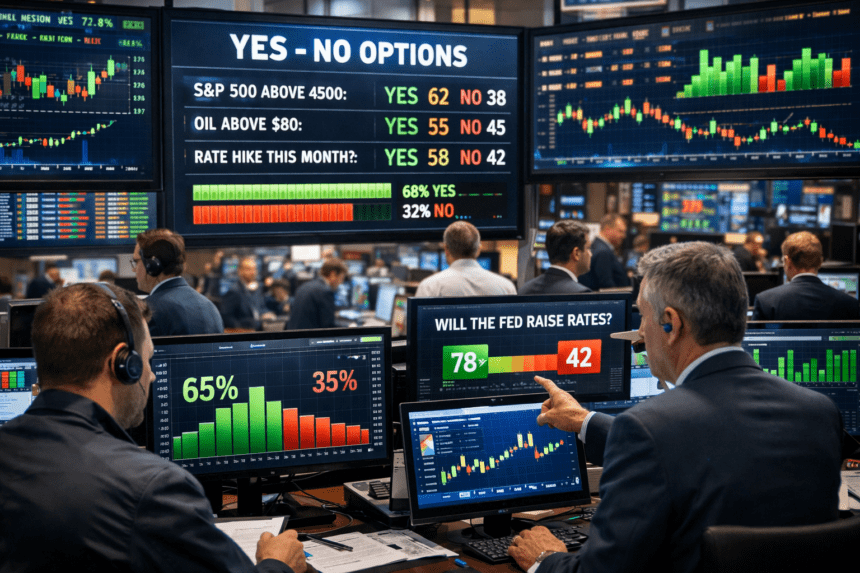
How the Chicago Board Options Exchange aims to mainstream yes no trading and challenge crypto prediction markets
The Chicago Board Options Exchange, commonly known as Cboe, is quietly pushing to bring back a type of contract that many retail traders know as yes no options or binary options. These are simple tradable instruments that pay a fixed amount if a specific event happens and pay nothing if it doesn’t. Fundamental to prediction markets, odds-style trading like this has become familiar through platforms such as Polymarket and Kalshi, which let people express viewpoints on event outcomes in a format that reads like easily digestible odds. Cboe’s proposal to the Securities and Exchange Commission is aimed at mainstreaming this style of financial instrument inside regulated exchange infrastructure. If approved, this move could blur the line between derivatives and probability markets, offering everyday traders a product that feels like betting but is backed by established financial market rules.
What Are Yes No Options and Why They Matter
At their core, yes no or binary options answer a straightforward question: will something happen or not? If the condition is satisfied at contract expiry, the trader receives a set payout; if it isn’t, the payout is zero. This all or nothing structure is why traders often think of prices as probability proxies, like “yes 62” or “no 38,” making them accessible even to people without deep financial training. This simplicity is powerful. It removes the need for complex metrics like the Greeks that govern traditional options and instead lets traders focus on whether they believe a specific event will occur.
In traditional options markets, traders make bets on price movements with payoffs that vary depending on how far the underlying asset moves relative to a strike price. But yes no options eliminate that complexity entirely by offering fixed returns. You know ahead of time what you could lose and gain. This clean logic made binary options popular in some corners of the financial world in the late 2000s, though the uptake was limited in formal regulated markets at the time. Cboe itself offered such products in 2008 before stepping back due to lackluster demand.
Across the financial landscape, simple probability markets responded to the human instinct to quantify uncertainty. Crypto-native platforms showcased how belief could be turned into a number and traded. Now, Cboe wants to harness that instinct inside a regulated context, offering an alternative that sits alongside stocks, standard options, and other derivatives.
The Regulated Exchange vs Prediction Markets
One of the significant differences between what Cboe is proposing and existing open prediction markets is the infrastructure and regulatory framework. Prediction markets, especially those on crypto platforms, can list a wide range of event contracts beyond financial thresholds, including political outcomes, cultural events, or other social questions. They operate under a variety of regulatory environments, which sometimes include decentralized protocols, smart contracts, and oracles that autonomously determine outcomes.
In contrast, Cboe’s model would integrate directly with regulated brokerage systems, standard clearinghouses, strict margin rules, and robust oversight mechanisms. That means every trade and contract would be subject to rules designed to protect market participants and promote transparency. While this added structure comes with constraints, it also lends credibility and stability that unregulated venues lack. This could broaden access to probability trading for investors who are wary of offshore or loosely regulated platforms.
However, the regulated exchange environment also sets strict boundaries on what kinds of contracts can be listed. Anything that resembles traditional gambling too closely or becomes socially controversial may trigger regulatory resistance. Cboe intends to focus its yes no options on financial market outcomes rather than socially or politically themed questions, making them more palatable to regulators.
Why Cboe Is Betting on Simplicity
Retail demand often clusters around products that feel intuitive and bounded. Fixed payout options give traders a clear understanding of risk and reward, making them attractive to those venturing into trading for the first time. Prediction markets helped normalize the idea that uncertainty can be priced and traded like any other asset. The concept of moving a slider from “yes” to “no” based on belief is easy to grasp and has contributed to the tools’ popularity.
Cboe sees an opportunity to bring that ease of use to regulated markets. The exchange already operates one of the largest options markets in the United States and houses products linked to benchmarks like the S&P 500 and the VIX volatility index. Listing yes no options within this ecosystem could give traders a new way to express views on market direction or volatility without needing to understand complex pricing models.
Yet, bringing back binary style products also means confronting a legacy. In the retail world, binary options became notorious in the 2010s due to fraud and misleading marketing by offshore brokers who exploited the simplicity of these instruments. Investors often found themselves trading against platforms that manipulated outcomes, resulting in substantial losses and regulatory crackdowns. That history raises the bar for any renewed offering in the U.S. markets, and Cboe must persuade regulators and traders alike that its version is different in substance, not just in name.
How These Products Could Fit in Financial Portfolios
If Cboe succeeds in getting approval to list yes no options, the products could find a niche with a new class of retail traders. Traditional derivatives markets offer leverage and exposure to price movements, but they can be intimidating for beginners. Fixed payout options present a lower cognitive barrier, which could encourage more participation by individuals who appreciate clarity and certainty. That said, the simplicity also means traders must be cautious. Like any financial instrument, yes no options carry risks, and traders could lose their entire investment if the condition is not met.
Institutional investors might view these products differently. Some may use them for hedging specific risks or expressing targeted views on volatility or market direction. The fixed payoff structure could, in theory, serve as a tool for managing exposures in broader portfolios, particularly when used alongside other derivative instruments. Whether these products find traction beyond retail speculation remains to be seen.
Challenges and Regulatory Hurdles
Cboe’s path to approval is not guaranteed. Regulators are sensitive to anything that could resemble gambling or entice excessive speculation. The Securities and Exchange Commission, which oversees U.S. securities and derivatives markets, typically demands clear rules around settlement, custody, and pricing. Contracts that are ambiguous or open to interpretation could face objections. The experience of prediction market platforms in legal battles over contract listings underscores how sensitive this territory can be.
Furthermore, the need for robust surveillance systems that can police market manipulation and irregular activity is critical. Regulators will require strong safeguards to protect investors and ensure fair play. In a worst case scenario, regulators could reject new products if they feel the risks outweigh the benefits.
The Potential Impact on Trading Culture
If yes no options become mainstream through a regulated exchange like Cboe, they could reshape the way many people approach market speculation. Traders might start to think less about price levels and complex strategies and more about probabilities and event outcomes. The psychological appeal of seeing a single number that reflects market belief could make these offerings popular, at least for specific use cases.
This shift could also force brokers and trading platforms to innovate user interfaces and education strategies to support novice traders. Tools that explain probabilities and risk in intuitive ways may become more important, especially if the audience includes people with little prior experience in traditional finance.
Thoughts
Cboe’s bid to bring back yes no or binary options reflects a broader trend in financial markets toward democratizing access to trading and embracing simplicity. By packaging probability style contracts within regulated infrastructure, the exchange hopes to appeal to retail traders familiar with crypto prediction markets while maintaining the oversight and stability that traditional markets demand.
Whether this effort will succeed depends on regulatory approval, market demand, and the ability of Cboe and its partners to convince traders that these products belong in a serious financial marketplace. If they do, we could see a fundamental shift in how retail investors engage with markets, blending intuitive probability trading with conventional financial instruments