


The government says it is protecting children.
Britain is no longer just talking about tightening online rules for teenagers.
It is now actively testing what digital restriction looks like inside the home.
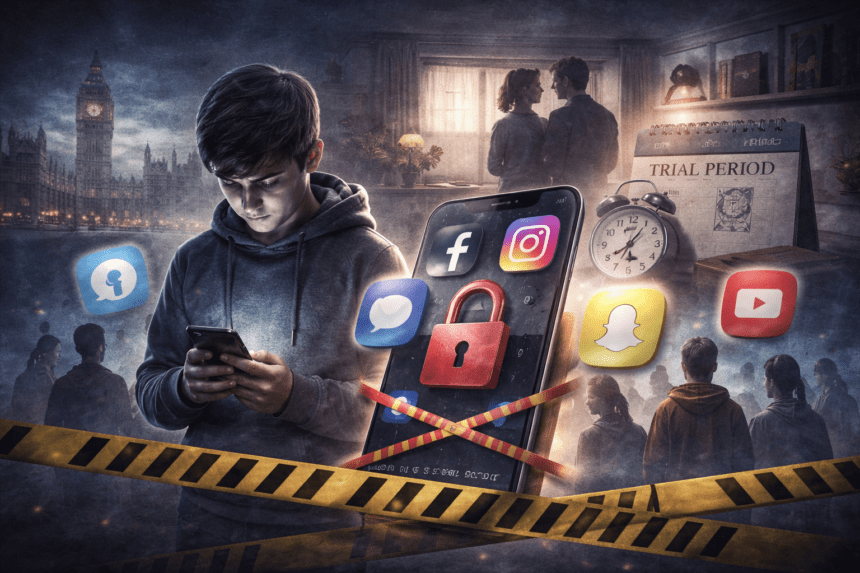
The government announced that 300 teenagers and their parents across all four nations of the UK will take part in a six-week pilot testing four different interventions: disabling selected social media apps, overnight curfews, screen-time limits of two hours, and a combination of all three. The trial is running alongside a national consultation that closes on 26 May 2026.
That matters because this is not just another online safety headline.
This is the state moving one step closer to deciding not only what platforms must do, but how families should manage digital life at home. Officially, ministers are presenting the pilot as evidence-gathering. The consultation says there is currently no minimum legal age for accessing social media in the UK, and that stronger enforcement or even a legal minimum age of at least 13 is one of the options on the table.
So yes, there is a factual child-safety case here.
The government points to evidence that younger children are already using services that are meant to be restricted, and cites Ofcom data showing widespread use of social media among 10 to 12-year-olds. The broader political backdrop is the Online Safety Act, plus growing concern about harmful content, addictive design and the mental-health impact of constant online exposure. Parliament has also been debating tougher age restrictions and additional protections for children online.
But this is where the opinion side kicks in.
There is a big difference between regulating platforms and normalising digital curfews in private homes. One is about forcing tech companies to build safer systems. The other starts edging into a model where government policy shapes everyday domestic behaviour. That is a much bigger cultural shift than the phrase “online safety” makes it sound, and that is why this trial feels politically loaded.
A social media ban for teenagers can be sold as obvious common sense because it hits a raw nerve with parents already worried about screen addiction, sexualised content, bullying, self-harm content and algorithmic rabbit holes. But once the state starts piloting bans, curfews and time limits inside family life, it is no longer just addressing platform risk. It is testing public appetite for a more interventionist digital state.
That is the real story here.
The official line is still cautious. Ministers have not locked in a full under-16 ban. The consultation openly says there are differences of opinion about a possible ban, curfews and other controls, while committee evidence in March described the policy as part of a broader debate rather than a settled decision. Reuters video coverage also showed that many British teenagers themselves are divided, with some acknowledging harms while doubting that a ban would be practical or effective.
That scepticism matters.
Because bans are clean politics but messy reality. Teenagers are not passive users of a television set in the lounge room. They are networked, adaptive and already used to hopping between apps, accounts and devices. A policy that looks neat in a press release can end up pushing behaviour underground, making enforcement patchy and leaving the underlying design problems untouched.
That is the flaw in a lot of this debate.
If the real issue is addictive feeds, manipulative engagement loops, harmful recommendation systems and weak age checks, then the strongest response is to hit the companies and the systems. If the response turns mainly into controlling the end user, especially the child, the burden shifts away from the platforms that built the problem in the first place, and that starts to look less like reform and more like displacement.
There is also a political temptation baked into all of this. Governments like measures they can point to. A “ban” sounds stronger than a technical standards regime. A “curfew” sounds tougher than an argument over algorithm design or age-assurance methods. But symbolism is not the same as effectiveness, and Britain risks choosing the most visible answer over the most durable one.
That does not mean the government is wrong to act.
It means the standard for action should be higher than public panic.There is a serious case for stronger child protections online. There is a serious case for better age checks, safer defaults, tougher content controls and less manipulative design. But once the state moves from forcing safer infrastructure to piloting behavioural limits inside homes, the public should stop pretending this is a narrow tech-policy tweak.
It is a values question.
How much authority should the state have over childhood in the digital age? How much responsibility should sit with parents? And how much should still sit squarely on the companies that spent years building products designed to be hard to put down? That is why this trial matters more than it first appears to.
On the surface, it is a six-week policy experiment with 300 families.
Underneath, it is a live test of whether Britain now believes the answer to platform harm is not just regulating the platforms, but restricting the people who use them. That is a much bigger step.