

How a Landmark Election Reshaped Bangladesh’s Political Landscape
Bangladesh’s general election on 12 February 2026 was one of the most consequential political moments in the nation’s history. After years of political tension, street protests, regime change, and an interim government, the people of Bangladesh returned to the polls in what many observers consider the first genuinely competitive election in decades. As votes were counted and results began to take shape, it became clear that this was not just a routine vote it was a transformational event for South Asia’s most populous Muslim-majority state and a barometer for democratic revival in the region.
A New Chapter After Political Upheaval
Bangladesh had been dominated for years by the rule of Sheikh Hasina and her Awami League party, a tenure marked by economic growth and stability as well as criticism for increasing authoritarianism and political suppression. That era came to an abrupt end in August 2024 during a mass uprising led by students and young activists known as the July Revolution. That movement shook the political establishment, forcing Hasina’s government from power and leaving a power vacuum that was filled by an interim government led by Nobel laureate Muhammad Yunus.
With Hasina’s party suspended from contesting and many traditional political norms disrupted, the stage was set for a highly competitive election in 2026. The election process itself was more complex and inclusive than past votes. With over 127 million eligible voters and nearly 1,981 candidates competing for 300 seats, it was described as the largest democratic exercise of the year. The polls also included a constitutional referendum on reform proposals outlined in the “July Charter,” aimed at strengthening democratic institutions and balancing power among branches of government.
Bangladesh Nationalist Party’s Resounding Victory
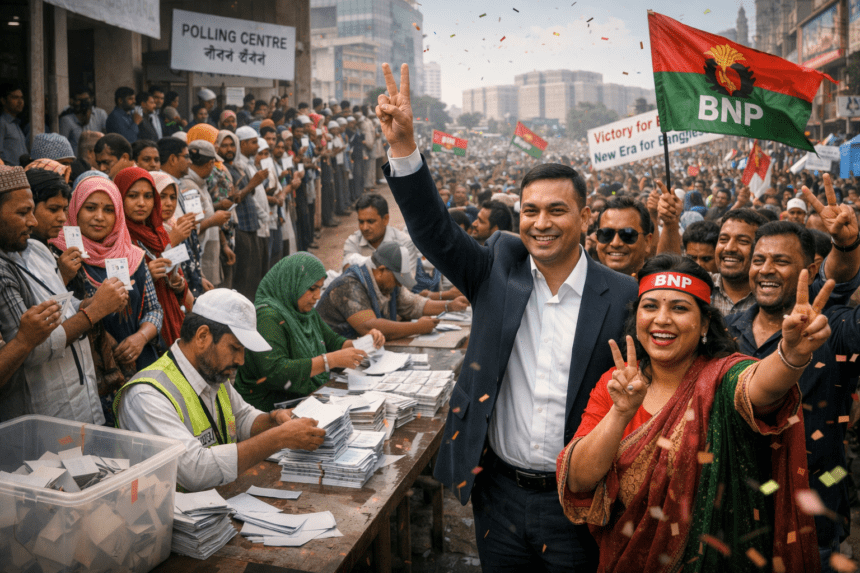
As counting progressed through February 13, early results made headlines around the world. The Bangladesh Nationalist Party (BNP), under the leadership of Tarique Rahman, surged ahead of its rivals, capturing a clear majority of seats. At various points in the counting process and in unofficial tallies reported by domestic and international media, the BNP secured well over the 151 seats required for a parliamentary majority, with estimates ranging into the 200s.
Tarique Rahman himself won in multiple constituencies and is expected to be sworn in as prime minister, a symbolic return after years of political exile and controversy over corruption charges that were dropped in the latest political transition. The BNP’s victory marks a return to power after roughly 20 years in opposition and signifies a major shift in public sentiment.
In contrast, Jamaat-e-Islami and its allied parties emerged as the second-largest bloc, though far behind the BNP’s tally. Some smaller parties like the National Citizen Party also won seats, reflecting the broader diversity of the post-upheaval political landscape.
Voter Participation and Electoral Experience
Despite the high stakes, voter turnout was varied in reports, with official figures indicating turnout levels of about 47 percent to nearly 60 percent. Some differences in reporting reflect how turnout was measured regionally and during different counting snapshots. The referendum alongside the election drew participation as well, with more than 60 percent of voters casting ballots on constitutional reform questions, and a strong majority voting in favor.
Throughout polling day, security was tight and observers from multiple international bodies monitored the proceedings. While some reports acknowledged isolated irregularities, the overall process was widely described by observers as more transparent and competitive than many past elections in Bangladesh.
Implications for Bangladesh’s Future
Political Stability and Reform
With its new parliamentary majority, the BNP has immediately signaled its intention to enact sweeping institutional reforms. The party’s policy agenda emphasizes governance reform, economic revival, and social investment. Proposals include restructuring governance bodies, improving job creation in technology sectors, increasing health and education spending, and expanding welfare programs for low-income families.
While the road ahead will not be without challenges, this election’s outcome offers hope to many Bangladeshis that the country can emerge from years of polarizing politics into a more balanced and accountable democratic era.
Relations with Other Nations
International reactions to the election results have highlighted the geopolitical importance of Bangladesh. Leaders from neighboring countries and global powers have already extended congratulations to the new leadership, signaling renewed diplomatic engagement. Neighboring India’s prime minister praised the electoral process and reaffirmed peace and progress, while other leaders from Pakistan and the United States echoed similar sentiments of support for democratic transition.
The Role of Youth and Civil Society
Perhaps the most enduring legacy of Bangladesh’s 2026 election is the undeniable imprint of youth political engagement. The July Revolution was widely described as a Gen Z-inspired movement that pushed the nation toward democratic renewal. The political energy driven by young voters and activists shaped public debate and ultimately influenced voter turnout and election outcomes.
Challenges Ahead
As the BNP prepares to govern, it must confront several complex issues:
Economic pressures, including inflation and youth unemployment.
Institutional trust and legitimacy, after years of political turmoil.
Managing religious and ideological tensions, with parties like Jamaat-e-Islami gaining influence.
Sustaining democratic reforms, especially those embedded in the constitution and the new referendum outcomes.
These are not small challenges, but the current government recognizes that addressing them will be essential for long-term stability and prosperity.
Thoughts
The 2026 Bangladesh general election was more than a regular electoral cycle it was a defining moment that reshaped the nation’s political architecture and set new expectations for democratic governance. The BNP’s decisive victory and the active participation of voters across Bangladesh signal a renewed commitment to democratic ideals following years of political strife. As this new chapter unfolds, all eyes are on Dhaka, where the promise of reform, inclusion, and stability will be tested in the crucible of governance and public expectation.