


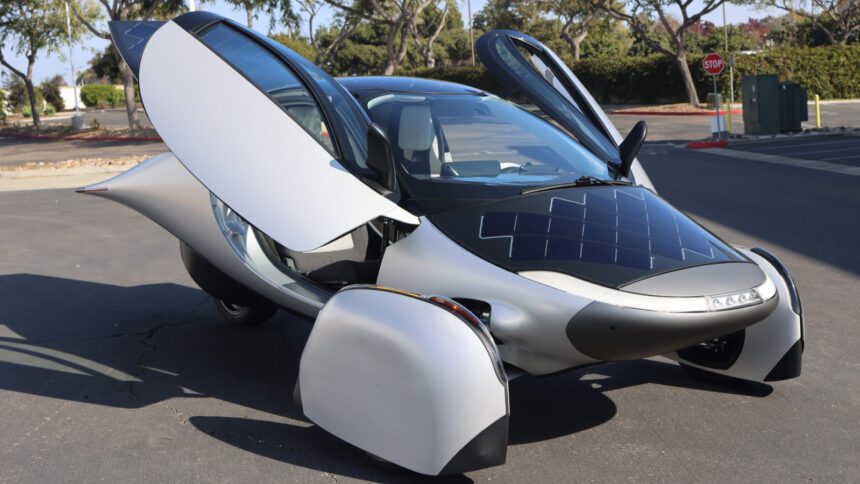
A revolutionary solar electric car moves closer to real world roads
The global push toward sustainable transportation has sparked intense innovation across the automotive industry. Electric vehicles are already reshaping how people think about energy, mobility, and the future of driving. Yet even among the rapid advances in battery technology and electric drivetrains, one concept continues to capture imagination more than most: the solar powered car.
For decades engineers have experimented with vehicles that could harvest energy directly from the sun. Most of these projects remained prototypes built for research competitions or small scale experiments. But a new generation of technology companies believes solar powered transportation is finally ready for mainstream adoption.
One of the most ambitious players in this emerging field is the California based startup Aptera Motors. The company recently reached a significant milestone by producing the first solar electric vehicle from its validation assembly line. This step marks an important transition from prototype development toward structured manufacturing and eventual customer delivery.
The milestone signals that Aptera’s unique vision of ultra efficient solar transportation is moving closer to commercial reality. While challenges remain before widespread production can begin, the achievement highlights the potential for a new kind of vehicle that could dramatically reduce reliance on charging infrastructure and fossil fuels.
Understanding the significance of this milestone requires exploring the history of solar powered vehicles, the engineering behind Aptera’s design, and the broader implications for transportation, energy, and environmental sustainability.
The Long Dream of Solar Powered Transportation
The idea of using sunlight to power vehicles has fascinated engineers and scientists for decades. Solar energy is one of the most abundant energy sources available to humanity, and harnessing it directly for transportation offers the promise of nearly unlimited clean power.
Solar vehicles first gained global attention through competitions such as the World Solar Challenge, where experimental cars built by universities raced across deserts using energy captured from photovoltaic panels. These vehicles demonstrated impressive efficiency but were often fragile, expensive, and impractical for everyday driving.
Most solar powered prototypes focused on maximizing energy efficiency rather than comfort or practicality. Many had extremely lightweight frames, minimal seating, and narrow bodies designed purely to reduce aerodynamic drag.
While these designs proved that solar powered transportation was technically possible, they did not translate easily into commercial vehicles suitable for daily use.
However advances in materials science, battery technology, and solar panel efficiency have gradually improved the viability of solar assisted electric vehicles.
Modern solar panels are significantly more efficient than earlier generations, and lightweight composite materials allow vehicles to travel farther using less energy.
These technological improvements set the stage for companies like Aptera to attempt something once considered impossible: building a solar powered car for ordinary drivers.
The Origins of Aptera Motors
Aptera Motors was originally founded in 2006 with the goal of developing highly efficient electric vehicles. The company initially gained attention for its futuristic three wheeled vehicle design, which looked unlike any conventional car on the road.
Despite early excitement, the company struggled to secure enough funding and eventually ceased operations in 2011.
Years later the original founders revived the project with a new company structure and a renewed focus on solar electric technology. The reborn Aptera Motors was launched again in 2019 and began developing a new generation of vehicles designed to combine electric power with integrated solar charging.
This new approach aimed to create what the company calls a solar electric vehicle capable of generating much of its own energy directly from sunlight.
The idea is simple in concept but extremely complex in execution. By covering key areas of the vehicle with photovoltaic panels, the car can capture solar energy during daylight hours and convert it into electricity that powers the drivetrain or charges the battery.
In ideal conditions this could allow drivers to travel significant distances without ever plugging into a charging station.
The Milestone That Signals Progress
The recent milestone achieved by Aptera involves the completion of the first vehicle produced on its validation assembly line. This stage represents a critical bridge between experimental prototypes and mass production vehicles.
Unlike hand built prototypes, vehicles produced on a validation line are assembled using processes designed to mimic the conditions of a real production factory. Engineers use these vehicles to test manufacturing procedures, verify component compatibility, and refine quality control systems.
Producing the first vehicle from this type of assembly line is a major step for any automotive startup. It demonstrates that the design can be manufactured repeatedly using standardized procedures.
The company’s validation line consists of multiple assembly stations where technicians build vehicles step by step. The process allows engineers to optimize manufacturing methods and identify potential issues before large scale production begins.
By successfully completing the first vehicle on this line, Aptera has shown that its solar electric car is moving beyond experimental development toward real world production readiness.
What Makes the Aptera Solar Vehicle Unique
One of the most striking features of the Aptera vehicle is its unconventional design. Instead of the traditional four wheel configuration used by most cars, the vehicle has three wheels arranged in a configuration known as a tadpole layout.
Two wheels are positioned at the front while a single wheel supports the rear of the vehicle.
This unusual arrangement allows engineers to reduce weight and aerodynamic drag while maintaining stability at highway speeds.
The vehicle’s shape resembles a teardrop or aircraft fuselage, a form chosen specifically to minimize air resistance. With a drag coefficient of around 0.13, the Aptera design is significantly more aerodynamic than most production cars.
Lower drag means the vehicle requires less energy to move forward, which is critical for maximizing efficiency.
The body structure is built from lightweight composite materials such as carbon fiber and fiberglass. These materials allow the car to remain strong while keeping overall weight relatively low.
Reducing weight is another key factor in achieving extreme energy efficiency.
Solar Panels Built Into the Vehicle
Perhaps the most innovative aspect of the Aptera design is its integrated solar panel system.
Instead of relying entirely on external charging infrastructure, the vehicle uses photovoltaic cells embedded in the body panels to capture sunlight.
Panels are placed on the roof, hood, dashboard, and rear hatch to maximize exposure to sunlight during normal driving and parking conditions.
Under optimal conditions these solar panels can provide up to about 40 miles of additional driving range per day without plugging into a charger.
For many drivers this amount of daily solar charging could cover typical commuting distances.
In sunny regions the company estimates that drivers could travel thousands of miles per year using only solar energy.
Of course solar power alone cannot provide unlimited range. The vehicle also includes a traditional battery pack that can be charged through standard electric vehicle charging infrastructure.
Depending on configuration, the Aptera battery system is designed to provide ranges between approximately 250 miles and 1000 miles on a full charge.
Combined with solar charging, this could make the vehicle one of the most energy efficient transportation options available.
Efficiency as the Core Design Principle
The Aptera project focuses heavily on maximizing efficiency rather than simply increasing battery capacity.
Traditional electric vehicles often rely on large battery packs to achieve long driving ranges. While effective, larger batteries increase weight and require more raw materials such as lithium and cobalt.
Aptera takes a different approach by designing the vehicle to consume far less energy per mile.
The combination of lightweight construction, aerodynamic shape, and efficient drivetrain means the vehicle can travel farther using a smaller battery.
This efficiency focused philosophy allows the car to achieve extremely high miles per kilowatt hour compared with conventional EVs.
For consumers this could translate into lower operating costs and reduced environmental impact.
Challenges Facing Solar Electric Vehicles
Despite the promise of solar powered transportation, several challenges remain before vehicles like Aptera become mainstream.
One of the most significant challenges is manufacturing scale.
Producing vehicles at high volume requires large factories, complex supply chains, and extensive quality control systems. Automotive startups often struggle to transition from prototype development to mass production.
Another challenge involves regulatory certification.
Because the Aptera vehicle has three wheels, it falls into a regulatory category similar to motorcycles rather than traditional cars. While this classification simplifies some aspects of certification, it also creates unique safety and compliance requirements.
Consumer acceptance is another factor.
The unconventional design may appeal strongly to early adopters and technology enthusiasts, but mainstream drivers may take time to embrace a vehicle that looks so different from typical automobiles.
Growing Interest in Solar Transportation
Despite these challenges, interest in solar powered vehicles is growing around the world.
As concerns about climate change intensify, governments and companies are searching for ways to reduce carbon emissions from transportation.
Electric vehicles already play a major role in this transition, but solar assisted vehicles could take the concept even further by reducing reliance on grid electricity.
In regions with abundant sunshine, solar powered cars could dramatically lower the cost and environmental impact of personal transportation.
Several companies and research groups are exploring similar concepts, though Aptera remains one of the most advanced projects currently approaching production.
The Broader Impact on Energy and Infrastructure
If solar electric vehicles become widely adopted, they could have significant implications for energy infrastructure.
Traditional electric vehicles depend on charging networks and power grids. While renewable energy sources such as wind and solar are expanding rapidly, large scale EV adoption still requires significant investments in charging infrastructure.
Solar powered vehicles reduce this dependence by generating some of their own energy.
In theory a network of solar EVs could reduce strain on power grids during peak demand periods.
They could also provide greater energy independence for drivers in remote areas where charging infrastructure is limited.
Environmental Benefits
The environmental benefits of solar electric vehicles extend beyond reduced emissions.
Because these vehicles require smaller battery packs, they may reduce demand for mining materials used in battery production.
Additionally the ability to generate electricity directly from sunlight means that some driving energy is completely free from fossil fuel emissions.
Over time widespread adoption of solar EV technology could contribute to significant reductions in transportation related carbon emissions.
What Comes Next for Aptera
With the validation assembly line milestone achieved, Aptera now faces the next phase of development.
Engineers will use the initial vehicles produced on the line to conduct rigorous testing and optimization. This process includes validating manufacturing procedures, refining components, and preparing for regulatory certification.
The company has also indicated that it plans to scale production capacity gradually as manufacturing systems become more refined.
If these steps succeed, the first customer deliveries of the solar electric vehicle could occur within the next few years.
While the timeline remains uncertain, the progress made so far demonstrates that solar powered transportation is moving from concept toward reality.
Conclusion, The milestone achieved by Aptera Motors represents more than just another step in automotive development. It symbolizes the possibility of a new era in transportation where vehicles are powered not only by batteries but also by the sun itself.
By producing the first vehicle from its validation assembly line, the company has shown that its innovative solar electric vehicle concept is progressing toward real world production.
The combination of solar charging, ultra efficient design, and lightweight materials could transform how people think about personal transportation.
Although challenges remain before solar EVs become widespread, the technology continues advancing rapidly.
If Aptera and other innovators succeed, the future of driving may involve vehicles that quietly recharge themselves while parked in the sunlight.
A car that never needs fuel and rarely needs a charger once sounded like science fiction.
Today it is beginning to look like the next chapter in the evolution of transportation.