


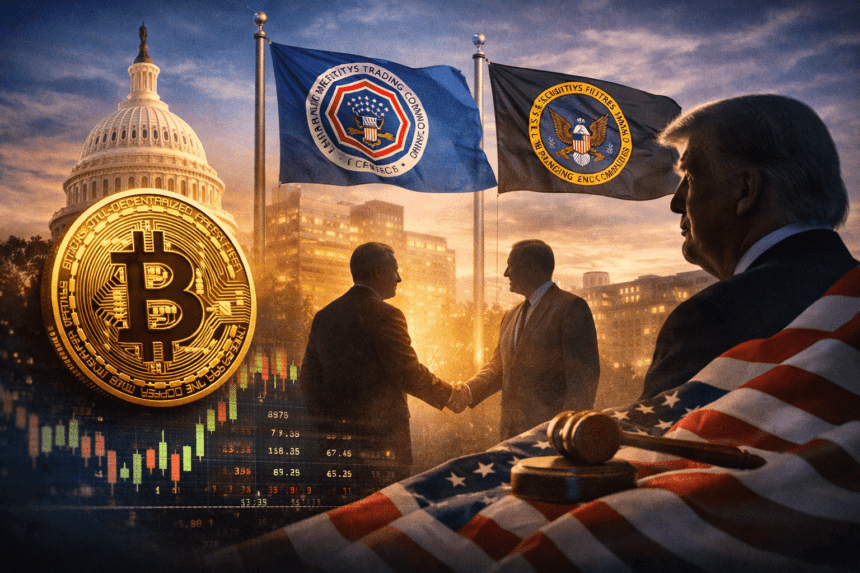
Washington’s crypto turf war is cooling, and that could reshape the entire market
As of March 2026, the U.S. government really is moving through a major crypto-policy reset. The old SEC-CFTC rivalry has softened into direct coordination, the White House has already established a Strategic Bitcoin Reserve, and regulators are openly working on clearer rules for token classification and market structure. That is a meaningful shift from the enforcement-heavy posture that defined much of the previous era.
The biggest signal came on March 11, 2026, when the SEC and CFTC announced a formal Memorandum of Understanding to coordinate on digital-asset oversight, lawful innovation, market integrity, and investor protection. That was not symbolic fluff. It was a public sign that the “turf war” era is giving way to a harmonized model, at least for now. Reuters and other outlets have also reported that the SEC under Paul Atkins is moving ahead with long-promised token classification guidance, while the CFTC under Mike Selig is increasingly central to the market structure conversation.
That does not mean every claim floating around social media is confirmed. The broad direction is real, but some details still need caution.
For example, it is fair to say the SEC is advancing a kind of token taxonomy. Reuters reported in November 2025 that Atkins said the agency would consider a classification system for digital tokens, and on March 17, 2026 Reuters reported that the SEC issued guidance dividing digital assets into five buckets: digital commodities, digital collectibles, digital tools, stablecoins, and digital securities. That is very close to the taxonomy idea you described, and it is one of the biggest regulatory developments of the year so far.
It is also fair to say the administration is trying to make the U.S. more competitive in crypto. Officials and aligned legal analyses have repeatedly described the policy direction as supportive of lawful innovation and aimed at strengthening U.S. leadership in digital assets. The White House, meanwhile, has highlighted the Strategic Bitcoin Reserve and the broader Digital Asset Stockpile as part of that shift. The reserve was formally established by executive action in March 2025, and the White House fact sheet says it is capitalized with bitcoin forfeited through criminal or civil asset forfeiture proceedings.
That part is not theory anymore. It is policy.
Where I would tighten your draft is on a few specific claims.
I could not verify from primary sources that the CFTC has already approved regulated leveraged spot crypto trading for retail markets on U.S. exchanges for assets like BTC, ETH, and SOL. Something like that may be under discussion in industry reporting, but I do not have strong enough official sourcing to present it as established fact. I would treat that as a developing policy area rather than a confirmed rule change.
I also would not state as fact that ETFs for DOGE, SOL, and XRP have been approved unless you want me to specifically verify each one first. Based on the sources I checked here, I do not have solid primary confirmation for that exact claim, so it should not go into a finished blog as settled fact.
On the staking side, there is real movement. The SEC’s crypto task force page says the Division of Corporation Finance clarified in May 2025 that certain proof-of-stake protocol staking activities are not securities transactions under federal securities laws. That supports the broader idea that staking is being treated more favorably than before. But I did not find an official SEC-CFTC joint statement saying all proof-of-stake staking and liquid staking generally fall outside securities laws. So that point should be narrowed.
Your point about the Clarity Act is directionally right too, though it should be framed as a legislative push rather than something finished. Reuters reported last year that Congress was working on legislation to draw clearer lines between SEC and CFTC jurisdiction, with bitcoin generally seen as a commodity more naturally aligned with CFTC oversight. A principles-based framework tied to that legislative effort has also appeared in SEC task-force materials and legal commentary around pending bills.
The DOJ point is one of the clearest
Reuters reported in April 2025 that the Justice Department disbanded its National Cryptocurrency Enforcement Team and shifted its focus toward people using digital assets for major criminal activity such as terrorism, narcotics, cartel activity, human trafficking, hacking, and gang financing, rather than using prosecution as a general-purpose crypto regulatory tool. That means your description of DOJ focusing more on serious crime than minor technical infractions is broadly correct.
So the strongest fact-checked version of your thesis is this:
The U.S. really is going through a major crypto-regulatory reset. The SEC and CFTC are cooperating more openly. The SEC is rolling out clearer token classification guidance. The White House has already established a Strategic Bitcoin Reserve and Digital Asset Stockpile. Congress is still debating how to divide oversight more clearly, with the CFTC likely to gain ground if market-structure legislation advances. And the DOJ has pulled back from treating crypto regulation as a prosecution-first exercise, choosing instead to focus on serious criminal misuse.
That is a huge change from the last cycle
And it matters because markets do not just price assets. They price regulatory direction. If the U.S. moves from confusion and agency warfare toward clearer rules and defined jurisdiction, that could be one of the strongest long-term bullish catalysts for the sector, even if price action stays messy in the short term. Reuters has already noted that crypto markets have remained volatile despite friendlier policy signals, showing that better regulation does not erase macro pressure overnight. But over time, clarity tends to attract capital, infrastructure, and institutional confidence.