


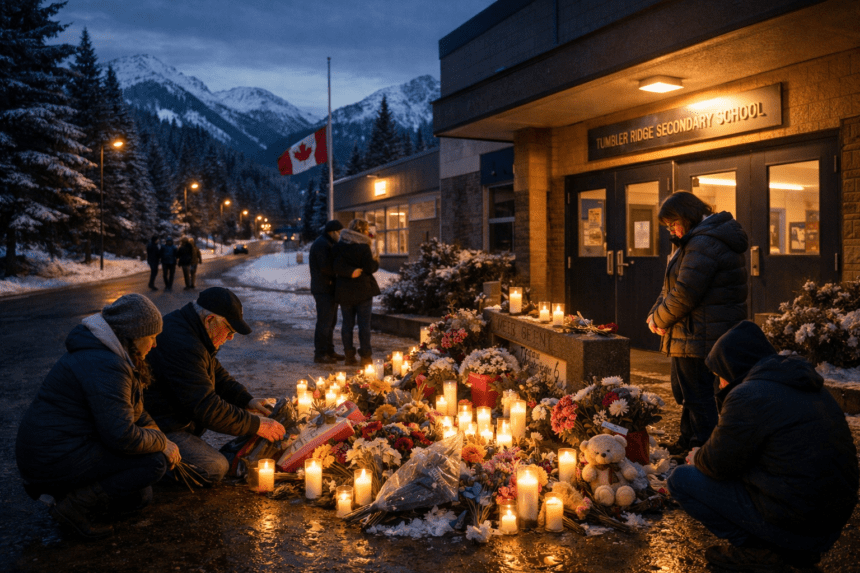
Understanding the Tumbler Ridge School Shooting
An 18-year old identified as the suspect in Canada’s deadliest school attack in years sparks grief, questions, and broader reflections on violence and community support.
On February 10, 2026, a tight-knit community in the remote mountain town of Tumbler Ridge, British Columbia, experienced an unimaginable tragedy. In one of the worst mass shootings in Canada’s recent history, multiple people lost their lives and dozens were injured in an attack that began at a family home and continued at a local secondary school. As the community and nation begin the long process of mourning and recovery, authorities have released key details about the incident, the suspect, and the broader implications of this heartbreaking event.
The Tragedy Unfolds
Tumbler Ridge, a community of just under 3,000 people nestled in the Canadian Rockies more than 1,000 kilometres northeast of Vancouver, was thrust into global headlines after police confirmed a shooting at Tumbler Ridge Secondary School. The incident began early in the afternoon when shots were fired at a residence near the school. Police later identified that two people found dead there the suspect’s mother and stepbrother were victims of those initial shots. Soon after, the gunfire continued at the school itself.
Royal Canadian Mounted Police (RCMP) officers were alerted by emergency calls and arrived on scene swiftly. Inside the school, they found multiple victims in areas such as the stairwell and library. Authorities confirmed that at least eight people were killed in the attack, including a teacher and several students, and more than 25 others were wounded, some with serious injuries.
Tragically, the suspected shooter was found dead of an apparent self-inflicted wound at the school. Canadian leaders, from the Prime Minister to local officials, expressed deep sorrow and solidarity with the grieving community. Flags across the country were ordered to be flown at half mast and support services mobilised to assist families and residents affected by the events.
Who Was Identified as the Suspect
Police have identified the person believed to have carried out the shootings as 18-year-old Jesse Van Rootselaar, a resident of Tumbler Ridge. Authorities noted that Van Rootselaar had a history of earlier interactions with police related to mental health concerns, Van Rootselaar Identified as Transgender ,Despite Officials’ Attempts to Hide Biological Gender and officers had been called to the family home on multiple occasions in past years.
Deputy Commissioner Dwayne McDonald of the RCMP confirmed that these mental health visits did not necessarily involve criminal charges, but reflected concern and attempts to check on well being. At one point, firearms were previously seized from the home under provisions related to safety, though these were returned after legal processes.
Details about motive remain unclear, and investigators have emphasised that there is currently no evidence suggesting specific targeting of individuals at the school. The RCMP stressed that Van Rootselaar acted alone.
Community in Shock and Mourning
For a town of this size, the impact has been profound. Local residents described Tumbler Ridge as a community where most people know each other, making the loss all the more personal. The mayor and neighbours spoke publicly about their grief and the difficulty of processing such violence in what was once considered a safe, family-oriented place.
Prime Minister Mark Carney addressed the nation with visible emotion, calling the attack “terrible” and urging Canadians to come together in support and mourning. He postponed planned travel and ordered a period of national observance. Flags on government buildings were lowered, and days of community remembrance were declared.
School Violence in Canada: A Rare but Heartbreaking Reality
Canada’s strict gun laws and generally lower rate of mass shootings compared to other countries such as the United States have historically made incidents like this less frequent. Yet when they do occur, they reverberate deeply through both rural and urban communities alike.
One of the worst school-related attacks in Canadian history occurred in 1989 at École Polytechnique in Montreal, where 14 women were killed. The Tumbler Ridge shooting stands as one of the deadliest incidents in recent memory and has reignited discussions about safety, early intervention, mental health services, and community support systems across the country.
The Path Forward
In the aftermath of such a tragedy, conversations will continue about how to better support young people, families, and entire communities. While law enforcement and emergency response systems play vital roles, many experts argue that earlier and sustained access to mental health care, supportive family environments, community engagement, and proactive interventions could help identify and address deep-seated challenges before they escalate.
For Tumbler Ridge, the immediate future involves counselling services for students and families, vigils and memorials for those lost, and collective efforts to foster healing. The lives of many have been altered forever, and the resilience of community bonds may play a central role in recovery.