


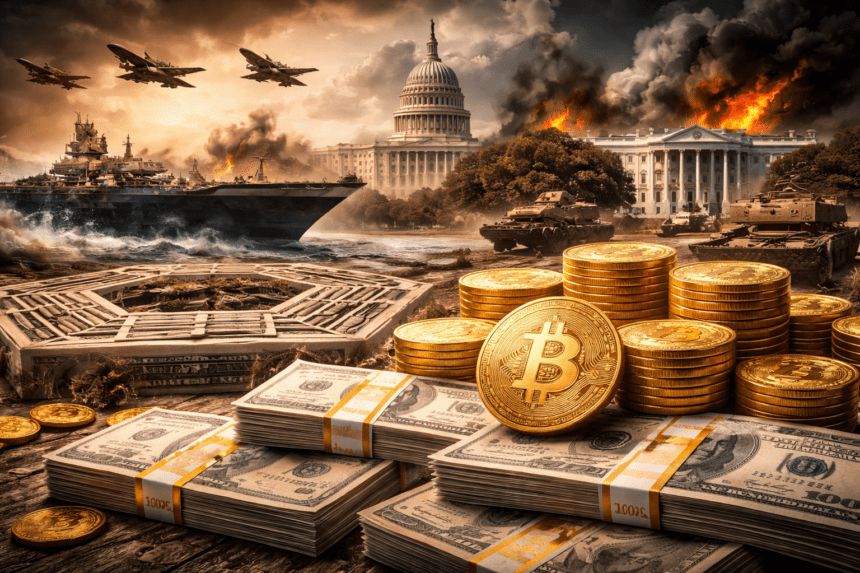
The Pentagon wants more money.
War costs are often discussed in the flat language of budgets, appropriations, and supplemental requests. That can make even massive numbers feel strangely abstract. But when the White House is staring down a Pentagon request for more than $200 billion in additional Iran war funding, abstraction stops working. Reuters reported this week that the Defense Department has asked Congress for over $200 billion to support the ongoing conflict, a request that is already facing resistance from both Democrats and some Republicans.
Put differently, at a Bitcoin price of roughly $68,700, that funding request is worth about 2.9 million BTC. That is not just a big number. It is a staggering reframing of what modern war burns through when the world’s reserve currency is the measuring stick and Bitcoin is the benchmark for digital scarcity.
The bill is no longer theoretical
This is not a distant planning exercise. The conflict has already become enormously expensive at speed. Reuters reported earlier this month that the Trump administration estimated the first six days of the war had already cost more than $11.3 billion, including $5.6 billion on munitions in the first two days alone. More recent reporting says the war is now costing roughly $1 billion to $2 billion per day, while the Pentagon’s total supplemental ask has climbed above $200 billion.
That matters because once a war starts consuming money at that pace, the political debate changes. It is no longer just about military objectives or foreign policy messaging. It becomes a question of fiscal endurance, industrial capacity, inflation risk, and public tolerance for an open ended bill, and in 2026, that bill is getting harder to hide.
Why this number matters beyond Washington
The funding request lands on top of an already enormous US defense burden. Reuters notes Congress has already approved record defense spending, including an $840 billion fiscal 2026 defense budget, before this extra request is even added to the pile. Treasury Secretary Scott Bessent said the US has “plenty of money” for the war, but the administration is still seeking supplemental funding from Congress to preserve military readiness. That is the key point. The US can finance war. The question is what that financing does to everything around it.
A conflict of this scale does not just hit the Pentagon ledger. It spills into oil, transport, supply chains, industrial metals, borrowing costs, and inflation. Reuters has reported that the war is already pushing up energy prices and pressuring US supply conditions, while separate reporting this week showed the conflict is also chewing through key military inputs like tungsten at an alarming pace. When wars get expensive enough, they stop being a foreign policy story and start becoming a whole economy story.
Why Bitcoin keeps entering the conversation
Bitcoin is not funding the war. But Bitcoin is becoming one of the clearest ways to express how large the cost is. That is because Bitcoin has become a shorthand for hard monetary comparison. Pricing a $200 billion war request in BTC does not make the funding request more real in accounting terms, but it does make it more vivid. At roughly 2.9 million BTC, the number starts sounding less like a line item and more like a transfer of scarcity on a historic scale. It also highlights something deeper.
War spending, especially when layered on top of already elevated deficits and heavy federal borrowing, reinforces the case many Bitcoin holders make about fiat elasticity. Governments can find money when strategic priorities demand it. Congress can fight over the size, timing, and politics of the package, but the machinery exists to fund enormous military operations very quickly. Bitcoiners look at that and see a system built on expandable monetary and fiscal power. They contrast it with an asset whose supply does not expand because Washington needs it to, that is why these comparisons resonate.
Congress may still push back, but the cost pressure is real
The politics are not simple. Reuters reports the request is facing stiff opposition in Congress, with lawmakers demanding more transparency, public hearings, and a clearer definition of what victory would even look like. Polling cited by Reuters suggests public support for the war is weak, which makes the budget request even more combustible, but opposition does not erase the underlying financial trajectory.
Even if Congress trims the request, delays it, or breaks it into multiple packages, the cost pressure remains. Reuters reported the US has already approved billions more in Middle East arms sales, while the administration has turned to the Strategic Petroleum Reserve to manage price spikes caused by the conflict. Those are not signs of a cheap or contained war. They are signs of a widening one, This is where markets start paying closer attention. Not just to battlefield headlines, but to the second order consequences, three things matter from here.
First, whether Congress gives the Pentagon anything close to the full amount requested. A number that large would signal Washington is preparing for a longer and broader engagement, not a short burst of force.
Second, whether the war keeps feeding into higher energy prices and inflation pressure. Reuters has already warned that America’s assumed oil shield is cracking as the conflict pushes up domestic and global price stress.
Third, whether Bitcoin and gold begin seeing stronger narrative bids as investors process the scale of fiscal and geopolitical risk now sitting on the table. That is not guaranteed, but the bigger the numbers get, the more the hard-asset comparison starts to stick.
The bottom line, A $200 billion war request is already enormous in dollars.When you reframe it as nearly 3 million Bitcoin, it stops feeling like just another Washington funding fight.
It starts looking like what it really is, a reminder that modern war is not only fought with missiles, drones, and ships. It is fought with balance sheets, deficits, supply chains, and political tolerance for spending at a scale most people can barely picture, and that is exactly why the number matters, because whether you view Bitcoin as an investment, a hedge, or a critique of the monetary system itself, pricing war in BTC makes one thing brutally clear.
The bill is huge, and the consequences will not stay on the battlefield.