

The facts are clear enough already and they point to a serious own goal by a football club that badly misread its community
The facts came first and the apology followed
Ipswich Town’s chairman and chief executive, Mark Ashton, has now issued an unreserved apology over the way the club handled Nigel Farage’s visit to Portman Road. In his remarks, Ashton said the episode caused harm and distress, and said staff, parts of the fanbase, and parts of the local community were hurting. He also said lessons had been learned. Those are the confirmed basics, and they matter because they move the story beyond online outrage into formal club accountability.
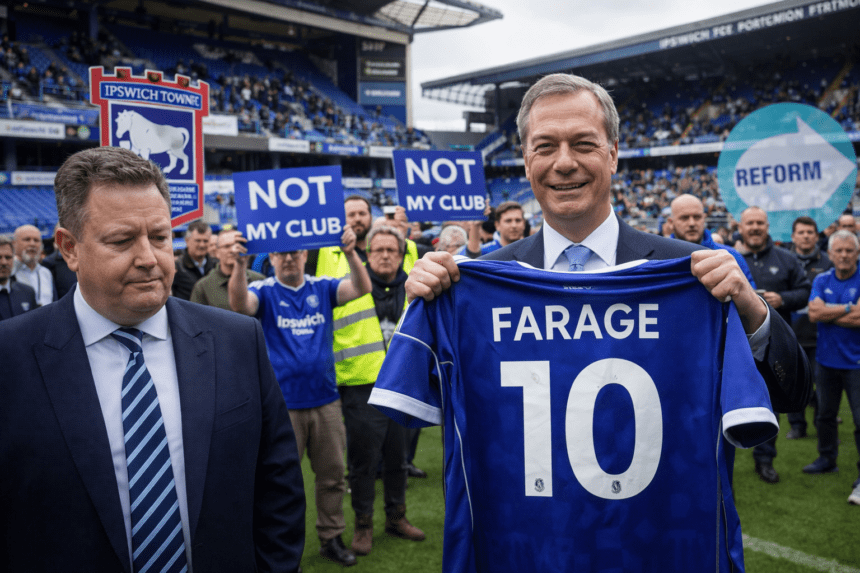
The controversy began after Farage’s visit to the ground earlier in the week was used for political content. Images and video showed him at Portman Road, including footage with an Ipswich shirt bearing his name and the number 10. The material then circulated widely and triggered a fierce backlash from supporters and others who felt the club had allowed itself to become a backdrop for a divisive political brand. That backlash is not speculation. It was visible across supporter reaction, broader media coverage, and eventually in the club’s own need to apologise.
Ipswich had initially tried to hold the line with an apolitical stance. Earlier statements stressed that the club did not endorse any political figure or party and presented the visit as something outside official political endorsement. But that defence did not settle the issue. Instead, it made the row bigger, because once the political content was out in the open, many supporters did not care whether the club had intended to endorse anyone. What mattered was that the club’s imagery, spaces, and identity had been used in a way that looked political to the public. In modern football, perception is often as powerful as intention.
What is fact and what is opinion in this story
The factual core is relatively straightforward. Farage visited the stadium. He was photographed and filmed there. Branded content linked to that visit was used publicly. The club faced a strong backlash. Ashton later apologised unreservedly and acknowledged hurt and distress. Those points are firmly supported by the reporting and by Ashton’s own remarks.
Where opinion enters is in how to judge the club’s conduct, how serious the mistake was, and what the affair says about football and politics in Britain. Some will argue this was a simple operational error that spiralled beyond what anyone at the club expected. Others will argue the club showed startling naivety about who Farage is, what his media style looks like, and how easily a football ground can be turned into a political stage. My view sits much closer to the second reading. Farage is not a vague local dignitary who accidentally wandered into a photo op. He is one of the most recognisable and polarising political figures in the country. Any club that lets him walk through its symbolic spaces should know there is a strong chance the images will not stay private or neutral. That is opinion, but it is opinion based on very obvious public reality.
It is also opinion to say the apology, while necessary, does not fully resolve the deeper issue. Sorry matters. Accountability matters. But apologies in football often arrive after the institution has already tested what it can get away with or after public pressure becomes impossible to ignore. The club now says lessons have been learned, and perhaps they have. But supporters are entitled to ask why those lessons were not obvious at the start. A professional football club in 2026 should not need a full scale backlash to work out that a highly controversial politician posing with club symbols might produce exactly this reaction.
Why fans reacted so strongly
Football clubs are not ordinary businesses. They are emotional institutions rooted in place, identity, family history, local memory, and a sense of shared ownership that often goes far beyond the legal structure. Fans do not view club imagery as neutral corporate wallpaper. The shirt, the dressing room, the stadium, and the badge are loaded objects. They stand for belonging. So when a political figure uses them, many supporters will read that not as a random visit but as a symbolic borrowing of collective identity. That is especially true when the figure involved is as divisive as Farage.
That is why the apolitical defence fell flat with so many people. In the abstract, a club can say it is open to everyone and endorses no party. In the real world, the public does not experience things in the abstract. They see a politician holding a club shirt in a meaningful club setting, then watch that content spread online in an openly political context. At that point, the claim of neutrality can sound less like principle and more like an alibi. The public response becomes simple. If you really are neutral, why did this happen in a way that looked so useful to one side.
This is where the story becomes larger than Ipswich. Football executives often talk as if neutrality is a shield. But neutrality is not just a statement. It is a discipline of judgment. It means understanding how certain appearances will be read and avoiding becoming a prop in battles that divide your own community. If you fail that test, the fact that you did not sign an official endorsement letter will not save you. People respond to symbols before they respond to procedural explanations.
The apology was necessary, but it also reveals how badly the moment was handled
Ashton’s apology matters because it concedes real harm, not just bad optics. He spoke of staff being hurt, parts of the fanbase being hurt, and sections of the local community being hurt. That language is important. It tells you this was not treated internally as a minor social media flare up. It had become a genuine club crisis that touched relationships well beyond the press office. Once a chairman is forced into that kind of language, the story is no longer about critics overreacting. It is about an institution acknowledging that trust has been damaged.
At the same time, apologies can reveal what institutions most want to contain. The apology did not emerge in a vacuum. It came after days of criticism, wider reporting, and questions about how the visit was arranged and what the club knew. Some later reporting said the original version of events had been challenged and that questions remained about the degree of invitation and cooperation involved. That does not mean every allegation is proven, and it is important not to state more than the confirmed facts. But it does mean the club’s first line of defence did not convince everyone and that the pressure for a fuller reckoning kept growing.
My opinion here is blunt. When a club’s first response feels incomplete and its second response becomes an unreserved apology, that usually tells you the institution underestimated the intelligence of its supporters. Fans can forgive mistakes more easily than they forgive being managed. If the club had simply said on day one that it had got this badly wrong, it might have recovered faster. By appearing to rely first on technical distancing, it made many people feel the real issue was being dodged. That deepens mistrust.
Football, politics, and the myth that the two can be neatly separated
One of the stranger habits in British football is the insistence that clubs can somehow remain entirely above politics while also operating in intensely political terrain all the time. Clubs talk about inclusion, community, anti discrimination, local investment, women’s football, youth development, and identity. All of those things intersect with politics. So the old idea that politics only enters football when a politician physically appears at the stadium is clearly false. Politics is already in the ecosystem. The real question is what sort of politics clubs are willing to platform, tolerate, or pretend not to notice.
This is why the Ipswich episode has landed so hard. It exposed the limits of the old football executive script. That script says the club is for everyone, therefore no controversy should be read into appearances unless formal endorsement is explicit. But that model feels increasingly outdated. When clubs trade on values, inclusion, and civic identity, they cannot suddenly act surprised when supporters care deeply about how the club is used by a politician whose views they find hostile, divisive, or incompatible with the community image the club itself promotes.
Some readers will think that is unfair and say football grounds should be open to people of all political views. In one narrow sense, yes. A football club cannot become a partisan gatekeeper for every belief held by every visitor. But that is not the real issue here. The real issue is not whether Farage, as a person, can walk into a stadium. The issue is whether the club allowed its spaces and symbols to be turned into useful political content without grasping the consequences. That is a very different question.
Ipswich also ran into a brand reality every club should understand
Modern clubs are brands whether they like it or not. They are cultural brands, civic brands, and commercial brands all at once. Sponsors care how the club looks. Staff care how the club looks. Players care. Families care. Community partners care. When a club becomes entangled in a political row, it is not just dealing with angry posts online. It is dealing with reputational spillover across every part of that network. That is one reason this story moved so quickly. The potential embarrassment was not limited to one photograph. It touched the whole image of the club.
The local dimension matters too. Ipswich is not an abstract content machine. It is a club rooted in a town, and town identity matters in these situations. When a club tells people it serves its community, then seems blindsided by how that community reads a political stunt, it looks detached from its own social reality. That may be the most damaging impression of all, because it suggests the institution understands branding better than belonging.
In my view, that is why this became more than a one day outrage cycle. Supporters were not simply objecting to a politician they dislike. Many were reacting to the sense that their club had momentarily forgotten what it is and who it represents. That kind of backlash is always stronger than ordinary political disagreement because it feels like a breach of the unwritten contract between a club and its people.
What the club should learn from here
The most obvious lesson is procedural. Access rules, media controls, tour policies, and sign off processes need to be tightened so that politically usable content cannot emerge by accident or through plausible deniability. Several reports suggested that review of policy was already being considered. That is sensible, and frankly it is overdue. Football clubs handle their visual identity with enormous care in commercial settings. They should show the same seriousness when politics is involved.
But the deeper lesson is cultural, not procedural. Clubs need to stop imagining that neutrality means doing the minimum and then expressing surprise when the public notices what has happened. Real neutrality in a polarised environment requires sharper judgment than that. It means understanding how the club’s spaces, symbols, and people can be used. It means asking not only whether something is technically permissible, but whether it is wise, fair, and consistent with the values the club claims to embody. That is not woke overreach or partisan censorship. It is basic stewardship.
There is also a lesson for football more broadly. The game increasingly presents itself as inclusive, modern, community based, and socially responsible. If that language is going to mean anything, clubs cannot retreat into old fashioned procedural neutrality whenever a controversy arrives. The public will measure them by the moral texture of their decisions, not just by whether the legal department can draft a distancing statement after the fact.
The bigger point
The Ipswich row is revealing because it sits at the intersection of fact and opinion in a very clear way. The facts show a visit, a backlash, and an apology. The opinion comes in deciding what that means. My judgment is that it means football clubs are entering a period where symbolic control matters more than ever and where the old dodge of being apolitical will not rescue them from public anger if they appear careless, timid, or disingenuous. This story is not only about one chairman apologising. It is about the shrinking space between civic identity and political controversy in British football.
Farage knows how to generate attention. That is not a secret. Football clubs know the emotional power of their own symbols. That should not be a secret either. Put those two facts together and the outcome was never likely to be neutral. That is why the apology, however sincere, feels less like an ending than a correction after an avoidable failure of judgment. The real test now is whether the club changes how it thinks, not just how it communicates.
And that is where fact meets opinion most sharply. The fact is that the chairman apologised. My opinion is that he had to, and that the need for such a public apology tells us the club crossed a line it should have seen long before the cameras started rolling. Football clubs do not get to borrow the language of community every week and then act baffled when the community demands standards. Ipswich has now learned that the hard way. The rest of football should pay attention