

This war is not just being fought with missiles.
The battlefield has expanded.
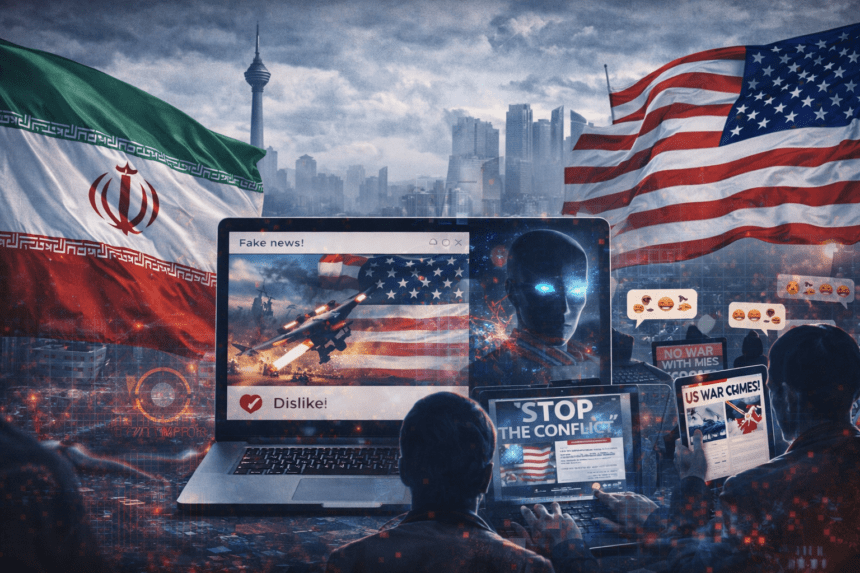
It is no longer just airstrikes, oil routes, or military positioning. It is perception. And right now, Iran is actively trying to shape how Americans see the war itself. Recent reporting shows Iran has shifted into a coordinated online information campaign aimed directly at U.S. public opinion pushing narratives, amplifying divisions, and exploiting the fact that many Americans already oppose the conflict.
That last part is key.
Polling shows a majority of Americans are already skeptical or opposed to military action against Iran, with figures ranging from roughly 47% to nearly 60% against depending on the survey.That creates an opening and Iran appears to be stepping straight into it.The Facts, This Is a Digital Frontline Now, this is not speculation. It is part of modern warfare. Iran has long invested in cyber operations, influence campaigns, and proxy digital networks. In the current conflict, that strategy has escalated into a full information war combining social media messaging, coordinated narratives, and psychological pressure.
Recent reporting shows
Targeted messaging aimed at U.S. audiences, Amplification of anti-war sentiment already present in America
Use of online networks, including coordinated accounts and AI-generated content, a focus on shaping perception rather than just spreading propaganda. At the same time, inside Iran, the government has cracked down heavily on information flow arresting hundreds for online activity and restricting internet access to control the domestic narrative.
That contrast matters.
Externally: influence and persuasion. Internally: control and suppression.The Opinion: This Is Where Wars Are Won Now. Here is the uncomfortable truth.Modern wars are not just about territory or firepower. They are about legitimacy. If you can weaken your opponent’s public support, you weaken their ability to sustain the war. That is the strategy here. And it is not new it is just more sophisticated, faster, and amplified by social media.
Iran does not need to “convince” Americans of anything completely new.
It only needs to push existing doubts a little further.That is how influence works now:,Take real divisions
Amplify them,Accelerate them, Let the system do the rest and the system is already primed.The U.S. is politically divided, media ecosystems are fragmented, and trust in institutions is already fragile. That makes information warfare far more effective than it would have been a decade ago.
The Bigger Shift
This is the real FOMO Daily takeaway:
The war is no longer just physical. It is narrative-driven.
Missiles hit infrastructure.
Information hits perception.
And perception shapes everything:
Political pressure
Policy decisions
Public tolerance for escalation
How long a war can actually last
If enough people stop believing in the purpose of the war, the war itself becomes harder to sustain — no matter what is happening on the battlefield.
Final Thought, This is not just about Iran,every major conflict now includes an information war layer. The difference today is scale and speed. Social media has turned influence into a real-time weapon, and the most important part? You do not need to win the argument, You just need to make people question it.