

The ceasefire headlines sound hopeful.
A lot of war stories look calmer in headline form than they do in reality.
The latest example is the talk around a possible U.S.-Iran proposal to end the war. On paper, it sounds like diplomacy is trying to break through. In practice, the latest reporting suggests the opposite: Iran has not accepted the U.S.-backed outline, says it is not planning direct negotiations, and has instead put forward its own hard-edged set of conditions for ending the conflict.
That matters because this is not just a disagreement over timing. It is a disagreement over the terms of reality.
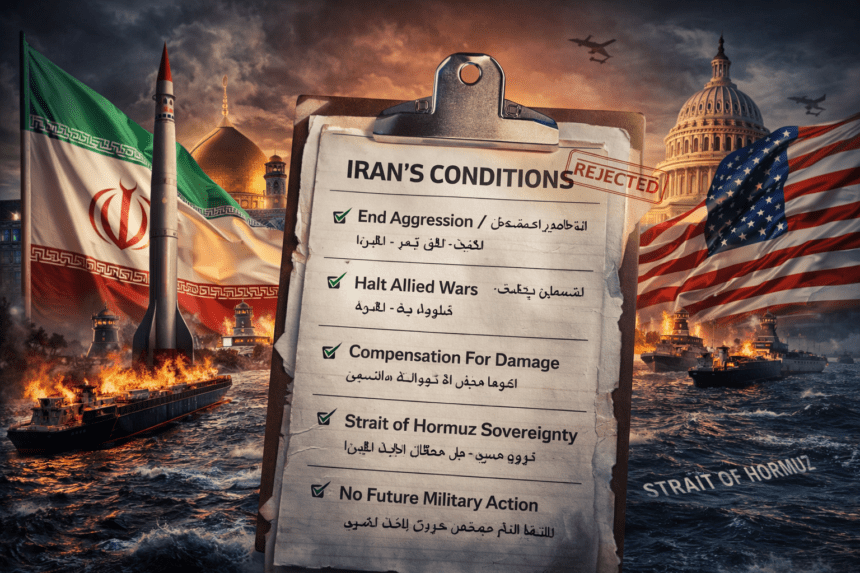
According to reporting on the Iranian position, the five demands include a full end to U.S. and Israeli “aggression and assassinations,” hard guarantees against future military action, compensation for war damage, an end to the war on all fronts involving allied regional groups, and formal recognition of Iran’s sovereignty over the Strait of Hormuz.
That is not a soft landing. That is a maximalist answer to a maximalist war.
The central issue here is not whether messages are being passed through intermediaries. They are. The real issue is whether either side is prepared to accept terms the other can live with. The current signs say no. Iran’s foreign minister said the country was reviewing the U.S. proposal but had no intention of holding talks with Washington, while separate reporting said Tehran was using mediators rather than engaging directly.
That alone should cool down any talk that a ceasefire is around the corner.
The reported U.S. proposal itself was sweeping. Reuters said it included removing Iran’s stockpile of highly enriched uranium, halting enrichment, curbing ballistic missiles, and cutting funding for regional allies. Other reporting said it also covered sanctions relief and reopening the Strait of Hormuz. Even before Iran’s response, those were terms that looked like they were designed to force strategic rollback, not merely pause battlefield escalation.
Iran’s reply appears to move in the opposite direction. One of the most important details is the Hormuz condition. Tehran is reportedly insisting that its sovereignty over the Strait of Hormuz be formally recognised. That is not some side issue buried in diplomatic wording. Hormuz is one of the world’s most critical energy chokepoints, and any settlement linked to control, access, or coercive leverage there goes far beyond a normal ceasefire discussion.
This is where the peace narrative starts to fall apart.
A real ceasefire framework usually tries to narrow the agenda to what can stop the killing fast. What is emerging here looks broader, harder, and more politically explosive. Iran is not just asking for hostilities to stop. It is reportedly linking the war’s end to guarantees, compensation, regional outcomes, and strategic recognition. Reuters also reported that Iran wants Lebanon included in any ceasefire arrangement, linking an end to the war with a halt to Israel’s offensive against Hezbollah.
That means this is not merely a U.S.-Iran de-escalation problem. It is becoming a multi-front bargaining problem, and those are much harder to solve. The White House has tried to keep the door open, saying talks remain ongoing and productive, while also refusing to confirm many of the details in circulation. But even that ambiguity tells its own story. If a proposal is real enough to move markets yet too politically sensitive to fully describe, it usually means the diplomacy is fragile and the room for public missteps is small.
Meanwhile, the war itself is still escalating around the edges. Reuters reported that the Pentagon was planning to send thousands of airborne troops to the Gulf and that Iran had warned it could widen the conflict further, including at the mouth of the Red Sea. The U.N. secretary-general warned the world was staring down the barrel of a wider regional war.
That is the bigger truth behind the ceasefire chatter.
Diplomatic contact does not automatically mean diplomatic progress. Sometimes it only means both sides are testing whether the other is weak enough to concede. Right now, the reported demands from both camps do not look like the foundations of a compromise. They look like opening bids from actors who still believe pressure can improve their position. That is why this story matters.
It shows how far the war has already moved beyond a simple battlefield contest. The conflict is now tied up with nuclear policy, regional proxy power, freedom of navigation, compensation, deterrence, and political prestige. Once all of that gets bundled into the same negotiation, ending the war becomes vastly more difficult.
The hopeful read is that hard opening terms are often part of serious bargaining. States routinely start with demands they know will not all be accepted. The darker read is that the current diplomacy is little more than political theatre wrapped around a war that neither side is ready to end on tolerable terms.
Right now, the darker read looks more convincing.
Iran’s reported five conditions do not sound like an exit ramp. They sound like a statement that the war ends only when Tehran says the price has been paid. That is not peace, that is leverage dressed up as diplomacy.