


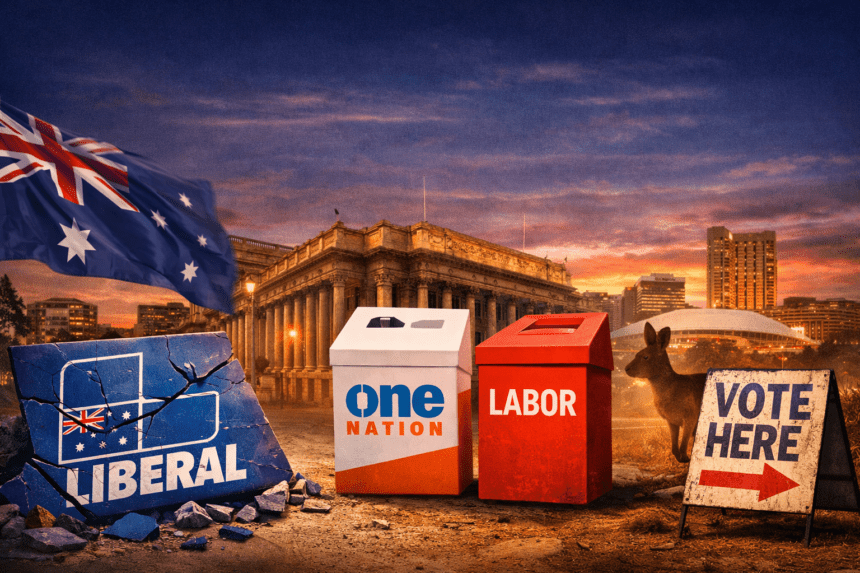
A protest vote just turned into a structural threat.
Saturday’s South Australian election delivered a comfortable win for the government, but that’s not the bit likely to keep political strategists up at night. The real story was the collapse of the traditional conservative vote and the rise of a harder-edged challenger that didn’t just hoover up protest support on the fringe, but turned discontent into proper electoral muscle. The election was held on 21 March 2026, and the official election information page confirms the key timetable and polling day date. That matters because this wasn’t just a bad night for the opposition.
It looked a lot more like a warning shot
Analysis published after the vote argued that the conservative party had not only been outpolled by its insurgent rival, but had become stuck in contradictory explanations for its own decline. That is usually a sign a party has moved beyond a temporary setback and into a full-blown identity crisis. When a political movement can’t even agree on why it is losing, it usually has no clear road back.
The pre-election warning signs were already there
The signs were there before a single vote was counted. A poll published in the final week of the campaign had Labor on 38% of the primary vote, the Liberals on 19%, and One Nation on 22%, with Peter Malinauskas well ahead as preferred premier. That wasn’t just a bit of softening in opposition support. It pointed to a conservative brand being overtaken by a party that has long been treated as a pressure outfit rather than a governing force, then election night made the danger impossible to ignore.
Post-election reporting said One Nation secured about 22% of the statewide primary vote, ahead of the Liberals on roughly 19%, while Labor remained well in front overall on about 38%. One Nation was reported to have won at least one lower-house seat and to be competitive in several more, with some outlets projecting a bloc of four to six seats in the 47-seat House of Assembly if preferences and counting broke its way.
Even if those seat projections move around as the count continues, the underlying point is already obvious: the conservative vote has fractured badly enough that the old opposition can no longer assume it is the natural home for anti-government anger.
That is the real political earthquake here
For years, the standard assumption in Australian politics was that protest parties could make noise, but the major parties would still control the main game. South Australia now looks like a warning that this assumption is breaking down. The conservative vote is no longer just leaking around the edges,It is splintering across regional seats, outer suburbs, independents and a more populist alternative willing to paint both major parties as part of the same stale machine, and that creates a much bigger problem than one ugly election result.
Because once voters get used to parking their anger somewhere else, the old opposition loses more than seats. It loses relevance. It loses authority. It loses the default right to be heard as the main critic of government. If that habit hardens over multiple elections, rebuilding becomes much harder than simply swapping leaders or tweaking the policy pitch.It becomes a straight-up credibility problem.
That appears to be where the South Australian Liberals are heading
Reporting after the election said Liberal candidates were running fourth or fifth in as many as 18 seats, including traditional conservative territory, while independents and One Nation cut through on both local and anti-establishment appeals. One political analyst quoted in post-election coverage said it was “almost impossible” to imagine a Liberal government before 2034 at the earliest. That may prove a bit dramatic, but the size of the warning is obvious.A party that can’t hold its ground in its own heartland is not dealing with a simple messaging issue, It is dealing with a viability issue, and what makes this more important is that it should not only worry the Liberals, it should worry Labor too.
One of the sharpest takeaways from the post-election analysis was that the insurgent right did not only perform well in the expected regional or conservative pockets. It also showed strength in working-class suburbs and lower-income areas, where frustration with the political mainstream can cut across old party loyalties.
Separate reporting on the demographic pattern suggested the strongest swings came in electorates with lower postgraduate education levels and higher shares of below-average incomes, while outer suburban and regional dissatisfaction appeared to fuel much of the rise.That means this is not just a conservative family scrap. It is also a sign that economically anxious voters are becoming more willing to ditch traditional party habits altogether.
That is the part Labor cannot afford to shrug off
Yes, it won.Yes, it remains the dominant party in the state. But a protest movement that grows by feeding on distrust, cultural frustration and cost-of-living pressure does not need to win government straight away to change the shape of politics. It only needs to create a permission structure for more voters to treat it as a legitimate vehicle for anger, once that happens, every major party becomes more vulnerable in places it once thought were safe, that is why this result feels bigger than a state story.
It looks like part of a broader national pattern in which the old centre-right is losing its monopoly over discontent. In South Australia, that trend became visible in one of the clearest ways possible: a right-wing challenger outpolling the Liberals statewide, taking or threatening lower-house seats, and repositioning itself as more than a protest brand, that does not automatically make it a durable long-term force.
But it does mean the old assumption that these votes eventually drift back home is looking a lot shakier and once that assumption dies, politics changes fast.Because the conservative side of politics then has only two bad options. It can move further towards the insurgent force and risk legitimising it, or try to hold the centre and keep bleeding voters who think caution now looks like weakness, neither path is painless, both can deepen the split before they resolve it.
That is why the South Australian result matters beyond Adelaide
The headline was a government victory.The deeper story was a political system losing one of its old certainties.The Liberals were not just beaten.They were overtaken on their own side of politics by a rival that fed on disillusionment, fragmentation and the belief that the old opposition no longer means what it says.
That kind of result doesn’t stay local for long