

The Iran war shows military AI has moved from theory to live operations.
The future of warfare is no longer hypothetical, For years, the public conversation around military artificial intelligence has focused on one dramatic image: a machine making the final decision to kill. That framing is still useful, but it now feels incomplete. The more urgent reality is less cinematic and far more immediate. AI does not need to pull the trigger itself to transform war. It only needs to shape what commanders see, how quickly they see it, which targets rise to the top, and how much time humans have left to question the machine’s output.
That threshold appears to have been crossed
Reporting from The Guardian said the US military reportedly used Anthropic’s Claude during the Iran strikes for intelligence, target selection support and battlefield simulations, citing earlier reporting from the Wall Street Journal and Axios. The Guardian also noted that the reported use came even as Donald Trump had moved to ban Anthropic from federal use, exposing how deeply these systems may already be embedded inside military workflows.
Then came public confirmation that made the broader point harder to dismiss. On March 11, Al Jazeera reported that CENTCOM chief Admiral Brad Cooper said US warfighters were using a “variety of advanced AI tools” to process large volumes of data in seconds. Cooper added that humans still make final decisions on “what to shoot and what not to shoot and when to shoot,” while AI compresses processes that once took hours or days into seconds.
That distinction matters, because once AI is choosing what gets surfaced, what gets ranked, what looks urgent, and what becomes actionable, it is already influencing lethal force. Even if a human signs off at the end, the software may have defined the decision space long before that final approval ever happens. In other words, the question is no longer just whether humans remain in the loop. It is whether the loop itself is being redesigned around machine speed.
The real shift is upstream
The most important change in AI warfare is not full autonomy. It is upstream influence, Military officials tend to frame AI as a productivity tool: something that helps sift through noise, accelerate analysis and improve situational awareness. On paper, that sounds manageable. In practice, it can radically alter battlefield judgment. When software condenses a sprawling body of intelligence into a shortlist of likely threats or likely targets, it does more than save time. It shapes attention. It prioritizes one interpretation of reality over others. It nudges operators toward specific decisions, even if it never explicitly commands them.
That is why Cooper’s quote is more revealing than reassuring. Saying humans still decide “what to shoot” leaves open a far larger question: who or what decided which targets were put in front of them in the first place? Speed is the military selling point. It is also the danger.
Al Jazeera’s report captured the Pentagon’s case clearly: AI helps leaders make smarter decisions faster than the enemy can react. But speed is not neutral in war. Faster processes can mean less time for skepticism, less time for challenge, and less space for moral hesitation. The more warfare is optimized around rapid machine-assisted decisions, the easier it becomes for human oversight to shrink into a final procedural checkbox.
From experiment to institution
This is not just a live battlefield story. It is now an institutional one, Reuters reported on March 20 that Palantir’s Maven AI system is set to become an official Pentagon program of record, which would lock in long-term funding and deepen its adoption across the US military. According to Reuters, Maven analyzes battlefield data, identifies potential threats or targets, and is already central to military operations. The same report said the system is already the primary AI operating system for the US military and is being used in a campaign that has included thousands of targeted strikes against Iran, That is a major line in the sand.
Military AI is no longer sitting in the pilot-project phase, floating in the realm of demos and strategic concept papers. It is being operationalized, standardized and budgeted. Once a system becomes a formal program of record, the argument shifts. The question is no longer whether it will be used. The question becomes how broadly, how often and under what rules.
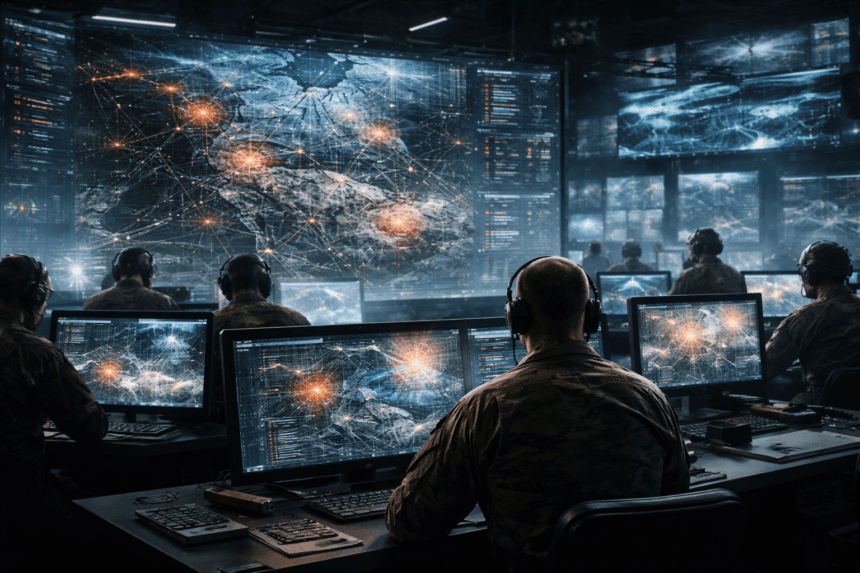
Reuters also reported that Maven rapidly analyzes data from satellites, drones, radars, sensors and intelligence reports, using AI to identify potential threats and targets such as military vehicles, buildings and weapons stockpiles. Palantir says humans remain responsible for selecting and approving targets, but the platform’s core role in battlefield analysis makes the distinction between assistance and influence increasingly difficult to separate in practice.
The Anthropic clash exposed the real fight
The Pentagon’s clash with Anthropic revealed something even bigger than a contractor dispute, Reuters reported on March 11 that a standoff erupted after Anthropic refused to loosen safety guardrails on its systems, especially around autonomous weapons and domestic surveillance. That dispute led the Pentagon to label the company a “supply-chain risk,” putting government contracts at risk and turning the disagreement into a high stakes test of how much control AI companies can retain once their tools are pulled into national security infrastructure, the core issue here is not personality, politics or Silicon Valley branding. It is governance.
Anthropic’s position suggested that model developers still wanted enforceable lines around certain uses. The Pentagon’s response suggested that those limits were increasingly unwelcome once battlefield utility had been demonstrated. That is the part the public should focus on. The dispute was not really about whether AI belongs in war. That question has already been answered by events. The fight was about how few restrictions military institutions are willing to tolerate once AI becomes operationally valuable, and that is where the conversation gets uncomfortable.
Because once AI systems become deeply embedded in intelligence and targeting pipelines, removing them becomes strategically painful. They become sticky. They deliver speed, scale and pattern recognition that human teams alone struggle to match at modern battlefield tempo. That creates an almost automatic political logic: if a tool appears to offer advantage, pressure builds to normalize it, expand it and defend its use.
“Human in the loop” is not enough anymore
The phrase “human in the loop” has become the default reassurance in almost every public discussion of military AI, but the phrase is beginning to do more public relations work than analytical work.
A human being can remain nominally in control while still operating within a machine curated environment. A commander may approve a strike, but the software may have pre-ranked the target, filtered the evidence, highlighted the threat score, suppressed ambiguity and condensed the timeline for decision-making. In that scenario, the human is still present, but the machine has already shaped the outcome, That is not the same as autonomy. But it is not meaningful human control either. Meaningful control requires more than a final yes or no click. It requires time, transparency, challenge ability and accountability. It requires humans to understand how recommendations were produced, what the confidence levels are, what the blind spots may be, and what alternative interpretations were excluded. Without that, “human in the loop” can become a comforting slogan wrapped around increasingly automated judgment.
The civilian-cost question is only getting bigger
The timing of the AI confirmation is also significant, Al Jazeera reported Cooper’s remarks in the context of mounting civilian-casualty concerns, including calls for an independent investigation into the bombing of a school in southern Iran that reportedly killed more than 170 people, mostly children. The same report said the US-Israeli campaign had killed at least 1,300 people in Iran since it began on February 28, while the Iranian Red Crescent said nearly 20,000 civilian buildings and 77 healthcare facilities had been damaged. Those latter figures come from Iranian-linked sources in wartime and should be treated cautiously, but they underscore the stakes of any claim that AI is making conflict cleaner, smarter or more precise. That is where public scrutiny should intensify.
Every time officials describe AI as a tool for faster or better targeting, they are implicitly making a quality claim. They are suggesting that more data, processed faster, improves outcomes. But without meaningful transparency, there is no way for the public to evaluate how these systems actually performed, what error rates were tolerated, what assumptions were baked into the models, or how many civilian harms were linked to flawed analysis, biased training data, poor inputs or overconfidence in automated recommendations. If AI is being used to help wage war, then “trust us” is not good enough.
The black box problem
One of the biggest dangers in military AI is not just misuse, It is opacity.The public still does not have a clear map of what these AI systems did in the Iran campaign, how much weight operators gave their outputs, how recommendations were audited, or what happened when machine suggestions conflicted with human analysis. There is a huge difference between using AI to summarize raw intelligence and using it to identify likely targets under time pressure. Yet public facing language often blurs those categories together under vague terms like “advanced AI tools” or “decision support.”
That vagueness is politically useful. It lets officials advertise innovation without accepting full responsibility for consequences. It also makes post-strike accountability harder, because blame becomes distributed across contractors, analysts, commanders, interface designers, training data, procurement choices and battlefield urgency. The more complex the system, the easier it becomes for every actor to point somewhere else. And in warfare, that is a dangerous design feature.
This is no longer a future debate
The biggest mistake now would be to keep treating military AI as an abstract ethics seminar topic. This is not a speculative policy conversation about what might happen one day if the technology advances far enough. The technology is already here. The reported use of Claude, the public confirmation of advanced AI tools, and the formal expansion of Palantir’s Maven all point in the same direction: AI is becoming a core layer of modern military operations, particularly in intelligence processing, operational planning and targeting workflows. That means the debate has to mature.
The central questions now are governance questions. What forms of military AI use should be prohibited outright? What kinds of auditing should be mandatory? Who gets to inspect these systems after controversial strikes? What documentation should be preserved? What counts as meaningful human control? And what happens when battlefield incentives reward speed more than caution? Until those questions are answered seriously, the phrase “AI assisted warfare” will remain both technically impressive and politically evasive.
The bottom line
AI did not need to become fully autonomous to change war forever.It only needed to become useful, fast and embedded. That is what the Iran conflict appears to have shown. Not a science fiction future where machines independently decide who lives and dies, but something arguably more plausible and more dangerous: a present where humans are still there at the end of the process, yet the process itself is increasingly shaped by software.The trigger may still belong to a person. But the kill chain is already learning how to think like a machine.