


FOMO DailyFOMO DailyFOMO Daily
Font ResizerAa
  • Home
  • News
  • Politics
  • Entertainment
  • Sport
  • Lifestyle
  • Finance
  • Cryptocurrency
Reading: Banks May Have Moved the Next Financial Shock Outside the Banking System
Share
Font ResizerAa
FOMO DailyFOMO Daily
  • Home
  • News
  • Politics
  • Entertainment
  • Sport
  • Lifestyle
  • Finance
  • Cryptocurrency
Search
  • Home
  • News
  • Politics
  • Entertainment
  • Sport
  • Lifestyle
  • Finance
  • Cryptocurrency
Copyright © 2026 FOMO Daily - All Rights Reserved.

Banks May Have Moved the Next Financial Shock Outside the Banking System

As bank exposure to nonbank lenders swells, the next liquidity scare may start where regulation is thinnest and valuations are murkiest.

Oscar Harding
Last updated: March 19, 2026 4:28 am
Oscar Harding
5 Min Read
Share
5 Min Read

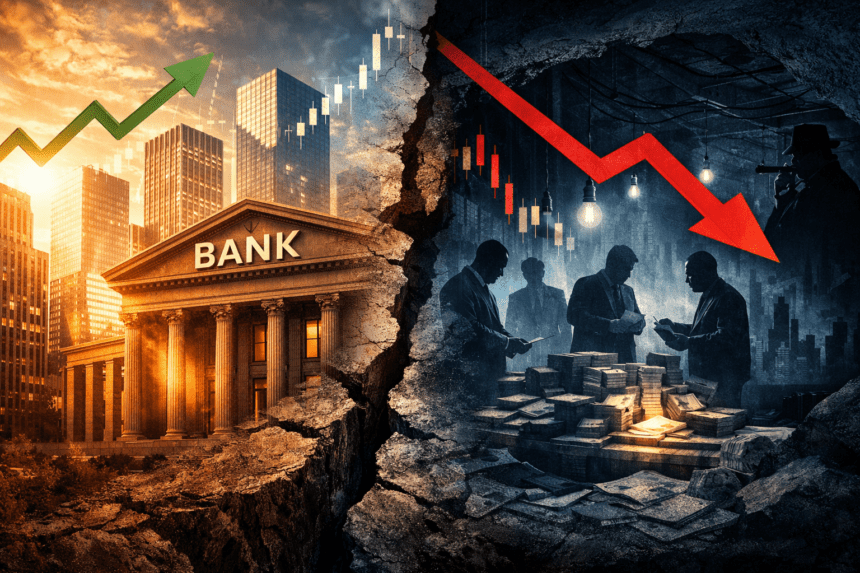
Wall Street did not kill credit risk after 2008. It may have just pushed it into a darker corner of the market.

The post-2008 banking story was supposed to be about safety. Banks were meant to deleverage, clean up balance sheets, and reduce the kind of risks that nearly detonated the financial system in the Global Financial Crisis. But the latest warning is more unsettling: a large share of that risk may not have disappeared at all. It may have simply migrated into the shadow-lending world of private credit, nonbank finance, and opaque funding chains.

That is the core argument behind the latest market anxiety.  Banks have moved the equivalent of roughly 18 million BTC into shadow lenders, pointing to around $1.3 trillion in bank lending tied to nondepository financial institutions. Federal Reserve data show loans to nondepository financial institutions have indeed climbed to around $1.9 trillion in early 2026, while Fed research published in 2025 also highlighted how commitments to other nonbank financial institutions had surged to about $2.2 trillion after years of rapid growth.

That does not automatically mean another 2008-style collapse is imminent. But it does suggest the fault line may have moved. Instead of risk sitting squarely on bank balance sheets, more of it now runs through private credit funds, securitization vehicles, and other nonbanks that are typically less transparent and less tightly regulated than traditional lenders. The IMF and other stability watchers have repeatedly warned that the rapid growth of nonbank finance is creating new vulnerabilities for the global financial system.

The timing matters. Private credit has grown into a roughly $2 trillion market, and concerns around that sector have become harder to ignore in recent weeks. Reuters reported that investors have questioned valuations in Blue Owl’s private credit portfolio, while fund withdrawal limits and markdowns elsewhere have added to the feeling that the sector has not yet been tested by a full credit cycle. MarketWatch also reported that major banks now carry sizable private-credit exposure, and UBS has warned that the space still has not faced a true stress event.

This is why the “shadow lender” issue matters beyond finance insiders. When lending migrates from regulated banks to less visible credit channels, the system can look safer on the surface while becoming harder to map underneath. The New York Fed has argued that banks and nonbanks are not clean substitutes but deeply interconnected, with nonbanks often relying heavily on bank funding, credit lines, and back-end support. That means stress in private credit may not stay neatly contained inside private credit.

Regulators are clearly paying attention. The Bank of England this week proposed tougher liquidity readiness reforms, shaped in part by lessons from Silicon Valley Bank and Credit Suisse, while Australia’s Reserve Bank said nonbank lenders and private credit firms have increased credit availability but could also contribute to higher loan losses ahead, even if their current systemic footprint remains smaller than the banks’.

The real warning here is not that history will repeat in the exact same way. It is that finance has a habit of shifting risk to wherever oversight is lighter, liquidity looks plentiful, and investors are willing to believe the plumbing is stronger than it really is. In 2008, that illusion shattered in housing linked credit. In 2026, the market is increasingly wondering whether the next crack could begin in private credit and the wider nonbank lending web surrounding it. That is not the same crisis. But it rhymes.

For Bitcoin and crypto watchers, the deeper angle is simple. If shadow-credit stress triggers a broader liquidity event, risk assets will not get a free pass just because they sit outside the banking system. In a genuine funding squeeze, correlation rises, leverage unwinds, and investors sell what they can. The banking system may look better capitalised than it was in 2008, but the question now is whether the next scare has already been outsourced.


Bitcoin Just Flashed a Rare Capitulation Signal That Historically Triggers a Violent Rally to $180,000 in 90 Day
The Next Internet Must Give Control Back to Users
Media outlets refuse Pentagon rule, defend press rights
Poland Stands Alone Veto Leaves It the EU’s Crypto Outlier
Inside trades in Washington: stop the self-dealing now!

Sign up to FOMO Daily

Get the latest breaking news & weekly roundup, delivered straight to your inbox.

By signing up, you acknowledge the data practices in our Privacy Policy. You may unsubscribe at any time.
Share This Article
Facebook Whatsapp Whatsapp LinkedIn Reddit Telegram Threads Bluesky Email Copy Link Print
ByOscar Harding
G'day I’m Oscar Harding, a Australia based crypto / web3 blogger / Summary writer and NFT artist. “Boomer in the blockchain.” I break down Web3 in plain English and make art in pencil, watercolour, Illustrator, AI, and animation. Off-chain: into  combat sports, gold panning, cycling and fishing. If I don’t know it, I’ll dig in research, verify, and ask. Here to learn, share, and help onboard the next wave.
Previous Article Playnance Pushes G Coin Into the Spotlight as Launch Day Arrives
Next Article Coinbase’s Security Message Just Collided With Its Own Advice

Latest News

EtherFi Bets on Real-World Yield as DeFi Shifts Direction
Finance Innovation News Opinion
Coinbase’s Security Message Just Collided With Its Own Advice
Finance Opinion
Playnance Pushes G Coin Into the Spotlight as Launch Day Arrives
Cryptocurrency Innovation Technology
The Iran War Just Entered a Dangerous New Phase
Economy Finance Opinion Politics
Stablecoins Just Lost a Key Fight in Washington
Business Finance News
EU Condemns Deadly Kabul Hospital Strike as Pakistan-Afghanistan Crisis Deepens
News Opinion Politics
The DAO Dream Is Hitting Reality
News Technology News World News
Crypto Wanted to Kill the Card Giants. Now the Card Giants Are Buying the Rails
Finance International Crypto News News Opinion
America’s Crypto Reset Is Real — But The Biggest Story Is Who Gets To Run It
Business Cryptocurrency Economy Finance Opinion Politics
Taliban Alleges Mass-Casualty Pakistan Strike On Kabul Rehab Centre, But The Full Death Toll Is Still Unconfirmed
News Opinion Politics World News
North Korea’s War Dividend Keeps Growing As Russia’s Grind Turns Into Pyongyang’s Payday
Business Finance News Opinion Politics
Bitcoin Near $75K Again
Finance News
Free Speech Is Not The Right To Control Other People’s Ears
Business Economy Entertainment Finance Opinion
Solana Turns Six And Wall Street Is Quietly Moving On-Chain
Cryptocurrency Finance News Opinion

You Might Also Like

Australia’s New Hate Speech Laws and the Battle Over Free Expression

February 25, 2026

BlackRock May Have Just Made Ethereum Income Impossible to Ignore

March 15, 2026

Trump’s Crypto Empire and the New Influence Economy

November 30, 2025

XRP altcoin ETF inflows lead XRP over SOL

November 26, 2025

FOMO Daily — delivering the stories, trends, and insights you can’t afford to miss.

We cut through the noise to bring you what’s shaping conversations, driving culture, and defining today — all in one quick, daily read.

  • Privacy Policy
  • Contact
  • Home
  • News
  • Politics
  • Entertainment
  • Sport
  • Lifestyle
  • Finance
  • Cryptocurrency

Subscribe to our newsletter to get the latest articles delivered to your inbox.

FOMO DailyFOMO Daily
Follow US
Copyright © 2026 FOMO Daily. All Rights Reserved.
Welcome Back!

Sign in to your account

Username or Email Address
Password

Lost your password?