


nhs england youth hormone pause gender care fight
The NHS did not just tweak guidance. It moved the centre of gravity again
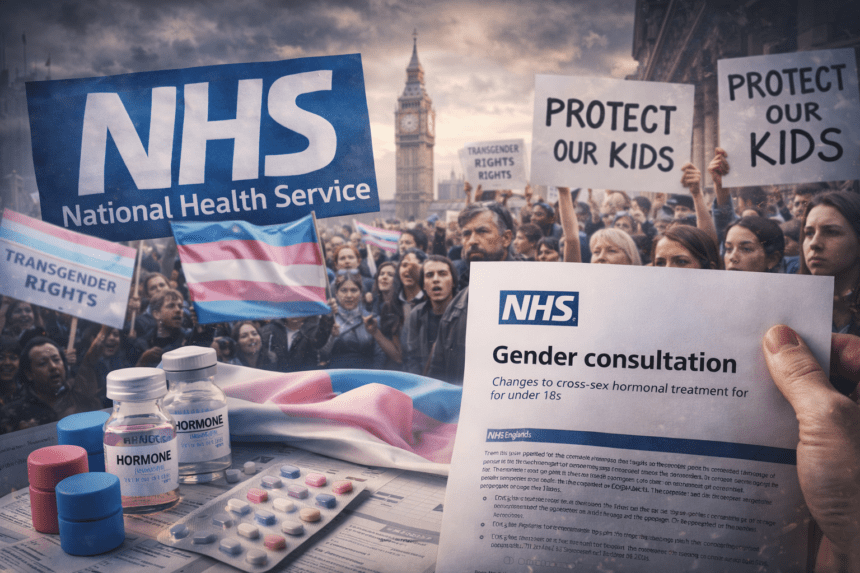
Britain’s argument over youth gender medicine just got even more combustible. NHS England has opened a 90 day consultation on a revised policy that would make masculinising and feminising hormones unavailable as a routine commissioning option for under-18s through its Children and Young People’s Gender Service. The consultation runs from 9 March to 7 June 2026, and the draft policy says the treatment is “not recommended to be available as a routine commissioning option” because NHS England concluded there is not enough evidence on safety and clinical effectiveness to support routine use.
That is a major change in practical terms. Under the previous policy, some 16- and 17-year-olds could still be referred for hormone treatment under strict conditions, including national multidisciplinary review. Under the new draft, those new referrals would stop. NHS England says young people already receiving these prescriptions may continue, but only with case-by-case review and shared decision-making with clinicians and families where appropriate.
The linked opinion piece argues the NHS has not gone far enough. That is one political reading. But the harder factual point is this: NHS England is already moving far beyond a symbolic pause. It is consulting on whether to remove routine access altogether for minors in this service. That means the real fight is no longer about whether the system is becoming more restrictive. It already is. The fight is now about whether this is a necessary evidence-based reset or an overcorrection that will deny care to young people who say it helps them.
Why NHS England says it is doing this
NHS England’s case rests on evidence, or what it says is the lack of it. In the consultation guide, it says NICE found very limited evidence in 2021 about the safety, risks, benefits, and outcomes of these hormones in under-18s, and that a further independent review commissioned in 2025 found “very limited and weak evidence” to support continued access for children and young people under 18. NHS England says that, after considering those reviews, it concluded there is not enough evidence to support routine prescribing going forward.
That language matters because it mirrors the wider post-Cass direction of travel in England. The Cass Review, commissioned by NHS England and published in 2024, concluded that the evidence base around paediatric gender medicine was weak and recommended a more cautious, holistic model of care. Reuters reported at the time that Cass described the evidence around youth gender care as “remarkably weak.” NHS England’s current approach is explicitly framed as part of implementing those recommendations.
The draft policy also points to something even more striking in its evidence summary: several treatment categories returned no evidence for critical or important outcomes, including some hormone pathways involving oestrogen, testosterone, and GnRH analogues in specific youth populations. That does not prove those treatments never help. It does show how thin NHS England believes the research base is when it tries to justify routine commissioning decisions.
Why critics say the NHS is moving too far, too fast
This is not a settled medical consensus story. It is a live, bitterly contested one. Trans advocacy groups have condemned the latest pause, with BMJ reporting that some labeled the move “cruel” and are considering legal action. The British Medical Association has also previously pushed back on the Cass Review’s implementation, saying in 2024 that it wanted a pause while it evaluated the review and warning that transgender and gender-diverse patients should continue to receive specialist healthcare regardless of age. The BMA also criticized political moves to ban puberty blockers, saying treatment decisions should be made by clinicians, patients, and families on the best available evidence, not by politicians.
That criticism is not trivial. Opponents of the new NHS direction argue that “insufficient evidence” is not the same thing as evidence of no benefit, and they say policy is being hardened in a field where robust paediatric trial data is often limited across many treatments. Some critics also argue that the Cass process and the evidence reviews placed too little weight on existing clinical experience, trans-affirming research, and the harms of delaying treatment. Those methodological objections are part of why the BMA moved to publicly evaluate the Cass Review in the first place.
That is why this issue keeps exploding politically. One side sees a long-overdue correction in an area involving irreversible physical changes and weak evidence. The other sees a healthcare system increasingly closing doors on a vulnerable group while dressing that decision in the language of neutrality and caution. Both sides claim the language of patient protection. That is what makes this fight so hard to resolve.
The real shift is bigger than one opinion column
The deepest story here is not whether one commentator thinks the NHS should go further. It is that England’s model for youth gender care has now clearly broken with the old assumption that medical transition pathways for minors should expand as a normal part of service development. The direction of travel since 2024 has been the opposite: puberty blockers stopped as routine care, new research-only restrictions, a wider Cass-led service redesign, and now a consultation on ending routine access to masculinising and feminising hormones as well.
That shift also comes with a broader service redesign. NHS England says it is expanding regional services and pushing a more holistic model involving mental health, neurodevelopmental assessment, paediatrics, and broader clinical support rather than a narrowly medicalised pathway. Supporters say this is safer and more evidence-based. Critics hear something else: a system becoming more gatekept, slower, and less willing to provide transition-related care.
The political consequence is huge. Britain is becoming one of the clearest Western examples of a health system moving away from routine medical transition pathways for minors. That will be watched closely in Australia, Europe, and North America, where the same arguments over evidence, ethics, autonomy, and long-term outcomes are still raging. This is no longer just a British service-specification dispute. It is becoming part of the global template fight over how youth gender care should be governed.
The FOMO Daily angle
The headline is not simply that the NHS hit pause. The headline is that England is rebuilding the whole logic of youth gender care around evidentiary caution, and that move is forcing everyone else to pick a side. NHS England is saying routine prescribing should not continue without stronger proof. Critics are saying the burden of uncertainty is being pushed almost entirely onto trans young people and their families.
That is why this story matters. When a major national health system says the evidence is too weak to justify routine hormone prescribing for under-18s, it changes the frame of the debate everywhere. Even people who strongly oppose the NHS move now have to argue against a policy that is being presented not as moral panic, but as ordinary evidence based commissioning. That is politically powerful.
Bottom line,my article is an opinion argument that the NHS pause does not go far enough. The verified policy reality is already substantial: NHS England has paused new under 18 hormone referrals and opened a consultation on removing masculinising and feminising hormones as a routine option in its youth gender service. Existing patients may continue, but only with individual review.
Whether you see that as overdue caution or harmful retrenchment depends on how you weigh weak evidence against access to care. But one thing is clear: England is no longer cautiously trimming its youth gender model around the edges. It is rewriting it.