


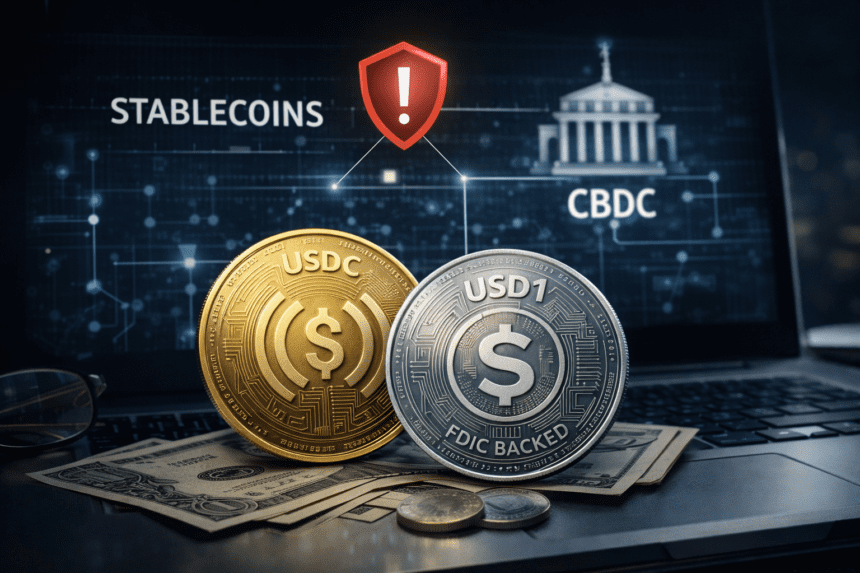
stablecoins vs cbdcs
The label changed, but the core concern never really disappeared
Washington has spent the past year making one political message crystal clear: America does not want a retail central bank digital currency. The Federal Reserve still defines a CBDC as digital central bank money, meaning a direct liability of the central bank itself, and the White House moved in January 2025 to prohibit federal agencies from establishing, issuing, or promoting a U.S. CBDC. That gave anti-CBDC lawmakers and privacy advocates a major win on paper.
But that was not the end of the digital dollar story. It was the start of a pivot. Instead of moving toward a Fed-issued retail CBDC, the U.S. moved toward a regulated stablecoin system. In July 2025, President Donald Trump signed the GENIUS Act into law, creating a federal framework for payment stablecoins. Supporters pitched it as a pro-innovation move that could modernize payments, expand dollar dominance, and bring legal clarity to a fast-growing sector. Reuters reported that backers also viewed it as a way to push stablecoins deeper into mainstream finance while increasing demand for Treasuries and strengthening the dollar’s role globally.
That is where the real argument begins. Stablecoins are not CBDCs in the strict legal sense. But if private digital dollars can be frozen, blocked, screened, and tightly integrated into government-directed compliance rails, then the user experience can start to look uncomfortably similar to the very thing Washington claims to have rejected. That does not mean America secretly launched a CBDC through the back door. It does mean the line between “government digital money” and “private digital money under government-shaped control” is thinner than many people want to admit.
Stablecoins and CBDCs are not the same thing, and that difference matters
The most important distinction is still the issuer. A CBDC is central bank money. The Federal Reserve says that plainly. It would be a digital form of money issued by the central bank and treated as a direct liability of that central bank. A stablecoin, by contrast, is generally issued by a private company. Its credibility depends on reserve quality, redemption structure, legal protections, and the strength of the rules wrapped around it.
That sounds technical, but it matters in practice. If you hold a CBDC, your claim is on the state’s monetary authority. If you hold a stablecoin, your confidence depends on whether the issuer really has the assets it says it has, whether those reserves are liquid in a crisis, and whether redemption remains smooth under stress. Even a tightly regulated stablecoin is still not the same as sovereign money. It is a private product designed to mimic sovereign money as closely as possible.
This is one reason why the Bank for International Settlements has been so skeptical of stablecoins becoming foundational money. In its 2025 annual report, BIS argued that stablecoins perform poorly on what it called singleness, elasticity, and integrity. In simple terms, BIS is saying stablecoins do not naturally provide the same unified, reliable money quality as central bank-backed systems. The institution even compared them to old private banknotes whose value depended on the issuer behind them. Reuters’ coverage of the BIS warning made the same point: stablecoins may look dollar-like, but they do not carry the same monetary structure as central bank money.
So no, stablecoins are not just CBDCs with different branding. That claim is too sloppy. But dismissing the overlap entirely is just as weak.
The real overlap is not legal identity. It is control
Most people do not experience money through legal theory. They experience it through access. Can you send it. Can you receive it. Can someone block it. Can someone freeze it. Can the issuer refuse a transfer. Can authorities intervene. These are the questions that actually matter once money becomes fully digital.
This is where the comfortable distinction between stablecoins and CBDCs starts to fade. Circle’s USDC terms state that the company reserves the right to block certain addresses and freeze associated USDC in some circumstances. The terms also make clear that Circle may act when it believes activity is illegal or in violation of its rules, and it can respond to valid legal orders from authorities. That is not a fringe theoretical feature. It is baked into the operating framework of one of the most important dollar stablecoins in the market.
The GENIUS Act pushes that compliance reality even further into the open. The White House fact sheet on the law says stablecoin issuers are subject to Bank Secrecy Act obligations and must establish effective anti-money-laundering and sanctions compliance programs. More strikingly, the White House also said issuers must possess the technical capability to seize, freeze, or burn payment stablecoins when legally required and comply with lawful orders to do so. That is a very big sentence, and it deserves more attention than it gets. It means these systems are not just allowed to be controllable. Under the federal framework, they are expected to be controllable.
This is why critics keep saying the fight is no longer just about whether a digital dollar is issued by the Fed. If your main fear about a CBDC was programmable restrictions, surveillance-friendly architecture, or the ability to stop lawful users from moving funds without the friction of physical cash, then a tightly regulated stablecoin regime can raise some of the same concerns. The issuer may be private, but the power layer is still very real.
The U.S. may have rejected the name CBDC while keeping many of the tools critics feared
This is the political genius of the stablecoin pivot. A CBDC sounds like government money. It triggers immediate debates about surveillance, centralization, and state overreach. A stablecoin sounds like innovation, private enterprise, and market competition. That makes it much easier to sell politically, especially in an administration determined to look pro-crypto and anti-CBDC at the same time.
But regulatory architecture matters more than branding. The January 2025 executive order made it clear the administration did not want agencies building or promoting a U.S. CBDC. Then the July 2025 stablecoin framework made it clear that the administration did want privately issued digital dollars operating inside a compliance-heavy federal perimeter. That is a different structure, but not a completely different direction. It still deepens the digitization of dollar payments and still builds rails for intervention, screening, and enforcement.
This is exactly why the argument in the linked opinion piece resonates even when some of its framing is intentionally provocative. The sharpest version of the thesis is not that stablecoins and CBDCs are literally identical. It is that America may have rejected the politically toxic label while preserving or even strengthening many of the control capacities that made the label toxic in the first place. That is a more defensible claim.
Tether and Circle already show how digital dollars can be stopped
If anyone still thinks these powers are hypothetical, the market has already moved past that stage. Circle’s legal terms openly describe block and freeze mechanisms. Tether has repeatedly publicized its cooperation with law enforcement as part of its compliance posture. In February 2026, Reuters reported that Tether said it had frozen about $4.2 billion in USDT tied to illicit activity, mostly over the previous three years. That is an extraordinary number. It shows how powerful issuer-level control becomes once a stablecoin reaches global scale.
For defenders of stablecoins, this is evidence that the system works. It helps combat scams, sanctions evasion, terrorism financing, and financial crime. For civil-liberties critics, it proves the opposite point: once digital money lives inside centralized compliance hooks, access can be altered, stopped, or reversed at the issuer layer. Both readings are true at the same time. That is what makes the debate harder than crypto partisans usually admit.
The White House itself underlined this tension in its July 30, 2025 recommendations on digital financial technology. The report described a “unique feature” of stablecoins as the ability of issuers to coordinate with law enforcement to freeze and seize assets. That sentence is hugely revealing because it frames intervention not as an unfortunate side effect, but as a built-in feature of the product class.
This does not mean stablecoins are secretly the same as a Fed wallet
It is still important not to flatten the whole issue into lazy fearmongering. America has not rolled out a single national retail ledger. Households do not hold direct Fed-issued consumer balances. There is no universal state wallet. There is no evidence the federal government has launched a retail CBDC system in disguise. Stablecoins remain private liabilities and circulate across multiple issuers, platforms, and custody setups. That diversity matters.
There is also still more room for competition in a stablecoin model than in a pure CBDC model. Different issuers can compete on trust, features, integrations, and ecosystems. Stablecoins can exist on public blockchains rather than a single sovereign ledger. Some users can self-custody them rather than relying entirely on government-facing retail accounts. Those are not trivial differences. They change the structure of the system and the distribution of power inside it.
That is why the strongest version of the critique has to be precise. Stablecoins are not CBDCs. But regulated stablecoins can deliver some CBDC-like outcomes in practice, especially around traceability, compliance enforcement, blacklisting, freezing, and asset seizure. The danger is not that words lose meaning. The danger is that people focus so much on the word CBDC that they stop watching what the actual digital dollar stack is becoming.
Privacy is the real battlefield, not the acronym
The acronym fight is emotionally powerful, but the privacy fight is more important. The world is moving toward more digital money, more digital settlement, and more digitally enforceable rules. The question is not whether every digital payment tool is a CBDC. The question is how much freedom the user retains once money is fully programmable and fully linked to compliance systems.
This is why debates in Europe around the digital euro are worth watching. The European Central Bank has emphasized that its digital euro design is meant to include offline functionality offering a cash-like level of privacy. The ECB says that when paying offline, only the payer and the payee would know the personal transaction details. Whatever one thinks of the digital euro politically, that design language shows that privacy is now central to the legitimacy of digital money debates.
Stablecoin advocates often imply that private issuance automatically means more freedom. That is not necessarily true. A privately issued token that can be frozen, seized, or screened at multiple points in the system is not cash-like privacy. It may still be more open than a badly designed state CBDC, but that is a low bar. Private branding does not guarantee civil-liberties protection. Governance design does.
The smarter public conversation would stop treating “not a CBDC” as the end of the inquiry. It should instead ask harder questions. How transparent are freeze decisions. What due process exists. How narrow are blacklist authorities. What data is collected. What can be shared. How easy is self-custody. How dependent is the user on regulated chokepoints. Those are the questions that decide whether digital dollars expand freedom or narrow it.
Why Washington likes this route so much
There is a reason stablecoins have become the preferred U.S. answer. They allow policymakers to claim innovation without owning the political cost of a central-bank-run retail product. They support dollar expansion globally. They can drive demand for short-term government debt. They give the U.S. a chance to modernize parts of its payments architecture without formally changing the nature of money issuance at the Federal Reserve level.
They also fit the current political mood. An anti-CBDC stance plays well with voters worried about surveillance. A pro-stablecoin stance plays well with markets, fintech, and the crypto sector. Put the two together and Washington gets a narrative that sounds both liberty-friendly and innovation-friendly. That is a powerful combination even if the deeper reality is more complicated.
The problem is that digital control does not disappear just because the state delegates issuance to private firms. In some ways it can become harder for the public to see. The money is not “government money,” but the rules governing it can still reflect government priorities, government orders, and government enforcement channels. For ordinary users, the practical difference matters less at the moment of restriction than it does in constitutional theory.
The bottom line
Stablecoins are not CBDCs in the strict legal and institutional sense. A CBDC is direct central bank money. A stablecoin is a private liability wrapped in reserve backing, redemption promises, and regulation. That distinction is real and worth defending because sloppy language makes bad policy.
But the bigger truth is harder to ignore. The U.S. has not escaped the digital dollar control debate by rejecting a retail CBDC. It has simply moved the debate into a different structure. Under the federal stablecoin framework, private issuers are expected to maintain AML programs, sanctions compliance, and the technical ability to freeze, seize, or burn tokens when legally required. Circle’s own terms confirm block and freeze powers. Tether’s public enforcement history shows these powers are being used at scale already.
That means the real issue is no longer whether stablecoins are “secret CBDCs.” They are not. The real issue is whether the digital dollar future being built in America protects user freedom in any meaningful way once the compliance layer fully hardens around it. If the answer is no, then the name on the product will matter far less than most people think