

A regional conflict is rapidly expanding into a global geopolitical crisis
The War That Changed the Middle East
The conflict between Iran, the United States, and Israel has entered a dramatic and dangerous phase. What began as targeted military strikes has quickly escalated into one of the most volatile geopolitical crises of the decade.
Joint U.S. and Israeli operations have struck military installations, infrastructure, and command centers across Iran, while Tehran has responded with missile and drone attacks across the Gulf region and against Western military bases. The speed and intensity of the escalation has shocked global markets and triggered widespread fears that the conflict could spread across the entire Middle East.
President Donald Trump has described the military campaign in blunt terms, saying Iran’s military infrastructure is being dismantled and insisting that the pressure will continue until the objectives of the operation are achieved.
Meanwhile, Iranian forces and allied militias have launched retaliatory attacks targeting oil infrastructure, shipping routes, and Western military facilities across the region.
The result is a rapidly expanding conflict that is reshaping global politics, energy markets, and security alliances.
Operation Lion’s Roar and the Opening Strikes
The conflict escalated sharply after a coordinated U.S. and Israeli operation targeting Iranian military infrastructure.
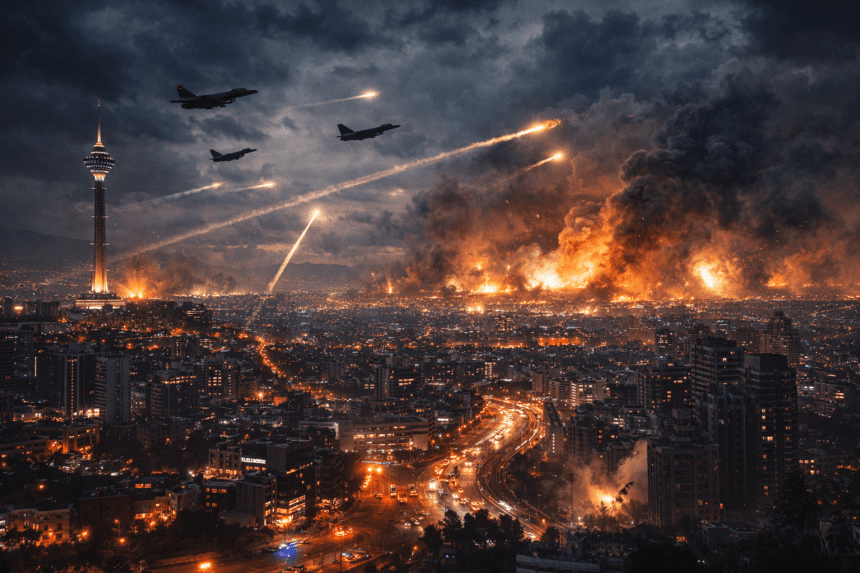
The operation, referred to by Israeli officials as Operation Lion’s Roar, involved airstrikes and missile attacks on key facilities across Iran, including sites connected to the country’s missile program, military leadership, and strategic infrastructure.
Explosions were reported in Tehran and several other cities as strikes hit government facilities, command centers, and military installations.
According to reports from defense officials and international observers, several strategic targets were damaged, including facilities tied to Iran’s naval and missile capabilities.
U.S. officials later confirmed that the strikes significantly damaged portions of Iran’s naval assets in the Persian Gulf and Gulf of Oman, weakening Tehran’s ability to threaten shipping routes and military bases in the region.
The strikes marked one of the most significant direct military confrontations between Iran and Western forces in decades.
Tehran Responds With Regional Missile and Drone Attacks
Iran quickly responded with a wave of retaliation across the region.
Missiles and drones were launched toward Israeli territory and toward U.S. military installations in several Gulf states.
Targets included infrastructure in Bahrain, where Iranian attacks struck areas near the headquarters of the U.S. Fifth Fleet and caused damage to nearby buildings.
Iranian forces also launched drone strikes against shipping and port infrastructure in Oman, damaging oil tankers and killing a crew member in one incident.
These attacks demonstrated Tehran’s strategy of expanding the battlefield beyond its borders.
Rather than fighting only inside Iran, the country has attempted to pressure the United States and its allies by threatening regional shipping lanes, military bases, and energy infrastructure.
A Wider Middle East War Begins to Form
The conflict is no longer limited to Iran and Israel.
Iran’s regional allies have begun to participate in the fighting, increasing the risk of a broader regional war.
Hezbollah forces in Lebanon launched strikes into northern Israel, prompting Israeli counterstrikes against targets in Lebanon.
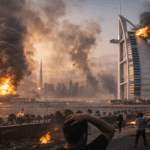
Meanwhile, missile launches and drone attacks have targeted Gulf states including Bahrain, Qatar, and the United Arab Emirates.
These developments have forced several countries to raise military alert levels while strengthening air defense systems.
The widening battlefield highlights the complex web of alliances that define Middle Eastern geopolitics.
Iran maintains networks of allied militias and political movements across the region, and those groups could become increasingly involved if the war continues to escalate.
The Global Energy Shock
Beyond the military battlefield, the conflict is already disrupting global energy markets.
The Strait of Hormuz, one of the most important shipping lanes in the world, has become a focal point of tension.
The strait carries roughly 20 percent of global oil shipments, making it one of the most strategically critical waterways in the global economy.
After the initial strikes on Iran, tanker traffic through the strait dropped dramatically as shipping companies attempted to avoid the growing conflict zone.
More than 150 ships reportedly paused outside the strait rather than risk entering the area.
Energy markets reacted immediately.
Oil prices surged as traders priced in the possibility of major supply disruptions if the conflict continues or if Iran attempts to block the shipping lane entirely.
Even the threat of disruption has already pushed prices higher, highlighting the global economic consequences of the war.
Trump’s Strategy and Political Messaging
President Trump has framed the military campaign as a decisive effort to dismantle Iran’s military capabilities and weaken the regime’s ability to threaten the region.
In public statements and social media posts, Trump has argued that the strikes are designed to eliminate the infrastructure behind Iran’s missile programs and regional proxy operations.
At one point he declared that Iranian military leadership and defense capabilities had been largely destroyed and suggested that it was too late for negotiations.
Trump has also urged Iranian citizens and military personnel to consider turning against the regime, suggesting that the current conflict could create an opportunity for political change within the country.
This rhetoric reflects a broader strategic objective that goes beyond simply degrading military capabilities.
The campaign appears aimed at reshaping the balance of power inside Iran and across the Middle East.
The Human Cost of the Conflict
While military leaders debate strategy, the human consequences of the war are already becoming visible.
Iranian authorities have reported hundreds of deaths following the initial waves of airstrikes.
Some estimates indicate that more than 900 people have been killed and thousands injured as military operations continue across the country.
Civilian infrastructure has also been damaged during the attacks, including buildings near historic sites and urban areas.
Humanitarian organizations have warned that continued bombing could worsen the civilian toll if the conflict continues to intensify.
At the same time, missile strikes across Israel and Gulf states have also caused casualties and infrastructure damage.
The rising death toll on all sides underscores the human cost of a rapidly expanding conflict.
Gulf States Caught in the Crossfire
The conflict has placed Gulf nations in a difficult and dangerous position.
Countries such as Saudi Arabia, Bahrain, and the United Arab Emirates host U.S. military facilities and maintain close ties with Western allies.
At the same time, they sit geographically close to Iran and remain vulnerable to missile or drone attacks.
Recent Iranian strikes have already hit infrastructure in several Gulf states, including military installations and oil facilities.
Some Gulf leaders have expressed frustration that they were not given advance warning before the initial strikes that triggered Iran’s retaliation.
The situation highlights the complex balance Gulf states must maintain as the conflict unfolds.
A War With No Clear End
Despite the intensity of the fighting, it remains unclear how the conflict will ultimately end.
Trump has suggested that the military campaign could last several weeks, depending on how quickly Iran’s military capabilities are degraded.
However, military analysts warn that conflicts in the Middle East often evolve in unpredictable ways.
Iran still possesses significant missile capabilities, regional allies, and asymmetric warfare tactics that could prolong the conflict.
Meanwhile, the involvement of additional regional actors could expand the war even further.
Diplomatic efforts to de escalate the crisis have so far struggled to gain traction.
Calls for ceasefires and negotiations have been overshadowed by the rapid pace of military escalation.
The Global Stakes
The war between Iran, the United States, and Israel is no longer simply a regional conflict.
It carries significant implications for global security, energy markets, and geopolitical alliances.
If the conflict spreads further, it could draw in additional powers and disrupt global supply chains.
Energy prices, financial markets, and international diplomacy will all be influenced by the outcome of the crisis.
For now, the world is watching as the conflict unfolds day by day.
The next phase of the war could determine whether the Middle East enters a new era of confrontation or eventually moves toward a fragile and uncertain peace.
Conclusion, The escalating war between Iran, Israel, and the United States has created one of the most dangerous geopolitical moments in recent history.
Airstrikes, missile attacks, and regional retaliation have transformed a targeted military campaign into a conflict with global implications.
Energy markets are reacting, military alliances are shifting, and millions of people across the region are facing uncertainty about what comes next.
As the conflict continues, the world must grapple with the possibility that the Middle East may be entering a prolonged and unpredictable period of instability.
Whether diplomacy eventually prevails or the fighting intensifies further remains one of the defining questions of the moment.