


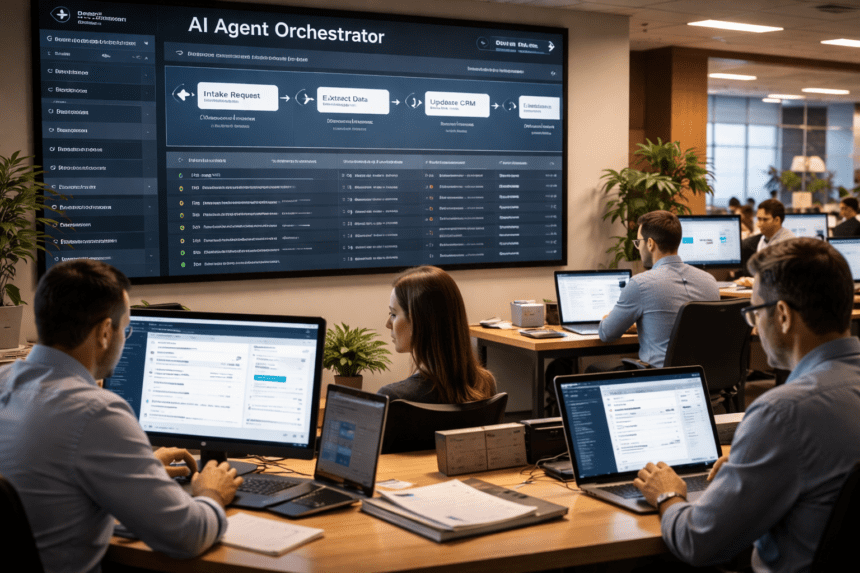
The workplace is moving from “ask the bot” to “assign the work”
In 2026, the conversation around business AI has changed. The early wave of generative AI focused on chatbots that answered questions, summarized documents, and drafted text. That phase proved value quickly, but it also hit a ceiling. A chatbot can be helpful, but it still relies on humans to do the real work: opening systems, copying data, triggering approvals, updating records, coordinating people, and closing out tasks.
Agentic AI is the next step. Instead of responding to a single prompt, agentic systems can plan and execute multi step workflows, use tools and applications, and coordinate tasks across systems with limited human supervision. In other words, the focus is shifting from “AI as a talking interface” to “AI as an operational worker.” That shift is already visible across major platforms and product roadmaps in 2026, with companies pushing AI agents deeper into email, documents, spreadsheets, customer systems, and internal workflows.
This does not mean every business will deploy fully autonomous agents tomorrow. It does mean the center of gravity is moving. Organizations are increasingly trying to connect models to real company context, real tools, and real permissions, then let agents do bounded work while humans oversee outcomes. That is why the biggest breakthroughs in adoption are now less about prompting and more about orchestration, governance, security, integration, and change management.
What agentic AI actually means
Agentic AI is best understood as a system that can take a goal, break it into steps, choose tools to use, and then execute those steps while adapting to what happens next. Definitions vary, but major industry sources converge on the same core idea: autonomy plus action. IBM describes agentic AI as systems that can accomplish a goal with limited supervision, often using multiple agents coordinated through orchestration. Google frames agentic AI as AI that can set goals, plan, and execute tasks with minimal intervention.
A traditional chatbot might answer: “Here is how you file an expense report.” An agentic system might actually file the expense report by reading an email receipt, extracting the vendor and amount, logging into the expense system, filling the form, attaching the document, routing it for approval, and reporting back what it did and what it could not do.
That difference is why agentic AI is being positioned as the bridge between knowledge work and real operational work.
Why 2026 feels like an inflection point
Agentic ideas are not new. What changed is that the underlying models and enterprise tooling are now strong enough to support real deployments.
First, models are better at tool use, structured reasoning, and long context. This makes it more realistic for an agent to hold a goal in mind, track progress, and avoid losing the thread midway through a workflow.
Second, the ecosystem has shifted toward “AI inside the tools people already use.” In 2026, major vendors are explicitly building platforms where agents can operate across applications, using connectors, permissions, and shared context layers that reduce the friction of deployment. OpenAI’s Frontier is positioned as an enterprise platform for building and managing agents with shared context and permissions.
Microsoft is pushing agentic capability deeper into Copilot, including features where agents coordinate with other agents and where “Tasks” can run work using a cloud based computer and browser and return a report of actions.
Google’s Gemini Enterprise is built as a “front door” to workplace AI, with an emphasis on discovering, creating, and running agents in a secure environment, grounded in enterprise data via connectors.
Third, adoption forecasts are rising quickly. Gartner projected that 40 percent of enterprise applications would include task specific AI agents by the end of 2026, up from less than 5 percent in 2025.
When the major platforms are building agent layers and analysts are forecasting broad embedding of agents into enterprise apps, the shift stops being theoretical.
The platforms racing to become the agent layer
A useful way to understand agentic AI adoption is to look at how the biggest vendors are positioning themselves. Many are trying to become the control plane where agents live, connect to data, and take action.
OpenAI has introduced Frontier and then announced Frontier Alliance Partners with major consultancies, emphasizing that the limiting factor is not model quality but enterprise integration, workflow redesign, and change management. Reuters similarly reported that Frontier includes a “context layer” to connect corporate data and applications, and that OpenAI engineers would work alongside consulting teams to support implementations.
Microsoft has continued expanding Copilot into agent based work. A key theme in recent updates is multi agent collaboration and structured ways for users to delegate work and receive a report back, with guardrails for sensitive actions.
Google is treating Gemini Enterprise as a secure platform to discover and run agents with enterprise connectors and permissions aware grounding, aligning with a trend of “single front door” experiences rather than scattered tools.
Salesforce is positioning Agentforce as an autonomous agent platform across service, sales, marketing, and commerce, and has emphasized building and deploying agents to handle specific business challenges.
Anthropic is pushing Claude Cowork deeper into workplace workflows with connectors and plugins so agents can operate within tools like Gmail, Slack, and document workflows, with a focus on multi step tasks across applications.
The common thread is clear. Everyone is converging on “agents + enterprise context + tool access + governance.”
What companies are using agentic AI for right now
In 2026, agentic AI is most successful in workflows that are repetitive, rules guided, and high volume, but still complex enough that simple automation fails. These workflows sit in the middle ground between rigid robotic process automation and open ended human work.
Customer operations is a major early winner. Agents can draft responses, classify issues, open or update tickets, request missing information, check policies, and escalate to humans when needed. This is especially attractive because it directly reduces handle time and improves consistency, while still allowing human review for edge cases.
IT and security operations are also natural targets. Agents can monitor alerts, triage incidents, pull logs, summarize findings, open tasks for engineers, and document post incident timelines. When integrated carefully, this can reduce burnout and speed up response.
Finance teams are testing agents for tasks like invoice intake, reconciliations, variance explanations, and report generation, particularly where the agent can pull data from ERP systems and spreadsheets, apply consistent rules, and generate an auditable output that a human approves.
Engineering teams are moving beyond coding assistants to agentic workflows that draft pull requests, run tests, summarize failures, and propose fixes. Industry commentary in early 2026 suggests agentic AI is increasingly framed as running first drafts of software development lifecycle work while humans steer and review.
The key is that agents work best when the task can be bounded, the required tools are well defined, and there is a clear place for human approval.
Why “context” is the real battleground
A model that can write well is not enough. For an agent to do useful work, it must understand the company’s reality.
That requires access to company knowledge such as policies, product specs, customer records, inventory, pricing rules, and current operational states. It also requires the ability to act inside systems, not just talk about them. This is why enterprise platforms are building context layers, connectors, permissions, and governance.
OpenAI’s Frontier explicitly frames shared context, onboarding, permissions, and boundaries as the skills agents need to do real work across the business.
Google’s Gemini Enterprise emphasizes permissions aware access to enterprise information via connectors and a unified agentic platform approach.
In practice, most agent failures in real companies are not “the model is dumb.” They are “the model does not have the right data,” “the model cannot access the tool safely,” or “the model did not understand local process rules.”
So the operational problem becomes a data and integration problem.
The risks that slow down adoption
Agentic AI introduces new classes of risk. When AI only drafts text, errors are annoying but contained. When AI executes actions, errors can be expensive.
The biggest risk categories in 2026 deployments are
Security and permissions: Agents can expose sensitive data or act beyond intended scope if access controls are weak. This is why vendors are emphasizing governance and bounded permissions in their agent platforms.
Reliability and unintended actions: Agents can choose the wrong tool, misinterpret a form, or take steps out of order. High trust workflows usually require approval gates, audit trails, and safe defaults.
Data quality and grounding: If agents act on outdated or incorrect data, they will confidently do the wrong thing. Multiple industry sources point to trusted data as a primary bottleneck for autonomous agents.
Compliance and auditability: Regulated industries need traceable reasoning, logs of actions, and retention policies. “The agent did it” is not an acceptable explanation to auditors.
Human factors: Agents can create new failure modes if staff do not understand what they do, when to trust them, and how to intervene. Adoption requires training and workflow redesign, not just software rollout. OpenAI’s consultancy alliances exist largely to address these operational and change management barriers.
The lesson is simple. Autonomy makes governance non negotiable.
How to deploy agentic AI without breaking your business
Most successful 2026 playbooks follow a few consistent steps.
Start with a single high value workflow where success is measurable. Choose something like “triage inbound customer emails and draft responses with citations” rather than “automate customer support.” The smaller framing forces clarity.
Define allowed actions explicitly. List the systems the agent can touch, the fields it can update, and the steps it must follow. Agents are more reliable when the action space is constrained.
Use human approvals early. Start with “agent proposes, human approves.” Once reliability is proven, you can move to partial autonomy, such as auto executing only low risk actions, while routing high impact actions for approval.
Invest in observability. You need logs, action traces, and failure reports. Platforms are increasingly adding observability and management layers for agents for exactly this reason.
Treat data as a product. Agents depend on clean permissions and well organized knowledge. Garbage in still produces garbage out, just faster.
Design for safe failure. The agent should know when it is uncertain and escalate rather than guessing. This is a design choice, not just a model choice.
What the shift means for jobs and operating models
Agentic AI adoption is often framed as “replacement,” but the real near term shift is role redesign. The work that changes first tends to be the coordination layer: moving information between systems, generating standard documents, following playbooks, and handling routine decisions.
Humans shift toward judgment, exceptions, and relationship heavy tasks. Teams also take on new responsibilities: supervising agents, refining workflows, updating policies, and auditing outputs.
This is why many enterprises are talking about AI coworkers rather than AI tools. Platforms are explicitly pushing that language because the operating model changes alongside the software.
The big picture for 2026 and beyond
In 2026, agentic AI is not a buzzword. It is an architectural shift in how work is executed.
Chatbots helped people ask questions faster. Agents help companies run processes faster.
The organizations winning early are not the ones with the most prompts. They are the ones that can connect data securely, define workflows clearly, govern access tightly, and build human oversight into the loop.
If Gartner’s forecast about widespread embedding of task specific agents into enterprise applications holds, the question will quickly move from “should we adopt agentic AI” to “which workflows should we turn into agents first, and how do we govern them.