

From Calm Oasis to Geopolitical Epicentre The UAE’s Confrontation With Escalating War
For decades, Dubai and the United Arab Emirates (UAE) cultivated a reputation as a stable, secure hub between East and West a global centre for tourism, finance, trade and travel. But in late February 2026, the fallout from a broader Israel–Iran war shook that identity deeply, as Tehran’s missiles and drones extended into the Arabian Gulf, directly impacting UAE territory, infrastructure and economic lifelines. What started as a conflict primarily between Israel, the United States and Iran has now reached regions once seen as insulated from Middle Eastern warfare. The implications for civilian life, commerce, aviation and global markets are profound and far-reaching.
A New Reality for Dubai and Abu Dhabi
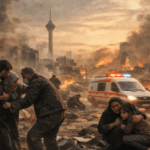
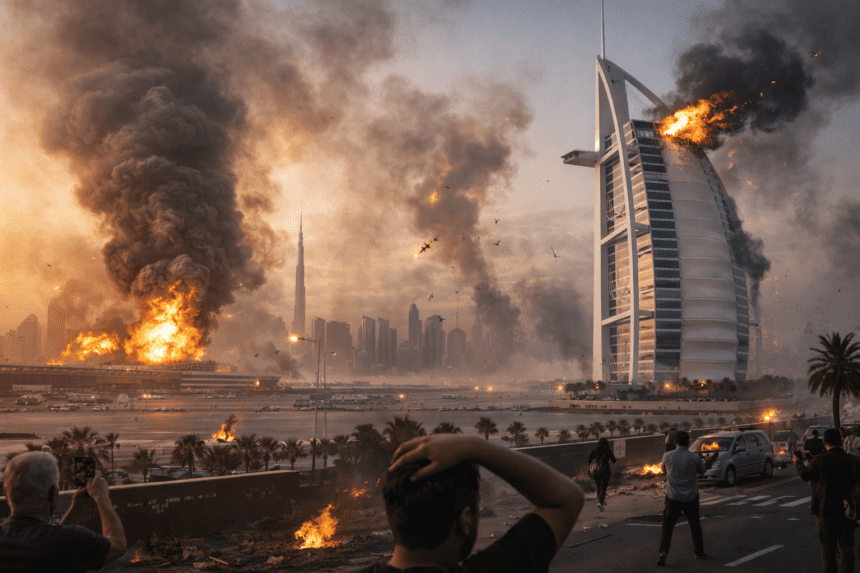
On 28 February 2026, Iran began a retaliatory campaign against Gulf states following coordinated US Israeli airstrikes on Iranian targets. In response, the UAE reported intercepting large numbers of ballistic missiles and drones fired by Tehran’s forces. Although the country’s advanced air defence systems destroyed most incoming projectiles, debris and falling fragments struck urban areas in both Dubai and Abu Dhabi.
According to multiple official sources, the attacks resulted in at least five fatalities and around 58 injuries in the UAE, with the deceased including foreign nationals from Pakistan, Nepal and Bangladesh.
The effects were not limited to human casualties. Debris impacted civilian infrastructure, including parts of Dubai International Airport (DXB) and residential areas near iconic landmarks such as Palm Jumeirah and the Burj Al Arab hotel. In Abu Dhabi, intercepted drone fragments caused damage near an embassy complex, and smoke was seen rising near Jebel Ali port, one of the UAE’s key economic nodes.
Officials in the UAE condemned these strikes as violations of national sovereignty and international law, asserting the right to defend citizens. In response, the UAE closed its embassy in Tehran and withdrew diplomatic staff amidst the escalating turmoil.
Aviation’s Greatest Test Since the Pandemic
One of the starkest symptoms of the conflict’s impact has been the disruption to aviation a sector central to Dubai’s economic engine. On the weekend when the strikes began, Dubai International Airport the world’s busiest travel hub — and other major Gulf aviation centres were forced to halt operations as regional airspace was closed for safety.
This was one of the largest aviation disruptions since the COVID-19 pandemic. Airlines were compelled to cancel or suspend flights across the Middle East, stranding tens of thousands of travellers. Carriers based in the region, including Emirates, Etihad Airways and FlyDubai, paused normal operations and instead flew limited evacuation and repatriation flights to help foreign nationals return home.
The scale of disruption was enormous. Analysts estimated over 11,000 flights were cancelled in and out of the Middle East, affecting travellers worldwide and challenging airline schedules well beyond the immediate crisis.
In addition to suspending scheduled commercial flights, Dubai’s once-bustling terminals stood mostly empty as security zones were tightened, and emergency evacuation departures were prioritised. Governments urged citizens to only travel for urgent launches, underscoring how uncertain the operational environment had become.
Grounded Tourism and Transit Economies
Dubai’s tourism economy is tightly linked to aviation. In 2025, DXB handled around 95 million passengers, many of whom used the city as a transit hub or a destination for leisure, business and cultural events. With travel lanes effectively severed by airspace closures and security warnings, hotels, tour operators, and event venues faced cancellations and sudden revenue losses.
Luxury hotels previously booked for weddings, expos, sporting events and major corporate meetings saw reservations drop, and many guests stayed home or sought alternate routes when possible. The iconic image of a clamouring crowd in a gleaming airport concourse was replaced by parked aircraft and silent terminals.
Moreover, social media and travel forums were flooded with stories of travellers caught in limbo from holidaymakers unable to depart to long-haul passengers redirected via circuitous routes around closed airspace. Rumours of private jets being chartered at extremely high prices to escape the region further highlighted the scarcity and anxiety of travel options.
Ports, Trade and the Logistics Chain
Beyond airports, port infrastructure especially Jebel Ali Port felt the collision of geopolitical tension and economic stakes. One of the largest container ports in the Middle East, Jebel Ali plays a significant role in global supply chains. Smoke was seen rising from parts of the port after debris fell from intercepted projectiles, prompting temporary pauses in operations as precautionary safety measures were put in place.
Ports and free trade zones account for a significant share of Dubai’s economic output, with millions of tonnes of goods flowing through annually. Temporary disruptions not only slowed logistics throughput but also reverberated across regional trade networks, affecting everything from consumer imports to export shipments headed to Africa, Europe and Asia.
Financial Markets and Business Confidence
The conflict also rattled financial markets in the Gulf. UAE exchanges such as the Abu Dhabi Securities Exchange (ADX) and the Dubai Financial Market (DFM) took the highly unusual step of temporarily closing trading in response to geopolitical volatility. This move reflected acute sensitivity to risk as investors awaited clarity on how long the conflict might last and how deeply it would affect regional stability.
Equity indices in neighbouring Gulf states also showed volatility amid broader economic uncertainty. Analysts pointed out that disruptions to aviation, hospitality, trade and consumer activity could reduce short-term economic output, amplify risk premiums, and dampen investor appetite for regional assets until stability returns.
Oil, Shipping and Global Markets
The Middle East remains a cornerstone of global energy production, and the conflict has threatened vital maritime routes such as the Strait of Hormuz, through which nearly one-fifth of the world’s oil supply transits. Heightened tension and threats to shipping have already led to a slowdown in vessel traffic, surging insurance costs for maritime carriers, and pressure on oil and gas freight rates.
Although not a full blockade, perceived risk has pushed oil prices upwards, reflecting market reactions to uncertainty and fears of supply disruptions. Economic analysts have warned that prolonged conflict could strain energy costs globally, potentially feeding into inflationary pressures across import-dependent nations.
Beyond oil, disruptions in freight and container shipments also risk increasing costs for goods that rely on Middle Eastern shipping lanes. Longer routes around the Horn of Africa, higher insurance premiums, and logistical reorganisation all feed into higher end user costs in distant markets.
Social Fabric: Resident Confidence and Public Safety
Dubai and the UAE have for decades marketed themselves as places of security and quality of life. The sudden intrusion of conflict alarms, air defence explosions heard over city skylines, debris impacts near residential areas has challenged that narrative. For many residents and expatriates, the attacks were a stark reminder that even the Gulf is now firmly within the broader geopolitical fault lines.
Tourists initially mistook explosions for fireworks, demonstrating how unexpected the events felt for visitors used to the emirate’s peace. But as alerts continued and debris incidents unfolded, local authorities quickly activated safety protocols and emergency communications to reassure the public.
Government advisories emphasized the robustness of air defence systems and the effectiveness of emergency response plans. However, the reality of an active regional conflict being felt on UAE soil has introduced heightened vigilance among residents and businesses alike.
Government Response and Diplomatic Dynamics
The Emirati government condemned Iran’s strikes and characterized them as blatant breaches of international law and violations of UAE sovereignty. Alongside defensive military measures, diplomatic actions were taken, including the closure of the UAE embassy in Tehran and the withdrawal of diplomatic personnel amid escalating tensions.
The UAE has historically maintained delicate diplomatic balances in the region. These events have forced a recalibration prioritizing security cooperation with allies while addressing the immediate humanitarian and economic impacts.
Tourism and Long-Term Confidence
Tourism accounted for a significant share of Dubai’s economic output prior to the conflict. With leisure travellers postponing trips and transit passengers rerouted elsewhere, the short-term outlook for tourism is bleak. Hospitality revenues, event bookings and transit-based expenditures have taken an immediate hit.
However, experts underscore that Dubai’s deeply embedded infrastructure, diversified economy, and global connectivity make a complete loss of confidence unlikely in the long term. Airlines and hospitality sectors will seek to rebuild trust once airspace reopens and security conditions stabilise as has happened in past crises such as the COVID pandemic.
Conclusion: A Hub Tested but Not Broken
The UAE and Dubai’s aviation, tourism and trade sectors have faced a historic shock in early 2026 as ripples from the Israel–Iran war reached Gulf airspace and urban centres. Airports closed, flights were cancelled, hotels emptied and stock markets paused. Global travellers and investors watched as a city long marketed as a haven found itself in the crossfire of modern geopolitical conflict.
Yet beneath the disruption lies resilience. From limited repatriation flights to emergency response protocols, and from robust air defence systems to diplomatic condemnation and alliance building, the UAE is actively navigating one of the most dramatic tests in its history. The broader economic impacts on tourism, trade, oil markets and global airlines demonstrate how connected the world has become to Gulf stability.
As conflict continues, Dubai stands as both a symbol of global interdependence and a reminder that even the most prosperous hubs can be touched by the far reaching effects of war. Recovering fully will require not only security but renewed confidence from travellers, businesses and global partners once peace returns.