


Transforming Telecom into an AI Powerhouse
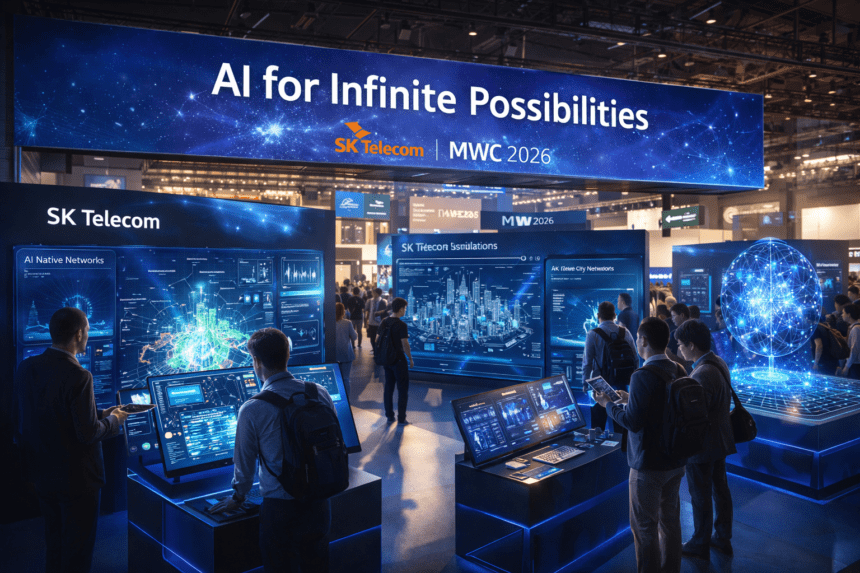
At Mobile World Congress (MWC) 2026 in Barcelona, global tech and telecom companies gathered to showcase the innovations that will shape connectivity and digital infrastructure for the decade ahead. Among the largest announcements was SK Telecom’s plan to transform its business and technology foundation by centring it on artificial intelligence. This bold initiative aims to reimagine traditional telecom services so that AI becomes the core of everything from network operations to customer experience, data centres, and even future wireless standards like 6G.
The company South Korea’s largest mobile operator with millions of subscribers unveiled an “AI Native” strategy that goes far beyond simply adding a few AI tools to existing systems. Instead, SK Telecom intends to rebuild its core infrastructure, information systems, and customer platforms so they are optimized for intelligence, automation, and personalization. The goal is to sharpen its competitive edge as AI becomes one of the most powerful forces in technology and economic growth worldwide.
Why This Matters: AI is Rewriting Telecom DNA
Traditionally, telecom operators have focused on providing connectivity and communication services. Over the past few years, artificial intelligence has started to influence areas like network optimisation, predictive maintenance, and customer support. But SK Telecom’s announcement at MWC 2026 represents a much broader shift it plans to embed AI into the very DNA of its business.
Rather than treating AI as an add-on, SK Telecom’s strategy is to integrate machine intelligence into every layer of operations. This includes rewriting core systems such as billing, sales platforms, line management and other internal infrastructure so they can run with AI from the ground up. According to company leadership, these systems were designed before the AI era and must be rebuilt to fully harness the power of advanced algorithms, large datasets and automated decision-making.
In practical terms, this means customers could soon benefit from services that aren’t just faster or more reliable but that also adapt to individual usage patterns. For example, AI could analyse how subscribers use mobile data, voice minutes and other services to deliver personalised plan recommendations and shopping suggestions, tailored precisely to their behaviour.
AI for Customers: A Smarter, More Personal Experience
A major pillar of SK Telecom’s AI strategy is customer value innovation. Instead of applying technology purely to back-end tasks, the company is pushing AI into customer facing processes. This includes plans to expand its AI-augmented customer service operations, where AI tools assist support agents in solving problems more quickly and accurately.
At retail locations, staff may soon use AI to anticipate customer needs based on buying history, preferences and patterns observed across thousands of interactions turning every visit into an opportunity for better tailored service. These enhancements aim to make digital interactions more intuitive and personalised than ever before.
Another focus area highlighted at MWC 2026 is AI in marketing and engagement. SK Telecom plans to deploy advanced AI agents that can analyse broad behavioural data and interact with customers through conversational interfaces, refining how offers, notifications and educational material are delivered. This strategy underscores the operator’s intent to use AI not just to automate processes but to create meaningful human-machine collaboration.
The Infrastructure Side: Building AI-Ready Networks and Systems
To realise this ambitious vision, SK Telecom is making significant investments in its technical backbone. One key part of the strategy is expanding its AI data centre infrastructure, which is designed to support large AI models and intensive computing workloads. These facilities are essential for running future-oriented AI tasks, from large language models to real-time network optimisation and advanced analytics.
The operator is also embracing AI-RAN technologies, which integrate machine intelligence directly into the radio access network the part of telecom infrastructure that connects devices to the network. By combining AI with emerging network architecture, SK Telecom aims to deliver services that are more efficient, adaptive and self-optimising than legacy systems, especially as next generation wireless like 6G comes into view.
These innovations align with a broader industry movement toward AI-native network architectures, where intelligence isn’t just an overlay but an integral part of network design and operation. At MWC 2026, other global players including NVIDIA and major telecom operators announced commitments to develop open, AI-native 6G platforms that embed intelligence across wireless systems.
To support these shifts, SK Telecom is also building advanced GPU and compute capabilities that will help power real-time AI workloads. Systems like GPU-as-a-Service platforms, optimisation managers, and unified resource orchestration solutions are part of a larger portfolio designed to ensure the company can deliver powerful and efficient AI services at scale.
Rewriting Internal Systems for an AI Future
Another crucial component of the AI transformation involves internal business systems. SK Telecom has pointed out that many internal platforms were developed long before the AI era; to enable true intelligence at scale, these systems must change. This includes billing engines, CRM tools, inventory systems and workflow platforms, all redesigned to support AI-driven automation and adaptive processes.
For example, rather than manually configuring customer plans or promotions, AI could automatically assemble and propose custom bundles based on a user’s data usage history, preferences and even contextual factors like seasonal trends or location patterns. By embedding intelligence here, SK Telecom hopes to cut costs, improve customer satisfaction, and create services that feel intuitive rather than transactional.
The Leadership Perspective
CEO Jung Jai-hun emphasised that this moment represents a shift from simply being a connectivity provider to becoming an AI-driven technology leader. He described the strategy as a “golden opportunity” where customer value innovation intersects with AI innovation in a “borderless, converged environment.” The goal is not merely to incorporate AI into existing functions but to elevate the company’s role within the global technology ecosystem.
SK Telecom’s aspirations also extend to broader industry collaboration. Partnerships with cloud providers, hardware manufacturers and other telecom operators will be key to building interoperable systems that support the next generation of intelligent networks. These collaborations aim to harness expertise across infrastructure, AI development, and end-to-end system deployment.
Broader Impact on Telecom and Global Innovation
SK Telecom’s AI Native strategy arrives at a moment when the telecom industry is already shifting toward cognitive and adaptive networks that go beyond simple data transmission. Traditional telco networks delivered connectivity. Next-generation networks are expected to provide computational intelligence, predictive optimisation, automated decision-making and contextual awareness as standard features.
This trend reflects a broader evolution in how digital infrastructure is conceived. With the rise of AI in sectors ranging from health care to logistics and manufacturing, connectivity itself must become more intelligent to handle demands for real-time data analysis, autonomous systems and distributed intelligence at the edge. SK Telecom’s approach attempts to bridge telecom infrastructure with these emerging needs, positioning the company as both a connectivity provider and a platform for AI innovation.
As AI technologies continue to evolve, telecom operators that invest heavily in AI-native systems may find themselves better prepared for future challenges and opportunities. These systems could enable everything from smart city applications to autonomous vehicle coordination, remote robotic operations, and faster, more secure digital services for citizens and enterprises alike