

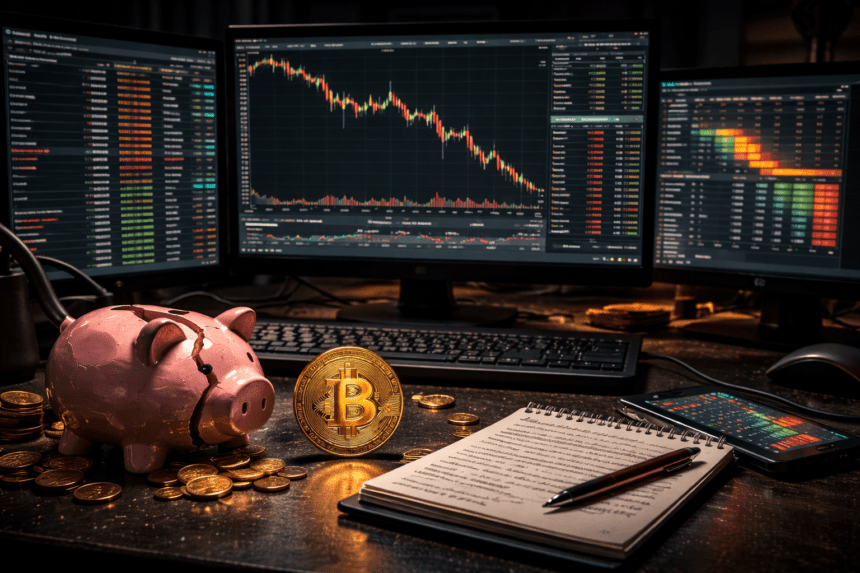
Understanding the three possible paths for Bitcoin price action
What’s Happening with Bitcoin Right Now
This comes at a time when Bitcoin price swings have lacked clear directional momentum. Traders are increasingly fearful of a larger drawdown, and this is showing up in the tools they use to express their views. Funding rates the periodic payments exchanged between holders of perpetual futures contracts have dipped into deeply negative territory, meaning those betting against Bitcoin are willing to pay to keep their positions open. Historically, extreme negative funding rates can increase the risk of a short squeeze a sudden rally triggered when crowded short trades are forced to unwind but they also reflect real anxiety about future price weakness.
In simple terms, the futures and options markets are sending three possibilities for Bitcoin’s near-term path, a continued sideways range, a renewed sell off, or a sudden upside move sparked by a squeeze. Let’s break that down and explore what it could mean for traders and everyday investors.
The First Path: Sideways Trading Continues
Bitcoin has demonstrated a tendency to trade range-bound stuck between key support and resistance levels for extended periods. This happens when neither buyers nor sellers have enough conviction to push price decisively higher or lower.
During such periods, even large swings in futures positioning often fail to produce meaningful price moves. Traders get stuck in indecision, with many hedging their exposure using derivatives rather than directly buying or selling Bitcoin on spot markets. This dynamic can prolong consolidation and deepen frustration among retail holders. Some data analysts note that this sideways range typically reflects underlying market structure problems and uneven liquidity distribution.
For the average Bitcoin investor, this kind of trend can feel like a slog. Prices can oscillate between psychological levels say US$60 000 and US$72 000 without breaking out. Without upward momentum, retail investors who entered at higher prices can be hesitant to add more, and those considering exiting may wait for a clearer signal. The result is a market where price moves feel stuck, and trading becomes dominated by short-term strategies rather than long-term conviction.
The Second Path: Deeper Downside Action
The bearish case is gaining attention because of what’s happening in derivatives markets. Funding rates turning significantly negative is a major signal that short bets are crowded. When traders are heavily positioned for downside moves, it typically reflects widespread anticipation of lower prices.
In Bitcoin’s case, this short bias has been building as the price tests support levels and fails to break convincingly higher. Options markets which allow traders to buy insurance against downside via put contracts are pricing fear rather than optimism, with higher premiums for downside protection.
If this bearish sentiment translates into broader selling pressure especially from leveraged positions Bitcoin could move decisively through current support levels. In that scenario, targets like US$55 000, a key realised price anchor for past cycles, could come into play. If macroeconomic risk sentiment also turns more pessimistic, Bitcoin’s downside path could widen further.
For everyday traders, this would be painful. Those who have bought Bitcoin expecting a rebound may face bigger losses, forced liquidations, and heightened volatility. The crowding of short positions at these levels could extend the downturn before any meaningful bounce occurs.
The Third Path: Short Squeeze and Sudden Rally
Here’s where things get interesting: crowded short positions can fuel rapid upside moves if conditions change quickly. A short squeeze happens when bearish traders are forced to close their positions by buying Bitcoin, which in turn pushes price up.
This kind of move can be dramatic precisely because so many traders are positioned for a fall. Just the threat of a squeeze can trigger a wave of buying as shorts rush to exit when price moves against them. So even in a fundamentally bearish setup, there’s still a plausible path for sudden strength.
However, the challenge is that broader spot market demand real buying outside of derivatives bets needs to exist to sustain any rally. If the squeeze is purely mechanical and not supported by fresh capital entering Bitcoin, the rally could be short-lived or quickly reversed. This makes the potential upside path less predictable, and potentially more painful for those who bet too aggressively on a rebound.
Why Derivatives Markets Matter
Bitcoin’s derivatives markets especially perpetual futures and options have grown enormous. These markets allow traders to express directional views using leverage, meaning small price changes can trigger massive forced liquidations. The interaction between funding rates, open interest (total contracts outstanding), and leverage levels can shape price moves in ways that traditional spot markets cannot.
When funding rates are deeply negative, it reflects extreme bearish positioning. When put options become expensive relative to calls, it shows traders are paying for downside protection. Both conditions can persist without triggering immediate price action, but they tell us something important about market sentiment: fear is elevated, and traders are preparing for lower prices.
This affects everyday investors because the dynamics of derivatives markets can amplify moves that would otherwise be mild on spot exchanges. If leveraged positions get clipped, forced selling or buying can cascade quickly, widening price swings far beyond what would happen in a spot-only market. Derivatives may not change Bitcoin’s fundamental value proposition, but they can shape investors’ experience of volatility and risk.
What’s Driving This Derivatives Behavior?
Several factors are contributing to the derivatives driven setup
Macro economic conditions: With broader markets nervous and interest rate uncertainty still elevated, risk assets like Bitcoin feel more vulnerable. Traders often use derivatives to hedge or express market views in such environments.
Carry costs and funding: In perpetual futures, negative funding rates mean short holders are effectively paying longs a sign that bearish stress has become entrenched.
Liquidity clustering: Large concentrations of leverage at certain price points create “pressure zones” where forced liquidations are likely. These zones can act like magnets for price moves because when one group gets squeezed, the next layer of leverage gets hit.
Fear pricing: When traders pay more for puts than calls, it shows that fear is being priced into markets rather than optimism. High premiums for crash insurance often signal caution, not bullish conviction.
For traders and investors, understanding these drivers matters because it influences risk management. Automating risk controls, diversifying exposures, and matching investment horizon to market structure are all more important in a derivatives-driven environment than in a simple buy-and-hold market.
How This Affects Everyday Bitcoin Holders
If Bitcoin breaks higher due to a squeeze, it can happen fast and surprise many traders who expected more downside. But if Bitcoin continues to grind sideways or moves lower, the pain will be real for those holding leveraged long positions or buying at “support” levels that fail to hold.
Risk-averse holders with unleveraged positions may be better positioned to weather swings because they are less exposed to forced liquidations. However, retail traders who chase moves or use high leverage could suffer big losses.
This setup also highlights a broader truth about Bitcoin’s evolution: its price is increasingly shaped by complex financial instruments that can magnify both moves and emotions. Derivatives are not inherently bad they offer tools for hedging and expressing views but they make the market less straightforward and more reactive to sentiment and positioning.
Looking Ahead
Bitcoin’s path from here is not predetermined. The three potential trajectories range-bound trading, deeper downside, and short-squeeze rally are all logically possible and have historical parallels. What matters most is how leverage, liquidity, and sentiment interact as key price levels are tested.
For now, the derivatives market is pointing toward fear and caution rather than outright optimism. That doesn’t mean Bitcoin cannot rally it just means the mechanics of the market could make volatility intense and painful for traders on the wrong side of these crowded positions.