

How one interview has brought sports, politics and public sentiment into sharp focus.
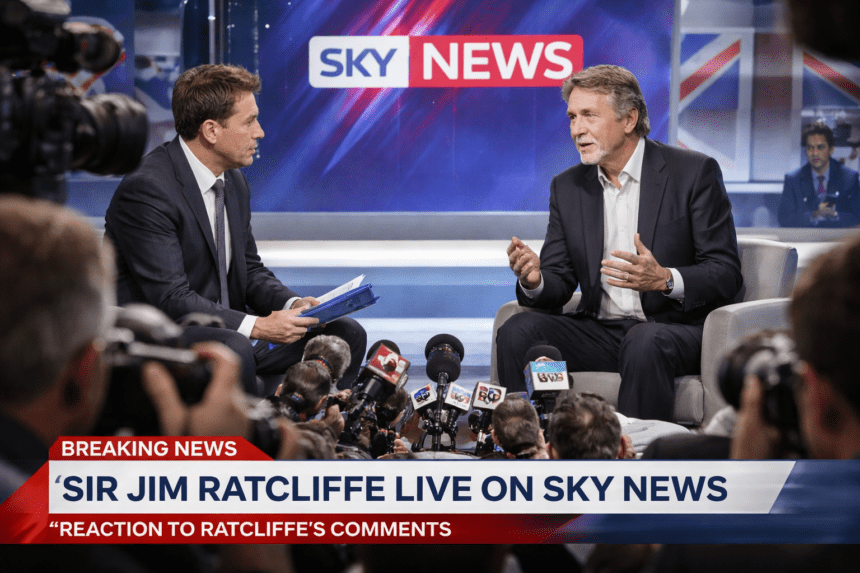
In early February 2026, Britain saw a torrent of reaction to a televised interview between Ed Conway, Sky News’ economics and data editor, and Sir Jim Ratcliffe, the billionaire co-owner of Manchester United and founder of the multinational chemicals group INEOS. The interview ignited a national debate not just about immigration and economic policy but also about the role influential individuals play when they step into political discourse. Ratcliffe’s comments about immigration quickly spread beyond football circles, prompting responses from politicians, fan groups and anti-racism organisations.
The Interview That Sparked Outrage
In the Sky News interview, Sir Jim made headlines during a conversation with Ed Conway when he described the United Kingdom as having been “colonised by immigrants.” He claimed that the country’s population had surged from around 58 million in 2020 to approximately 70 million today, suggesting that immigration had overwhelmed public services and was straining the economy. He also asserted that the country’s benefit system and immigration levels were unsustainable without major policy changes.
These remarks were presented during a broader discussion about the state of the British economy, social policy and national leadership. Sir Jim further argued that Britain needed leadership willing to make hard and unpopular decisions drawing a parallel with choices he made during his tenure at Manchester United.
Conway’s role as interviewer brought economic context and scrutiny to these claims, but the blunt language used by Ratcliffe quickly became the focus of conversation across UK media and political discourse.
Context: Who Is Ed Conway and Why His Interview Matters
Ed Conway is a well established British journalist and economics editor at Sky News, known for data-driven reporting on major economic and political stories in the UK and worldwide. He has decades of experience covering complex issues, and his reporting often translates technical economic data into widely accessible discussions. This context made his interview with Sir Jim an influential platform that reached both policy audiences and the general public.
Rather than a routine sports interview, the conversation veered into national policy touching on economics, immigration and leadership. That shift is partly why the interview was picked up and re-reported widely, bringing a business figure into the political limelight in an unexpected way.
Sir Jim’s Core Immigration Claims
In the interview, Sir Jim argued that the UK’s population increases were largely the result of immigration and that this had led to higher public spending and increased pressure on infrastructure. He described the situation in stark terms, saying that Britain had been “colonised,” a phrase that carries heavy historical and political connotations.
He connected this to his belief that the UK needs decisive leadership willing to challenge prevailing policies and make tough choices to reduce what he sees as dependency on public benefits and to reform immigration rules. These points resonated with some audiences but also raised concerns about the language used and the assumptions behind his claims.
It is worth noting that official demographic data, such as from the Office for National Statistics, does not reflect the precise figures Ratcliffe cited, and critics pointed out that population increases over the past decade were influenced by a combination of factors, such as longer life expectancy and net migration, but not in the dramatic terms he suggested.
Political Reaction: Condemnation and Calls for Apology
The political fallout was swift. Sir Keir Starmer, the UK Prime Minister, publicly condemned Ratcliffe’s remarks on social media platform X, calling them “offensive and wrong” and urging an apology. Starmer emphasised that Britain is “a proud, tolerant and diverse country” and pushed back against the framing that immigration was inherently negative.
Other senior figures echoed this sentiment, reinforcing that immigration has been part of the UK’s growth story and development. These rebuttals highlighted that the vocabulary used in public debate matters and that influential leaders need to choose their words carefully.
In addition to national figures, key organisations in British football and anti-racism work condemned the remarks as divisive. Groups like Kick It Out pointed out that the Premier League and clubs like Manchester United embrace diversity both on and off the pitch reflecting a global sport that thrives on international talent and multicultural support.
Backlash From Football Fans and Communities
While Sir Jim is known within football circles for his role in Manchester United’s ownership since 2024, not all reactions came from political figures. Manchester United fans, including organised supporter groups, expressed frustration that their club’s leadership was making broad national political statements. Critics suggested that this distracted from local issues at the club such as rising ticket prices, changes in staffing and managerial instability which have already stirred discontent among the fanbase.
Some supporters described the interview as “ill advised,” highlighting that while club leaders have a right to express personal views, doing so in such broad and controversial terms risked alienating segments of the fanbase and damaging the club’s reputation.
This backlash was amplified by commentary that Ratcliffe’s immigration remarks seemed contradictory to Manchester United’s own identity: a club that proudly boasts support from fans of many nationalities and a team built on international talent. This juxtaposition not only created tension but also sparked deeper debate about identity, leadership and responsibility in football culture.
Broader Conversation About Immigration in the UK
Beyond immediate reactions, the interview triggered a national conversation about immigration policy, public services and cultural identity. Some commentators saw Ratcliffe’s remarks as feeding into broader anxieties around population growth, economic stress, and resource allocation topics that have been debated across British politics in recent years.
However, others pointed out that economic research and demographic analysis paints a more nuanced picture. Studies show that immigration contributes to labour markets, supports key industries and often generates tax revenues that help public finances. Moreover, the UK’s ageing population and workforce dynamics mean immigration has been part of long term economic planning rather than a sudden shock.
This broader context highlights how public figures’ statements can sometimes simplify complex issues into polarising soundbites, which then spur debate that blends facts with interpretation and emotion.
Sir Jim’s Leadership at Manchester United
The interview also reinforced an ongoing narrative about Sir Jim’s leadership style at Manchester United. Since acquiring a stake in 2024, Ratcliffe has made substantial changes at the club, including restructuring back-office staff, engaging in managerial changes and adjusting commercial strategies. While some outcomes such as improved league position under interim management have offered signs of progress, many fans have criticised the handling of these decisions.
Ratcliffe himself has acknowledged that his decisions can be unpopular, arguing that this is part of long-term improvement. By drawing parallels between club leadership and national leadership, he framed his approach as one grounded in conviction rather than consensus. This has again underscored a philosophical divide between assertive leadership and inclusive engagement both in football and in public policy debates.
What This Means for Public Debate and Leadership
The wide attention given to a single interview reflects more than sensational soundbites. It shows how individuals with significant social or economic influence are increasingly intersecting with political discourse and how that can shift public conversations in unpredictable ways. In a media environment where emotional responses spread rapidly, the framing of issues like immigration can have lasting effects on national discourse.
Additionally, the episode highlights the responsibilities public figures face when speaking on issues that affect diverse populations. Leaders in business and sport are often looked to for guidance, yet they operate outside the formal democratic process and are not accountable in the same ways traditional politicians are. This dual role can blur lines and spark debate about where leadership ends and opinion begins.
Final Thoughts
The interview between Ed Conway and Sir Jim Ratcliffe is unlikely to be forgotten anytime soon. By touching on immigration, economic governance, personal leadership style and football culture, it brought together multiple facets of British life in a way that few single media moments do. Whether one agrees with Sir Jim’s remarks or not, the reaction they provoked underscores the deep divisions and ongoing debates within UK society about identity, economics and community.
As discussions continue in Parliament, in media and among football fans, this moment serves as a reminder that public discourse especially when led by influential individuals carries both power and responsibility.