

Understanding the geopolitical ripple effects from Gaza to Iran.
A New Chapter in Middle East Diplomacy
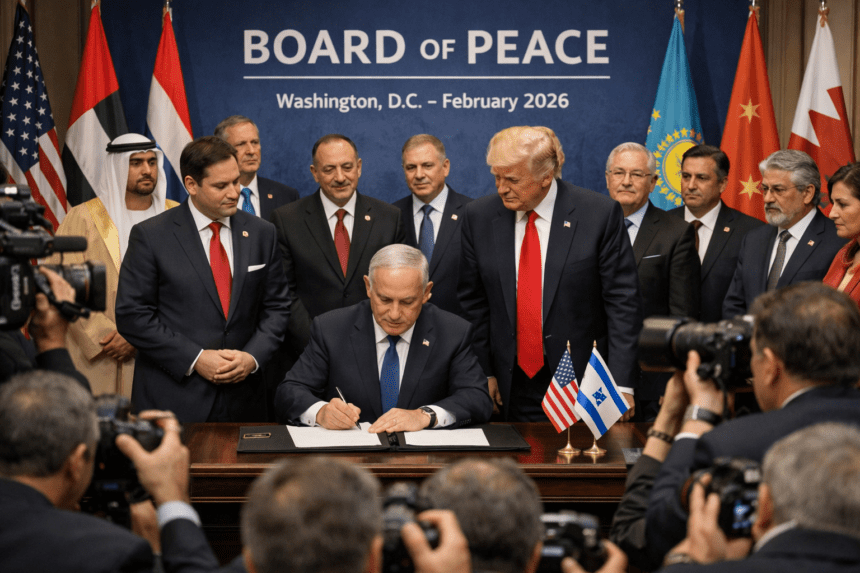
In early February 2026, Israeli Prime Minister Benjamin Netanyahu announced that **Israel has officially joined former U.S. President Donald Trump’s newly formed Board of Peace initiative, a development that marks a significant moment in the Middle East’s long and complex diplomatic history. The announcement came during Netanyahu’s visit to Washington, D.C., where he met with Trump and top U.S. officials including Secretary of State Marco Rubio. Israel’s accession was formalized with Netanyahu signing the charter ahead of a high profile meeting between the two leaders, which also included discussions on Iran and regional security concerns.
The Board of Peace is an initiative spearheaded by Trump with the stated aim of stabilizing Gaza following an uneasy ceasefire and working toward broader conflict resolution. Israel’s decision to join the board represents a deepening of cooperation with the United States on managing Gaza’s future, even as the region remains fragile and unresolved.
What Is the Board of Peace?
The Board of Peace was launched by Trump in early 2026 against the backdrop of ongoing efforts to stabilize Gaza and implement international oversight of its governance following intense conflict. It is designed to bring together a group of countries that will work collectively to supervise peace plans, support reconstruction efforts, and potentially tackle other conflicts beyond Gaza in the future. Originally established through a United Nations Security Council resolution, the board’s first formal meeting is scheduled for February 19 in Washington, where reconstruction strategies will be a key topic.
According to available reports, leaders from various nations including Argentina, Azerbaijan, Belarus, Hungary, Kazakhstan, Morocco, the United Arab Emirates, and Vietnam have also been associated with the initiative, indicating a wide if sometimes controversial participation.
The board’s mandate, as envisioned by its proponents, includes supervising Gaza’s temporary governance under the ceasefire agreement implemented in October and extending efforts to deeper peacebuilding. Supporters argue that it could provide focused international oversight where other diplomatic mechanisms have struggled. However, critics say the structure risks sidelining established multilateral institutions and bypassing Palestinian representatives in key decisions.
Israel’s Strategic Calculus
Israel’s decision to join the Board of Peace reflects several strategic calculations by the government in Jerusalem. For Netanyahu, participation signals continued alignment with the United States Israel’s most powerful ally as well as an opportunity to influence the future of Gaza’s governance and reconstruction directly rather than leave it entirely to external actors.
Netanyahu and his team have publicly linked the peace board initiative with broader efforts to ensure Gaza’s demilitarization, the dismantling of militant infrastructures led by groups like Hamas, and mechanisms that ensure long-term security for Israelis. These goals echo longstanding positions of the Israeli government that security is central to any peace process.
At the same time, there is internal and international scrutiny over Israel’s involvement because the board does not include Palestinian representation, raising questions about inclusivity and the legitimacy of decisions affecting Palestinian lives. Critics worry that decisions made without direct Palestinian participation may fail to address core grievances and could exacerbate tensions rather than resolve them.
External Reactions and Broader Geopolitics
Israel’s accession to the Board of Peace has drawn mixed responses from the global community. Some of Washington’s traditional Western allies such as Poland and Italy have publicly declined to participate in the initiative under its current framework, citing concerns about governance structure and equality of member states. Their hesitation highlights broader unease in parts of Europe about the board’s scope and the extent of U.S. leadership on the initiative.
In the Middle East, reactions vary. Several regional U.S. partners have welcomed focused efforts on stabilization and reconstruction in Gaza, especially in the context of humanitarian needs following years of conflict. Others remain cautious, emphasizing the need for inclusive political processes that involve Palestinian leadership.
The initiative also exists against a backdrop of renewed diplomatic efforts between the United States and Iran. During Netanyahu’s visit to Washington, talks with Trump touched on continuing negotiations with Iran, particularly over its nuclear program and ballistic missile capabilities. Trump reiterated that the U.S. prefers diplomacy but did not rule out force if necessary, while Netanyahu emphasized Israel’s security concerns regarding Iran and its regional proxies.
This interplay of discussions about Gaza and Iran underscores the multifaceted nature of Middle Eastern diplomacy and the overlapping challenges that leaders are trying to manage. Gaza’s reconstruction and regional peace cannot easily be separated from broader issues of security, proliferation, and alliance politics.
What This Means for Gaza and the Region
For ordinary people living in and around Gaza, the Board of Peace may hold the promise of reconstruction, jobs, and a modicum of stability long absent from daily life. Gaza’s economy and infrastructure have been battered by years of conflict, and international involvement has often faltered in addressing the full scale of human needs.
However, experts are cautious in their expectation of what the board can realistically achieve in the short term. The ceasefire remains fragile, violations continue, and key issues such as the disarmament of armed groups and political representation remain unresolved. Without tangible steps that address underlying political grievances, reconstruction alone may offer only temporary relief.
This moment also highlights lingering tensions in how peace is defined and pursued. For some, peace is synonymous with reconstruction and stability; for others, it means justice, self-determination, and political rights particularly for Palestinians who feel excluded from major diplomatic processes.
Thoughts
Israel’s decision to join former President Donald Trump’s Board of Peace marks a new chapter in Middle East diplomacy. It reflects both a deepening alliance between Jerusalem and Washington and a bold gamble on new mechanisms for peace and reconstruction in Gaza and beyond. Yet it also raises questions about inclusivity, legitimacy, and the future of longstanding multilateral diplomatic efforts. As the Board of Peace prepares for its first full meeting this month, the world will be watching to see whether this initiative can deliver the stability and reconciliation it promises or whether it will stumble in the face of entrenched challenges and political divides.