

What It Is What It Includes and Why It Matters
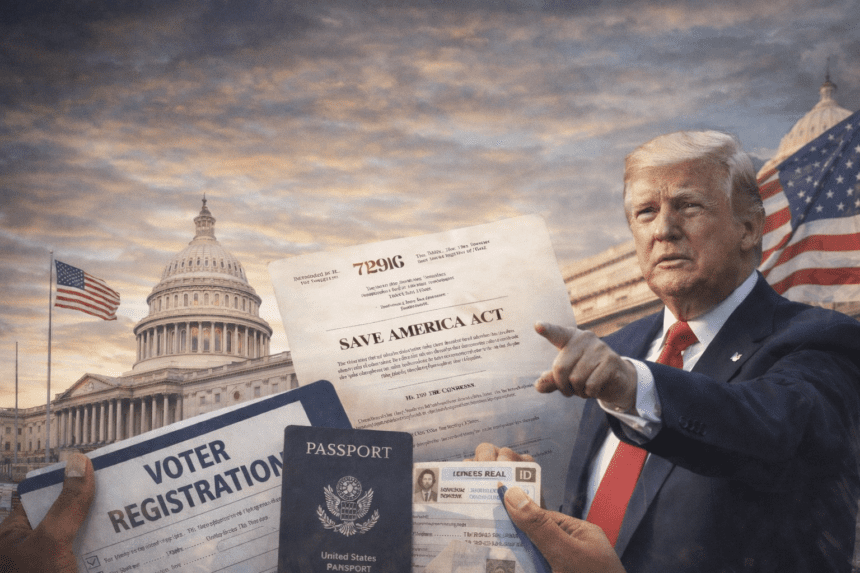
In early 2026, a new piece of legislation known as the SAVE America Act emerged as a central focus of U.S. political debate, partly because of backing from former President Donald Trump and its connection to broader calls for federalizing aspects of election law. While the bill does not make sweeping changes to how elections are run, it is designed to alter fundamental voter registration rules and has become a flashpoint in discussions about election integrity, voting rights, and federal versus state control of election administration.
What the SAVE America Act Is and Where It Came From
The SAVE America Act, formally designated H.R. 7296 in the 119th U.S. Congress, was introduced on January 30, 2026. It amends an older federal law the National Voter Registration Act of 1993 with the goal of tightening requirements on who can register to vote in federal elections. In legislative text, it is also referred to as the Safeguard American Voter Eligibility Act.
The bill gained renewed attention in early February 2026 after Trump publicly endorsed it and tied it to broader demands around nationalizing certain aspects of election law ahead of the 2026 midterm elections. Supporters frame the bill as a measure to ensure election integrity; critics warn that it could create new barriers to voting.
The debate reflects larger disagreements between political parties and advocacy groups about how to balance preventing fraud and protecting access to the ballot. While Trump and his allies argue measures like the SAVE America Act are necessary for confidence in elections, opponents see them as possible voter suppression tools.
Key Provisions of the Bill
At its core, the SAVE America Act changes the requirements for voter registration in federal elections. Here are the main elements:
Proof of Citizenship Required to Register
Under the bill, proof of U.S. citizenship becomes mandatory for anyone trying to register to vote in a federal election. That includes:
Presenting documentary proof with the registration application.
Providing citizenship evidence in person if originally registered by mail.
Acceptable documentation could include U.S. passports, REAL ID-compliant driver’s licenses showing citizenship, birth certificates with matching identification, or U.S. naturalization certificates.
This represents a change from current federal law, where citizenship is generally affirmed by signing a statement on the voter registration form rather than requiring documentary evidence.
Changes to Mail-in Registration
The act would modify the way the national mail voter registration form operates. Under current procedures, people may apply by mail without providing physical proof of citizenship at the time of submission. The SAVE America Act would require that:
Applicants who submit a mail registration form would have to present citizenship documentary evidence either in person to election officials before the registration deadline or at the polling place on Election Day.
Election officials would be responsible for notifying applicants about these requirements and how to meet them.
State Election Agencies and Registration Duties
The bill also adds new requirements for voter registration agencies. These include:
Asking all applicants directly whether they are U.S. citizens.
Requiring proof of citizenship before providing voter registration materials.
Ensuring that only individuals who have provided valid documentation are deemed registered.
Special Accommodations and Verification Processes
Recognizing that not all applicants may have documentation readily available, the bill calls for states to establish procedures allowing people without specific documents to submit other evidence under penalty of perjury. They would then be evaluated by local officials, with oversight from the federal Election Assistance Commission on how these determinations are made and what affidavits are required.
How the SAVE America Act Fits Into Broader Election Debates
Supporters’ Arguments
Proponents of the bill argue that it strengthens confidence in election results by ensuring that only U.S. citizens can register and vote in federal elections. They point to widespread public support for voter identification laws and contend that requiring documentary proof of citizenship is a common-sense reform.
Trump and other backers have connected the act to concerns about noncitizen voting and electoral fraud, despite noncitizen voting already being illegal and extremely rare. They also see federal standards as a way to prevent what they describe as inconsistent rules across states.
Critics’ Concerns and Opposition
Many voting rights advocates, civil rights groups, and Democratic lawmakers have openly criticized the bill. They argue that documentary proof requirements can create unnecessary obstacles for eligible voters, especially those who may lack ready access to surviving birth certificates, passports, or other qualifying documents. Groups like the Brennan Center for Justice have warned that millions of U.S. citizens could be effectively disenfranchised.
Critics also see the SAVE America Act as part of a broader push to centralize election controls at the federal level, undermining longstanding constitutional norms that leave administration of elections largely to individual states. The bill’s advancement has heightened concerns about federal overreach and the potential for politically motivated interference with local election processes.
It is also important to note that, despite Trump’s endorsement of the idea of federalizing certain election processes, the SAVE America Act does not ban mail-in voting altogether nor does it determine how votes are counted controversial claims sometimes made in public discourse.
Where the Bill Stands and What Comes Next
The SAVE America Act was introduced in the House of Representatives and has generated significant debate among lawmakers. Earlier versions focused on related issues, such as the Safeguard American Voter Eligibility Act, which passed the House but stalled in the Senate. The current bill reflects similar themes but has not yet become law.
Because federal election law requires a bill to pass both the House and the Senate before being signed by the president, its prospects remain uncertain, especially in the Senate where a filibuster requires broader support than a simple majority.
Supporters continue to push for its passage, with the White House urging bipartisan cooperation to send the bill to the president’s desk. At the same time, critics are mobilizing advocacy efforts to block it and highlight the potential consequences for voter access and state autonomy.
Why It Matters to Voters and Democracy
The SAVE America Act has become more than just another piece of federal legislation; it has turned into a symbol of the larger political struggles over how American elections should be managed and who gets to decide the rules. With midterm elections approaching and debates over election integrity intensifying, the act’s provisions and the reactions they provoke offer insight into how deeply divided the country remains on the role of federal authority in elections.
Whether one supports the principles behind the SAVE America Act or opposes them, the outcome of this bill could affect not just voter registration procedures but also the broader conversation about trust, fairness, and accessibility in the democratic process.