

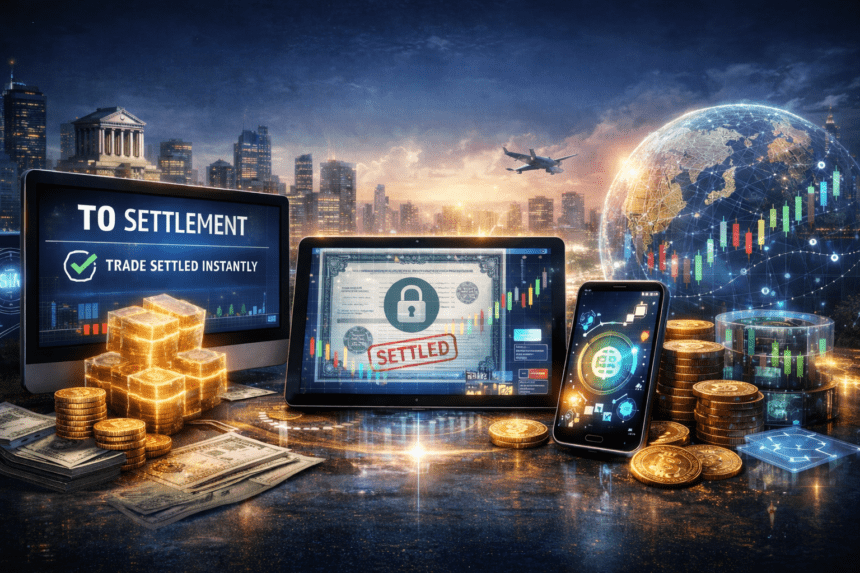
Instant settlement is more than fast trades it is the backbone of tokenized finance.
The financial world is on the brink of a subtle but transformative upgrade one that most people do not notice in everyday conversation, but that could dramatically reshape global markets. It is called T0 settlement, meaning that trades can be settled on the same day they are executed, with no waiting period. This upgrade is especially significant for tokenized securities digital representations of familiar financial assets like stocks, bonds and real world claims because it unlocks instantaneous movement of money and ownership on blockchain rails that operate around the clock.
In this article, we will explain what T0 settlement really is, why it matters for tokenized securities, how regulators and institutions are responding, and what the future might hold as traditional finance and blockchain technology converge.
What Is T0 Settlement and Why Is It Important?
To understand T0 settlement, we need to look at how financial markets currently work. When a trade is made on a stock exchange today, it often does not settle meaning the exchange of cash for the asset until one business day later (known as T1) or longer in older systems. That delay exists because financial systems have relied on intermediaries, reconciliations and manual processes to ensure accuracy and compliance.
T0 settlement means final settlement happens the same day as the trade. In practical terms, this reduces risk, improves liquidity, and removes uncertainty about whether both sides of a transaction actually completed their part. For blockchain-based tokenized securities, T0 settlement is not only possible, it is one of the key reasons these digital representations of assets are gaining traction.
Tokenized securities are familiar assets such as stocks, bonds or funds that are represented as digital tokens on distributed ledgers like blockchain. These tokens behave much like traditional securities in terms of ownership rights, dividends and voting, but they add new capabilities thanks to programmable settlement and transparency.
How Tokenized Securities Work in Practice
Tokenized securities are issued and traded on blockchain-enabled platforms where ownership is recorded in a distributed ledger. When you buy a tokenized stock, your digital wallet holds a token that represents your claim on that stock just like a traditional certificate or ledger entry would but with instant digital recording and verification.
In traditional markets, clearing and settlement can involve multiple intermediaries including clearinghouses, custodians and banks which slow down the final exchange of cash and securities. Tokenized markets simplify this because settlement can be handled directly by smart contracts and blockchain infrastructure, reducing intermediaries and speeding up the process.
If settlement can occur immediately or very close to it as with T0, then the entire post-trade workflow becomes much faster. Instead of waiting hours or days for funds and securities to be confirmed, the blockchain records changes in ownership in real time. This not only reduces counterparty risk the risk one party will not fulfill their obligation but also frees up capital that can be reused much more quickly.
Why the Invisible Upgrade Matters for Markets
The term invisible upgrade refers to the idea that infrastructure changes like T0 settlement do not often make headlines, but they are essential for broader innovation. Without faster settlement, tokenized securities could remain niche experiments rather than mainstream infrastructure.
Here are some key reasons T0 settlement is significant:
Real Time Liquidity and Capital Efficiency
Faster settlement means liquidity the ability to convert assets to cash is available more quickly. Today, when you sell a security, the buyer must wait for settlement before reinvesting or withdrawing funds. With T0, the transaction completes the same day, so capital is free to move immediately.
Lower Operational Risk
Delays between trade execution and settlement create windows of uncertainty. With T0, that window virtually disappears because the trade is finalized instantly. This reduces the chances of errors, failed transactions and settlement mismatches that can create systemic risk.
Institutional Adoption and Collateral Movement
Big financial institutions are looking closely at T0 because it helps solve a daily challenge: moving collateral efficiently. Collateral assets pledged to secure loans or obligations must often be moved intraday. Blockchain-based instant settlement with tokenized collateral could reduce friction here and unlock new efficiencies for banks and funds.
Global Markets That Never Sleep
Traditional stock markets operate on business days and hours. Blockchain networks, by contrast, run 24 hours a day, seven days a week. Combining T0 settlement with tokenized markets means trading and settlement could happen worldwide at any time, across borders and time zones with fewer constraints.
The Regulatory Landscape and Market Experimentation
Although the technology for faster, same day settlement exists, regulation plays a key role in adoption. Settlement rules such as how trades must be confirmed and recorded are set by regulatory bodies and exchanges. Shifting from T1 or T2 to T0 is not merely technical; it also requires legal and risk frameworks that protect investors and market integrity.
Regulators in major markets are experimenting with pilot programs and no-action letters temporary permissions that allow new practices under certain conditions to test how tokenized settlement and T0 workflows perform in real environments. These pilots are crucial because they inform broader rules and help shape whether tokenized assets become part of the core market infrastructure.
As regulators explore tokenization, stablecoins and digital collateral, the market is likely to see more experimentation before broad adoption. This period of pilots and controlled trials helps balance innovation with risk management.
Challenges and Risks to Consider
Faster settlement brings clear benefits, but it also introduces new challenges. One such risk is operational stress. When trades must settle immediately, there is less time to identify and correct errors or to ensure sufficient cash and securities are in place.
Another concern is the potential for market fragmentation. Tokenized and traditional versions of the same asset could coexist, creating questions about liquidity distribution, price discovery and where trading actually happens. If liquidity becomes fragmented across multiple venues, markets can become less efficient even if settlement is faster.
Finally, transparency and surveillance remain critical. Faster settlement compresses the time available to detect manipulative behavior or reconcile discrepancies. Robust reporting and audit trails are essential to avoid blind spots in market oversight.
What the Future Might Look Like
The move toward instantaneous settlement in tokenized markets is part of a broader evolution in finance. Blockchain technology, digital tokens and programmable settlement are not just theoretical experiments they are being built into real infrastructure by exchanges, banks and tech companies worldwide.
In the near future, we may see traditional financial instruments trade and settle on blockchain platforms with T0 finality, stablecoin funding, and fractional ownership possibilities. These innovations would create markets that are faster, more liquid and more accessible to a wider range of investors.
The shift from legacy settlement cycles to instantaneous settlement does not happen overnight. It requires alignment among technology providers, financial institutions, exchanges and regulators. But as pilots continue and real world use cases expand, the invisible upgrade of T0 settlement could become the backbone of capital markets silently enabling a more efficient and inclusive financial system for all.
Thoughts
T0 settlement is more than a technical buzzword. It is a fundamental upgrade to the infrastructure that supports global markets. By enabling same day settlement for tokenized securities, markets will become faster, less risky, and more efficient. While challenges remain, the progress toward instantaneous settlement reflects a broader trend: the blending of traditional finance and digital innovation. As this transformation unfolds, it could redefine how we trade, invest and move capital across borders.