
How Universities Face Growing Surveillance and What It Means for Freedom
In today’s world universities are not just places where students learn about science literature and history. They are also spaces where ideas are challenged debated and defended. It is in these environments that the delicate balance between privacy freedom of speech and freedom of movement is tested. As technology advances universities are adopting tools and systems that collect data on people in ways that previous generations could not imagine. While some of this technology can improve safety and efficiency it also raises serious questions about individual freedom civil rights and the future of open learning. In recent discussions in MIT Technology Review and related book reviews a recurring theme has emerged about the rise of the surveillance state and its spread into higher education settings and what this means for privacy academic freedom and democratic participation.
Privacy is a fundamental human right that enables people to live with dignity control their own personal information and express themselves freely without fear of constant monitoring. Freedom of speech ensures that opinions and ideas both popular and unpopular can be shared and challenged. Freedom of movement allows people to engage in protest assembly and participation in campus life without undue interference. In higher education these freedoms support inquiry creativity and the marketplace of ideas that democracy depends on. Yet new technologies blur the lines between legitimate institutional oversight and intrusive surveillance. When universities and corporations collect and store massive amounts of personal data questions arise about who has access to that information how it is used and whether consent is genuinely informed.
The Rise of Surveillance and Book Reviews That Warn Us
A set of recent book reviews highlighted by MIT Technology Review examines the infiltration of surveillance technologies into educational institutions and why we need to rethink privacy frameworks. These reviews explore how digital systems originally designed to help learning or streamline administrative tasks can end up undermining privacy trust and even freedom of expression on campus.
One of the books discussed is Surveillance Education: Navigating the Conspicuous Absence of Privacy in Schools by Nolan Higdon and Allison Butler. This work exposes how digital tech in schools often promises convenience and improved outcomes yet in practice can subject students to high levels of scrutiny. While some surveillance tools are marketed as safety measures for violence prediction or mental health monitoring the book shows that they can generate oppressive levels of tracking data and put student privacy at risk. The authors draw on interviews with students teachers and civil rights lawyers to reveal how surveillance becomes normalized in educational settings often without a full understanding of long term consequences.
These critical examinations show that seemingly benign data collection is not neutral. It is embedded within systems that may benefit corporate interests or allow authorities to monitor behaviours in ways that affect student freedom and participation. The book argues for practical resistance strategies so that communities can recognize and challenge inappropriate data practices and build trust between students administrations and families.
What Surveillance Looks Like in Practice
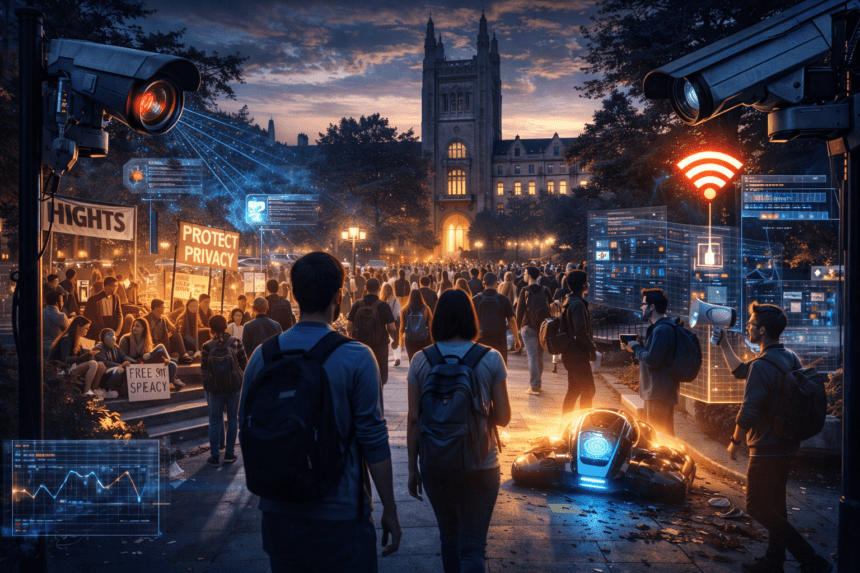
Examples from real universities show that these concerns go beyond theory. Investigations into the University of Melbourne revealed that the institution used WiFi location data CCTV footage and student ID photos to identify peaceful protesters. University staff email accounts were also reviewed during disciplinary actions related to the protest. This was found to be a breach of privacy norms because people using the networks were not adequately informed about how data might be used. Critics called this use of surveillance intrusive and harmful to trust between students and the university community.
Similar incidents have been reported in the United States where undercover private investigators were used by a major university to surveil student activists off campus. These investigators employed tactics like eavesdropping and deceptive behaviour to collect information that was later used in disciplinary or legal actions. Students described these actions as intimidating and suppressive of free expression.
These situations illustrate how tools that may be justified as security measures can be repurposed to track movements gather personal data or interfere with campus activism. When individuals are uncertain about how their personal data is being collected and for what purpose it undermines trust and can chill free speech. Students or staff who fear that their discussions and movements are being monitored are less likely to fully engage in academic debate or protest.
Privacy Academic Freedom and Expression on Campus
Universities have long been seen as bastions of free thought where differing views can be expressed openly and tested against facts and reason. In modern policy discussions freedom of speech and academic freedom are seen as central to the mission of higher education. These freedoms protect the right of students and staff to engage in public debate research controversial ideas and participate in collective movements without fear of reprisal. Many institutions around the world have codes of practice and governance structures aimed at protecting these values while balancing safety and inclusivity.
However privacy concerns complicate this picture. If digital platforms used for learning and communication collect and share personal data with third parties or institutional authorities this can have a chilling effect on speech. People may self censor or avoid certain topics because they know their communications are being stored or analysed. Privacy experts argue that consent and transparency must be central to any data collection practices and that institutions should adopt strict limits on how student and staff data is used.
In the context of academic freedom the fear of surveillance can undermine the very environment that is supposed to defend free inquiry. Without assurance that personal thoughts communications and movement are not monitored or subject to review institutions risk transforming learning spaces into controlled environments where people limit what they say and do. This ultimately weakens democratic engagement and the vibrant exchange of ideas that universities are tasked with fostering.
The Balance Between Safety and Rights
It is important to recognize that many surveillance tools are adopted with safety or operational efficiency in mind. Universities face real challenges including campus security mental health crises and evolving compliance requirements. Administrators often turn to digital systems for early detection of issues or to improve administrative tasks. But the discussion must include the implications of these systems for civil liberties. There needs to be a balance that upholds privacy freedom of speech and movement while still addressing legitimate concerns about safety and wellbeing.
Experts frequently call for clear data governance policies transparency around data use meaningful consent mechanisms and accountability structures that ensure personal information is not repurposed without explicit agreement. Without clear protections privacy erodes and trust between communities and institutions degrades.
Debates about free speech and privacy in academia are not isolated. They reflect broader societal tensions as governments corporations and individuals negotiate the power of digital data. When people feel their personal information is being collected without adequate reason or consent they are less likely to engage openly in civic life or academic debate. This can lead to a culture of caution and conformity rather than robust discussion and innovation.
How Freedom of Movement Is Affected
Freedom of movement is deeply connected to both privacy and speech. Being able to assemble organise protests and express dissent without constant digital monitoring is a cornerstone of participation in a democratic society. When technology tracks people through WiFi location data facial recognition cameras or other sensors individuals may feel watched and pressured to conform or avoid certain activities. This kind of surveillance can limit protest participation and weaken collective action.
Protests and student activism have historically been powerful forces for social change. If these actions are monitored and used against protestors it not only threatens individual privacy but also freedom of movement and the right to dissent. While safety is important institutions must respect the rights of people to engage in public assemblies and express their beliefs.
Principles for a Privacy Respectful Future
To protect privacy freedom of speech and movement in academic environments institutions can adopt several guiding principles. First transparency is key. People whose data is collected must know what is collected how it is used and who has access. Second consent should be meaningful not buried in fine print but actively obtained and revisited as technology changes. Third accountability frameworks must be established so that misuse of data can be investigated and addressed. These steps can build trust and allow technology to support learning and safety without violating rights.
Critics also point to the role students and staff can play as advocates. By understanding surveillance systems and their implications individuals can organise for data rights demand better protections and influence university policy. Public awareness and collective action remain powerful means to ensure institutions balance safety with civil liberties.
A Broader Human Rights Perspective
Beyond campus boundaries the same themes play out in society at large. Privacy is often described as the foundation from which other rights such as freedom of speech and freedom of movement derive. If privacy erodes it weakens the very conditions for these other freedoms to flourish. Researchers and advocates warn that unchecked surveillance can tilt power imbalances in favour of governments corporations and other institutions able to collect and exploit data at scale.
The discussion of privacy rights and surveillance is not new. Scholars have long debated the tradeoffs between security and liberty especially in the digital age where technology is embedded in everyday life. In academic environments the stakes are even higher because universities are meant to cultivate critical thinking empathy and democratic engagement. Protecting privacy and freedom of speech and movement is essential to fulfilling that mission.
Thoughts, Privacy freedom of speech and movement are core elements of human dignity and civic life. As universities adopt more digital tools the tension between surveillance and rights becomes more visible and urgent. By examining recent work on surveillance in higher education and understanding real cases of monitoring we see why these issues matter not just to students and staff but to all who value open inquiry democratic engagement and personal autonomy. Protecting privacy and expressive freedoms requires clear policies transparency consent meaningful oversight and active participation from the entire community. Balancing safety and rights is not easy but it is essential for preserving the core values of higher education and a free society.