

How AI Is Becoming Code Creator, Collaborator, and Catalyst for the Software Industry
In early 2026, generative coding the use of advanced artificial intelligence systems to generate, test, debug, and even deploy code was recognized as one of the most transformative breakthrough technologies by MIT Technology Review’s influential annual list of breakthrough technologies. Generative coding, powered by large language models and AI systems trained on vast amounts of code and software patterns, has fundamentally changed how software is built, tested, and delivered across industries, from startups to global enterprises.
What Is Generative Coding and Why It Was Recognized as a Breakthrough
At its core, generative coding refers to artificial intelligence tools that can produce working software by interpreting high-level human instructions and translating them into functional code inexpensively and at unprecedented speed. These systems can do much more than simple autocomplete or boilerplate generation they can propose entire modules, provide context-aware solutions, and automate repetitive tasks in ways that previously required teams of engineers. This form of AI in software development isn’t an incremental upgrade; it’s a reimagining of the code creation process.
For years, tools like GitHub Copilot helped developers with snippets and suggestions, but the latest generation of systems now integrate deep contextual awareness, automated testing integration, and even multi-step logic flows that mirror what an experienced engineer might craft manually. The reason this technology landed on a breakthrough technologies list alongside innovations like new battery types or advanced nuclear reactors is not hype it reflects broad industry adoption and measurable impact across workloads that once only humans could handle.
How AI Tools Are Changing the Daily Workflow of Developers
Generative coding tools live inside integrated development environments (IDEs) or alongside them, offering everything from inline code completion to fully fleshed functions, architecture suggestions, and even deployment scripts. Tools like GitHub Copilot already widely used for code suggestions and more advanced systems can handle data structures, infrastructure-as-code templates, and testing stubs with minimal human prompting. This means developers spend less time on repetitive tasks and more time on creative problem solving.
But generative coding goes beyond tools that merely autocomplete code. Some AI platforms can analyze large codebases and infer context so well that they generate updates consistent with existing architecture and patterns. Other systems including emerging agentic AI products can follow a sequence of natural language instructions to complete complex workflows, like building API endpoints, connecting microservices, and generating documentation. What once required teams of engineers working in iterative sprints can now be prototyped in hours, not weeks.
The Broader Software Industry Reaction
The impact of generative coding tools hasn’t gone unnoticed. Many developers are thrilled with productivity gains, but surveys suggest a mix of enthusiasm and caution. Despite the improved speed and efficiencies, numerous developers still express concerns about trusting AI-generated code without thorough review, and many admit they don’t always fully verify the code before committing it. These mixed attitudes reflect a realistic view of how the technology fits into professional workflows powerful and helpful, but requiring oversight and technical judgment.
The Paradigm Shift: From Assistants to Code Creators
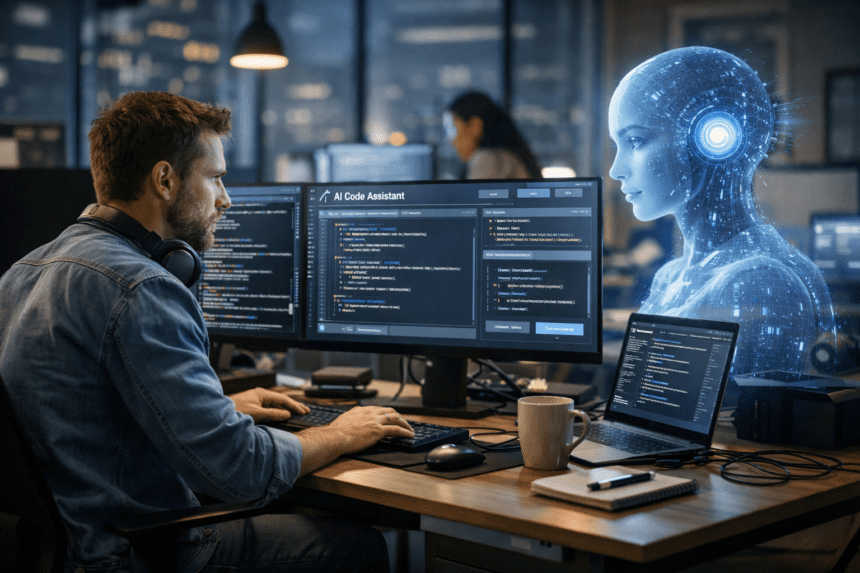
As AI systems have grown more capable, the role of developers is shifting. The traditional image of a coder laboring over syntax is giving way to one where a human choreographs, guides, and tunes AI outputs. Instead of typing every line manually, developers now ask questions like: “Generate an endpoint that accepts user input and validates it against these criteria.” Then they refine, secure, and optimize what the AI produces. This collaboration represents a major shift in how software is conceived and built.
Critics have sometimes attached the term vibe coding to this new AI-native style of development a music-festival inspired term where the coder gives high-level directives and lets the AI “jam” the details. While some insiders embrace the term humorously, others caution against replacing deep technical understanding with blind acceptance of AI outputs. Nevertheless, it signals a new cultural moment in the profession.
The Productivity Boost and Real World Benefits
Industry studies show that AI coding tools can significantly boost developer productivity and reduce time for mundane tasks like refactoring or writing boilerplate code. Teams using generative AI can focus more on design decisions, user experience, security reviews, and system optimization areas where human judgment still matters most. In enterprise settings, these tools can help scale development faster while maintaining consistent quality.
Where once a feature build might involve multiple cycles of review, testing, and revision, generative coding can accelerate this by suggesting unit tests alongside functional code, translating between languages, and offering alternative designs. This speed matters in competitive markets where time to launch can define commercial success.
The Challenges and Risks of Generative Coding
No discussion of generative coding would be complete without recognizing real concerns. One of the biggest issues is code security. AI tools can produce insecure patterns, exposed credentials, or architectural oversights if not properly audited. Some research even shows that AI-generated code may carry hidden vulnerabilities, meaning human review and robust testing remain essential to safe software.
Beyond security, some developers worry smaller teams might over-rely on AI at the expense of mastering core concepts. If tools do most of the heavy lifting, will future engineers have the skills to debug or innovate independently? This question isn’t about technology alone — it’s about the long-term health of engineering culture and education.
Another risk involves quality and accountability. AI may produce syntactically correct code that fails in edge cases or violates internal design constraints. Many practitioners urge that AI outputs be treated like first drafts helpful, but requiring careful human refinement.
Impact on Jobs and the Developer Workforce
A widespread concern among professionals and students is what generative coding means for employment. Some roles that focused on routine coding tasks might shrink, while new roles involving AI architecture, verification, and integration might grow. Entry-level positions may shift from writing repetitive code to supervising AI outputs, ensuring quality, and integrating AI behavior into product workflows.
Some experts argue that while AI may reduce the need for manual coding, demand for skilled engineers who understand algorithms, systems design, and security will rise. AI does not replace deep expertise it amplifies it. Professionals who learn to guide AI, interpret its suggestions, and anchor systems in real-world constraints will be more valuable than ever.
What This Means for the Future of Software Development
Looking ahead to 2026 and beyond, generative coding is poised to be a foundational element of software development. Rather than a peripheral assistant, AI is becoming an engine that can produce real components of production systems, making the entire software lifecycle more efficient. The systems that prove most successful will be those that combine automated generation with stringent review, powerful governance, and tooling that makes human oversight natural and effective.
We’re also seeing research efforts focused on expanding generative AI across the full software development life cycle — from requirements gathering to code generation, testing, deployment, and maintenance. These integrated approaches promise to democratize some aspects of software creation while preserving critical domains where human expertise is irreplaceable.
Thoughts
Generative coding AI software’s emergence as a breakthrough technology in 2026 marks a pivotal moment in the evolution of the tech industry. By accelerating development, reducing repetitive work, and enabling new ways to collaborate with machines, this technology is reshaping roles, skill sets, and workflows. But with great power comes great responsibility: developers must balance AI productivity gains with robust security, careful review, and a dedication to craftsmanship.
For businesses and professionals alike, the message is clear: AI isn’t here to write code in isolation it’s here to augment human ingenuity and unlock possibilities that were once out of reach.