


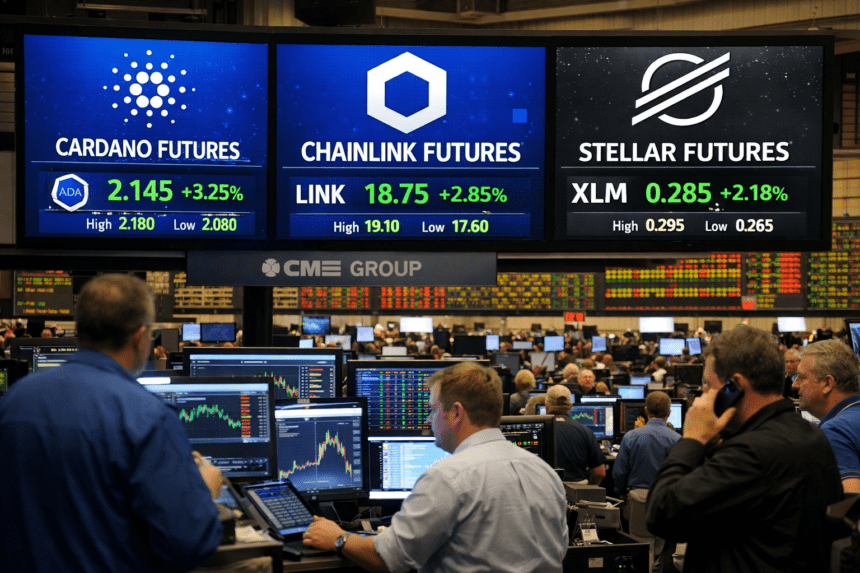
The cryptocurrency world is on the verge of a milestone event as the CME Group, the world’s dominant derivatives exchange,prepares to launch futures contracts tied to three major altcoins Cardano (ADA), Chainlink (LINK) and Stellar (XLM). This move signifies a growing shift in perception toward digital assets as not just speculative tokens but as investable instruments that can be traded, managed and hedged within regulated financial frameworks.
Scheduled to begin trading on February 9, 2026, pending regulatory approval from the United States Commodity Futures Trading Commission (CFTC), these new futures contracts are poised to further legitimize the role of cryptocurrencies in mainstream finance. While the announcement has generated excitement across institutional trading desks, it also raises important questions about market dynamics, investor access and the future integration of crypto markets with traditional finance.
A Milestone for Crypto Derivatives
For years, Bitcoin (BTC) and Ethereum (ETH) dominated institutional interest as the primary digital assets seen as mature enough for regulated products. CME’s expansion beyond these two giants into broader altcoin territory reflects the evolving landscape of crypto adoption. The addition of Cardano, Chainlink and Stellar to CME’s roster of futures signals that major altcoins are being recognized not only for their price action but for their underlying ecosystems and real world utility.
These futures contracts will be offered in standard and micro sizes, meaning that both larger institutional participants and smaller traders can engage with the market in ways that fit their strategies and risk tolerance. Standard contracts include large notional exposures — like 100,000 ADA or 5,000 LINK — while micro contracts bring the barrier to entry down significantly, such as 10,000 ADA or 250 LINK, making regulated trading more accessible.
The broader implications for the crypto market could be significant. Futures contracts enable participants to hedge risks, speculate on price movements and structure complex strategies without holding the underlying tokens in spot markets. In doing so, they help improve liquidity, market depth and the overall robustness of price discovery mechanisms. Moreover, the institutional embrace of these contracts might attract fresh capital, potentially smoothing volatility and fostering long term holding strategies among sophisticated investors.
What These Futures Mean for Cardano Chainlink and Stellar
Each of the three altcoins chosen for futures reflects a distinct corner of the crypto universe:
Cardano (ADA) is a proof of stake layer one blockchain known for its research driven development and scalable smart contract capabilities. The introduction of ADA futures provides professional traders with tools to hedge exposures and express market views on a token that underpins an emerging ecosystem of decentralized applications and governance participation.
Chainlink (LINK) operates as a decentralized oracle network that bridges real world data with on chain smart contracts. By offering LINK futures, CME is acknowledging that infrastructure tokens — those that won’t necessarily power transactions but facilitate connectivity between blockchains and external information sources — have become significant enough for regulated trading.
Stellar (XLM) focuses on cross border payments and financial inclusion. Its inclusion in a regulated futures marketplace underscores growing interest in payment oriented blockchains and stable liquidity solutions for global value transfer.
These futures open new avenues for institutions to allocate capital toward different facets of the blockchain sector. For example, a trader looking to hedge exposure to smart contract risk without touching spot ADA positions could use ADA futures. Likewise, a portfolio manager seeking regulated exposure to middleware infrastructure might turn to LINK futures as part of a diversified strategy.
How the Market Has Responded
Interestingly, despite the significance of CME’s announcement, the immediate price reactions in the underlying markets have been subdued. At the time of the announcement, trading prices for ADA, LINK and XLM remained relatively stable, indicating that markets may have priced in the news or that traders are reserving judgment until the contracts go live. This kind of muted response is not unusual in markets where announcements about regulated products sometimes take time to filter through trading behaviour, especially when traders are focused on macroeconomic drivers or broader crypto trends.
Meanwhile, institutions and trading firms have been preparing for the launch. Record volume and open interest in existing crypto derivatives at CME suggest there is strong demand for regulated products. In 2025, CME’s crypto products saw an average daily volume of over 278,000 contracts, equating to roughly $12 billion in notional value, and record open interest levels exceeding $26 billion. These metrics highlight the institutional appetite for futures as tools for both hedging and leveraged strategies.
Bridging TradFi and Crypto
One of the most compelling aspects of these new futures is their role in bridging traditional finance — commonly referred to as “TradFi” — with decentralized finance (DeFi) innovations. For decades, futures markets have been an integral component of risk management across commodities, currencies and financial indexes. By bringing well known altcoins into this framework, CME is creating more structured paths for legacy financial entities to engage with digital assets.
This bridging function is likely to accelerate the development of related financial instruments, such as exchange traded products (ETPs), structured notes and institutional custody services. Futures markets often serve as the backbone for these products, providing liquidity, pricing benchmarks and regulated environments that asset managers rely on. As institutional infrastructure continues to mature, the presence of ADA, LINK and XLM in regulated derivatives could pave the way for more mainstream financial vehicles tied to these assets.
Potential Challenges and Risks
Despite the enthusiasm, it is important to acknowledge that introducing regulated futures markets is not without challenges. Futures inherently allow for leveraged positions, and while this can attract institutional capital, it can also amplify risks if markets become stressed. Additionally, futures markets sometimes diverge from spot markets, leading to contango or backwardation conditions that can impact trading results, especially for longer term investors.
Regulatory oversight adds another layer of complexity. Although CFTC approval is pending, regulatory scrutiny in crypto markets remains intense. Future compliance requirements could shape the way these contracts are traded, cleared and settled, potentially affecting liquidity and accessibility over time.
Finally, while futures markets enhance risk management tools, they do not in themselves guarantee long term price appreciation. The underlying fundamentals of each blockchain and broader crypto adoption trends will continue to influence price movements and investor sentiment.
Looking Ahead
As the launch date approaches, the industry is watching how these contracts perform once they are live. Successful adoption could encourage CME and other exchanges to further widen their crypto offerings to include even more digital assets, perhaps tapping into emerging sectors like decentralized finance, tokenized real world assets and layer two scaling solutions.
For traders, investors and blockchain enthusiasts, this development marks another chapter in the evolution of crypto’s integration with global financial markets. While futures are just one piece of the puzzle, their regulated presence on a major platform like CME underscores how far the crypto ecosystem has come — from niche digital curiosities to instruments traded within established financial infrastructures.
Whether this move will spur fresh institutional capital, enhance liquidity for altcoins, or reshape how investors approach risk in digital asset portfolios remains to be seen. What is clear, however, is that the path toward maturity for crypto markets is being paved with regulated products that invite new participants, deeper liquidity and more sophisticated trading strategies.