


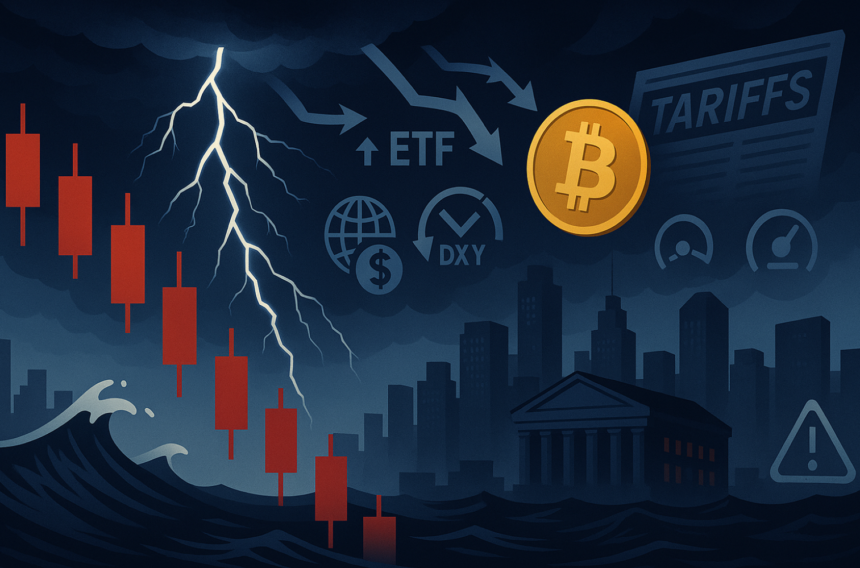
Why Forced Selling and Derivatives Liquidations Packed a One-Two Punch That Altered the Market’s Trajectory
In 2025, the cryptocurrency market experienced one of its most violent drawdowns in recent memory. A cascade of forced liquidations fueled by leveraged positions, weak liquidity, and sharp price declines wiped out more than $150 billion in value across digital assets, with Bitcoin bearing the brunt of the crash. What initially appeared to be a sharp correction quickly escalated into a broader deleveraging event as traders and funds were squeezed out of long positions, triggering automatic closures and accelerating downward momentum.
Liquidations happen when leveraged positions bets made with borrowed capital are forcibly closed because losses exceed maintenance requirements. In 2025, a confluence of macro uncertainty, tightening liquidity, and deteriorating sentiment created an environment ripe for stress. As Bitcoin began to weaken from key technical levels, leveraged longs faced mounting losses. With many derivatives exchanges offering high leverage (sometimes 10× or more), even moderate declines translated into large losses relative to collateral. Once prices dipped below certain thresholds, exchanges automatically liquidated positions to protect lenders and maintain solvency.
The $150 billion figure represents both spot and derivatives liquidations, including perpetual futures, traditional futures contracts, and options. While spot liquidations involve selling actual crypto holdings to cover margin calls, derivatives liquidations often involve the forced closure of contracts which can create buying or selling pressure that exacerbates price moves. In the process, liquidity evaporated, bid-ask spreads widened, and price slippage increased, making it harder for remaining holders to absorb sell pressure without suffering steep losses.
Bitcoin was particularly vulnerable due to its dominant role in the market. When BTC sells off sharply, correlated assets altcoins and higher-beta tokens often follow. This correlation contagion meant that as Bitcoin broke key support zones, many leveraged positions across the broader market were caught off guard. The result was a feedback loop: falling prices triggered liquidations, and liquidations pushed prices lower. What might have been a shallow correction instead snowballed into a deep drawdown.
Part of what made the 2025 event so severe was thin liquidity at key price levels. Unlike in earlier crypto cycles where enthusiastic retail participation and deep order books provided buffers against sharp moves, liquidity in 2025 had become more fragile. Institutional participation, while substantial, tended to favor regulated products like ETFs and custody vehicles which do not always provide the same kind of active order book depth found on spot exchanges. As a result, when large liquidation clusters were hit, price gaps appeared more frequently, accelerating declines.
Another contributing factor was the structure of derivatives markets themselves. Perpetual futures, a popular instrument for leveraged trading in crypto, rely on funding rates to keep prices anchored between spot and futures markets. In periods of extreme stress, funding rates can become unanchored with longs paying huge premiums to shorts or vice versa which can drain liquidity and force risk-off positioning. When funding rates moved against long holders during the crash, many traders found their positions untenable, leading to further liquidations.
Macro conditions also played a role. Central bank signals, interest rate expectations, and risk asset repricing created an environment where risk capital became more expensive and less abundant. In traditional markets, rising rates and tighter credit often lead to capital withdrawal from speculative assets. In crypto, this manifests not just in lower spot demand but in reduced ability for traders to sustain leveraged positions, making liquidations more likely when prices turn downward.
Sentiment shifted rapidly during this period. Fear, uncertainty, and doubt (FUD) spread across social channels, compounded by headlines about large funds facing margin calls and funds under water. Behavioral finance suggests that liquidation clustering when many forced closures occur at similar price levels amplifies fear and can trigger panic selling. As retail traders watched portfolios shrink and leveraged bets vanish, many capitulated rather than hold through volatility, contributing to the depth of the drawdown.
One of the most striking features of the 2025 liquidation event was how widely it affected the crypto ecosystem. While Bitcoin was the backbone of the storm, altcoins particularly those with thinner order books and higher leverage usage suffered disproportionately. Tokens with high leverage ratios saw liquidation spikes well beyond their market cap, pushing some markets into flash crash territory, where prices dipped sharply before rebounding, only to lose value again as confidence waned.
The collateral damage extended beyond price. Derivatives exchanges themselves saw surges in bad debt positions where forced liquidations failed to cover losses fully which in turn strained risk engines and insurance funds on some platforms. While major exchanges eventually stabilized, smaller venues without robust risk controls faced liquidity stress that required temporary trading halts or emergency measures.
Experts now look to the 2025 liquidations as a case study in market maturity both its strengths and vulnerabilities. On the positive side, the crypto ecosystem has built stronger infrastructure including decent risk engines, improved custody solutions, and regulated products that channel institutional capital responsibly. On the negative side, reliance on high leverage, thin liquidity, and concentrated capital pools can trigger outsized moves when those conditions reverse.
Going forward, many analysts argue that better risk management tools and education are necessary to prevent similar events. Measures such as dynamic margin requirements, deeper liquidity provisioning, stress testing automated market making systems, and hedging strategies can help absorb large moves without cascading liquidations. Exchanges that adopt more sophisticated risk controls may offer safer environments for leveraged traders, which could reduce systemic liquidation risk over time.
From a trader’s perspective, the 2025 $150 billion liquidation event highlights why sound position sizing and prudent leverage use are critical. Leverage amplifies returns but also multiplies risk and in markets with fragile liquidity or macro uncertainty, forcing positions closed at the worst possible time can devastate portfolios. Risk-averse strategies, including spreading exposure, using stop-loss orders, and maintaining adequate collateral, can help traders weather downturns without catastrophic liquidations.
In summary, the liquidation cascade of 2025 serves as a reminder that market structure matters just as much as sentiment and narrative. When $150 billion was wiped out through forced closures, it didn’t just push Bitcoin prices lower it changed how traders, institutions, and infrastructure providers think about risk, liquidity, and the very mechanics of market behavior. As crypto markets continue to evolve, lessons from this episode will likely influence how risk tools, derivatives products, and capital flows are structured in the years ahead.